Melasma
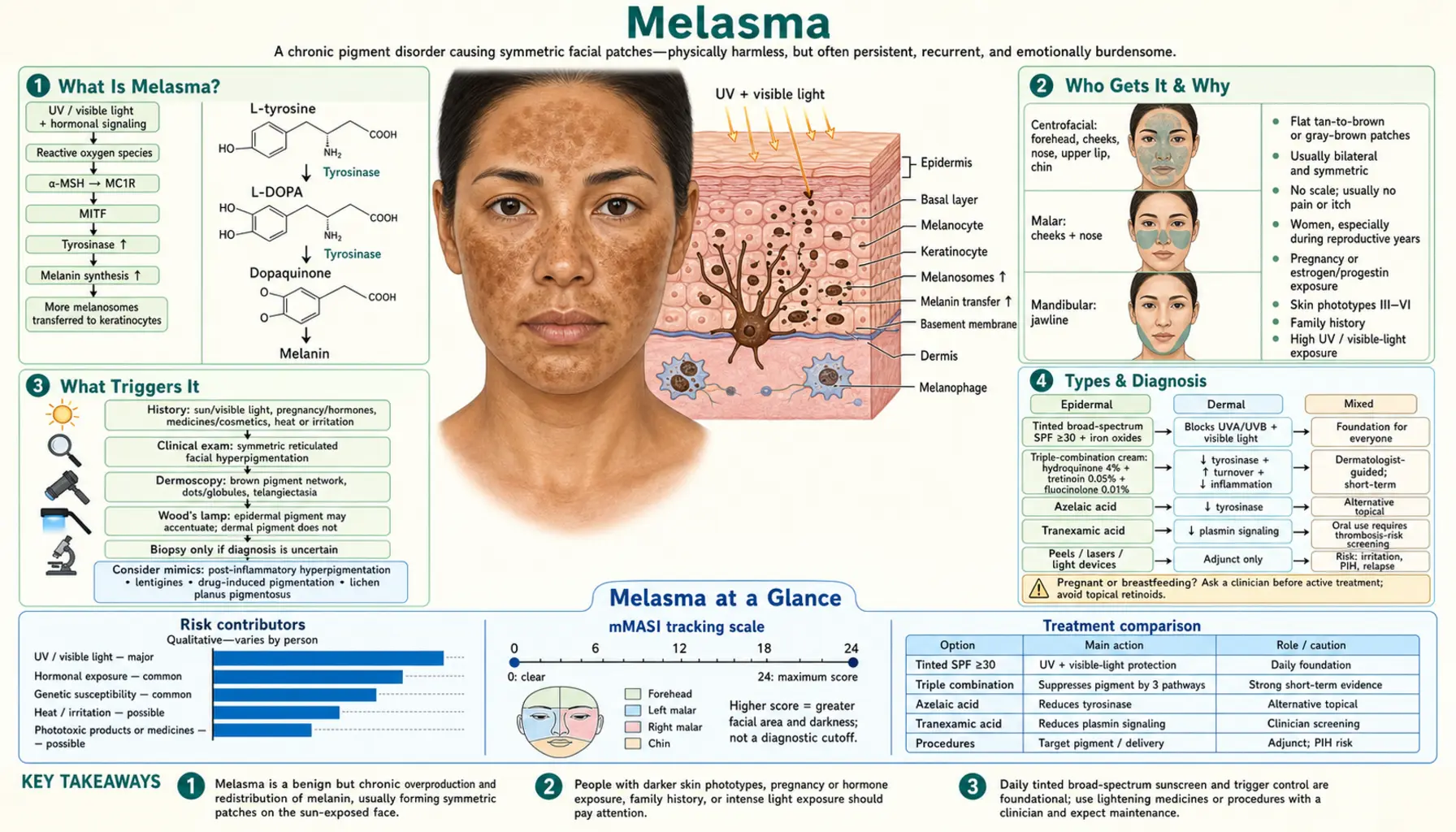
If you have noticed brownish or grayish-brown patches creeping symmetrically across your cheeks, forehead, upper lip, or the bridge of your nose — often after a pregnancy, a new birth-control pill, or a sunny stretch of weather — you may be dealing with melasma. It is one of the most common pigment disorders in the world, it is stubborn, and it is emphatically not your fault. Melasma is not a sign of poor hygiene, it is not dangerous, and it is not contagious. It is a light- and hormone-driven condition of overactive pigment cells, and while it can be frustratingly persistent, it is also very manageable once you understand what actually drives it. This guide walks through what melasma is, who tends to get it and why, and — most importantly — the sun-protection-first, evidence-based plan that gives you the best odds of fading it and keeping it faded.
Interactive Visualization Sunburn & Melanin — land UV photons on DNA and watch what happens next Rain UVB onto skin and watch DNA kink into dimers — repaired, or fatal to the cell, or banked as a mutation forever — then put sunscreen on and count how many never land. Launch →Table of Contents
- What Is Melasma?
- Who Gets It & Why
- What Triggers It
- Types & Diagnosis
- Sun Protection: The Foundation
- Topical Treatments
- Oral Tranexamic Acid
- Procedures: Peels & Lasers
- Why It Recurs & Realistic Expectations
- Prevention
- Key Research Papers
- Connections
- Featured Videos
What Is Melasma?
Melasma (from the Greek melas, meaning black) is a chronic disorder of acquired, symmetric hyperpigmentation — extra pigment that appears on both sides of the face in a roughly mirror-image pattern. The patches are flat (not raised, not scaly), tan to dark brown or occasionally grayish, and have somewhat irregular but well-defined borders. They do not itch, hurt, or flake. What makes melasma distinctive is where it lands and how symmetrically: it favors sun-exposed areas of the face where the light hits most directly.
Dermatologists describe three common facial patterns:
- Centrofacial — the most common pattern: forehead, cheeks, nose, upper lip, and chin.
- Malar — confined to the cheeks and nose.
- Mandibular — along the jawline, more often seen in older patients with significant sun damage.
Less commonly, melasma appears on the forearms, neck, or upper chest (extrafacial melasma) in sun-exposed areas. Because the pigment is a response to light and hormones rather than an infection or a growth, melasma poses no physical health risk — its burden is cosmetic and psychological. That burden is real, though: validated quality-of-life research shows melasma can meaningfully affect self-esteem and mood, which is why it deserves a serious, structured plan rather than a shrug.
Who Gets It & Why
Melasma has a strong and consistent demographic signature. Roughly nine out of ten people with melasma are women, and it most often begins during the reproductive years, between the late teens and the forties. Men do get melasma — they make up perhaps 10 percent of cases — and their melasma looks and behaves the same way, but the female predominance points squarely at the role of female sex hormones.
Several overlapping factors stack the deck:
- Pregnancy. Melasma is so linked to pregnancy that it earned the nickname the "mask of pregnancy"; the older term chloasma (melasma gravidarum) refers to melasma appearing during pregnancy. Surging estrogen and progesterone, plus sun exposure, activate pigment cells. It often fades after delivery — but not always, and it tends to return with a later pregnancy.
- Hormonal medication. Combined oral contraceptives, some hormonal implants, and menopausal hormone therapy can all trigger or worsen melasma through the same estrogen/progesterone pathway.
- Sun and light exposure. UV and visible light are the biggest external driver. Melasma essentially never appears on never-exposed skin, and it reliably flares in summer and eases in winter.
- Skin of color. It is far more common in medium-to-deep skin tones (Fitzpatrick III–VI) — including people of Latin American, East and South Asian, Middle Eastern, Mediterranean, and African descent — because more baseline melanin means more easily provoked pigment cells.
- Genetics. Many people with melasma have a close relative who also has it — further evidence that this is biology, not a skincare lapse.
- Thyroid and other hormonal conditions. Melasma is statistically associated with thyroid disease and polycystic ovary syndrome, reflecting how sensitive pigment cells are to hormonal signals.
Put simply: if you are a woman with a naturally deeper skin tone, a family history, and any hormonal driver, sunlight is the match that lights an already-prepared fire.
What Triggers It
Understanding the triggers is the whole game, because melasma treatment succeeds or fails largely on whether the triggers are controlled. Three matter most.
Ultraviolet and — crucially — visible light
Everyone knows UV rays darken skin. What is less widely appreciated, and what makes melasma so hard to treat, is that visible light — the light you can see, especially the high-energy blue-violet end of the spectrum near 400–450 nm — also stimulates pigment production, and it does so particularly strongly in darker skin. This is why melasma flares even in people who wear a "regular" sunscreen: most conventional sunscreens are designed to block UV and do little against visible light. Visible light streams through windows, is present on cloudy days, and reflects off surfaces. It is also emitted by screens, although sunlight delivers vastly more of it than any phone or laptop. The practical upshot — explored in the Sun Protection section — is that ordinary SPF is not enough for melasma.
Hormones
Estrogen and progesterone sensitize melanocytes (pigment-producing cells) to light. This is why pregnancy and hormonal contraception are such reliable triggers, and why melasma can be so difficult to clear while those hormonal exposures continue. For some people, switching from a combined hormonal contraceptive to a non-hormonal method is a genuine turning point.
Heat
There is growing recognition that infrared heat itself — not just light — can aggravate melasma: cooks over stoves, people in hot climates, and frequent sauna users sometimes find it harder to control, likely through heat-driven inflammation and blood-vessel changes. Friction and irritation aggravate it too (aggressive scrubbing, waxing the upper lip, harsh peels), because inflammation itself drives pigment — post-inflammatory hyperpigmentation layered on top of the melasma.
Types & Diagnosis
Melasma is usually diagnosed by eye. A clinician recognizes the characteristic symmetric, photodistributed brown patches, asks about pregnancy, contraception, and sun exposure, and rarely needs anything more. A biopsy is almost never required. But two questions guide treatment: how deep is the pigment, and how severe is it?
Depth: epidermal, dermal, and mixed
Historically, melasma has been divided by where the excess pigment sits:
- Epidermal — pigment concentrated in the upper layers of the skin (the epidermis). These patches tend to look brown and sharply defined, and they respond best to topical treatments and peels because the pigment is within reach.
- Dermal — pigment that has dropped deeper, into the dermis, where it is engulfed by scavenger cells (melanophages). Dermal pigment looks grayer or bluish, has fuzzier borders, and is much more resistant to treatment because creams cannot readily reach it.
- Mixed — a combination of both, which is in fact the most common situation in real patients.
Modern research complicates this tidy picture: melasma skin is not simply "too much melanin" but a broader disorder of a sun-damaged environment — a leaky basement membrane that lets pigment drop into the dermis, extra blood vessels, and features of accelerated photoaging. This is why melasma is now often called a photoaging disorder, and why treating it means calming an entire overactive system, not just bleaching a spot.
Tools: Wood’s lamp and dermoscopy
A Wood’s lamp (a handheld UV light used in a darkened room) can help estimate depth: epidermal pigment tends to stand out more sharply under it, while dermal pigment does not change much. It is imperfect — least reliable in the deepest skin tones, where melasma is most common — but a useful clue. Dermoscopy (a magnifying skin scope) reveals the pigment network and the dilated vessels that accompany melasma, and helps rule out mimics. To track severity, clinicians use scores such as the MASI (Melasma Area and Severity Index), turning "it looks a bit better" into a number followed across visits.
Sun Protection: The Foundation
If you take away one thing from this page, take this: no melasma treatment works without rigorous, daily sun protection, and much of the time sun protection alone produces the biggest single improvement. Every cream, peel, and pill discussed below is fighting uphill if the skin keeps getting the light signal that started the problem.
Effective photoprotection for melasma has three parts:
- Broad-spectrum, high-SPF sunscreen, applied generously every day and reapplied. Choose SPF 30–50 or higher, labeled broad-spectrum (UVA and UVB). Apply about a quarter-teaspoon to the face, every morning, rain or shine, indoors near windows or out, and reapply every two hours of meaningful exposure. Most people apply far too little, which cuts the real protection dramatically.
- Visible-light protection with iron oxides (tinted sunscreen). This is the melasma-specific step that ordinary sunscreen misses. Tinted mineral sunscreens contain iron oxides — the pigments that give the product its beige or tan color — and iron oxides are one of the few ingredients that actually block visible light, including the blue-violet wavelengths that provoke melasma. Randomized trials have shown that a sunscreen protecting against visible light plus UV controls melasma and prevents relapse better than a UV-only sunscreen. When shopping, look for the words tinted and iron oxides; a clear, colorless sunscreen — even a mineral one — generally does not provide this benefit.
- Physical measures. Wide-brimmed hats, seeking shade, and being mindful of reflected light (water, sand, snow, pavement) all add up. Sun-protective clothing does not help the face directly but supports extrafacial melasma on the neck, chest, and arms.
None of this is glamorous, and it is a genuine daily commitment. But it is also the most cost-effective, side-effect-free, and evidence-backed part of the entire plan — and it is the part you control completely.
Topical Treatments
Once sun protection is locked in, topical treatments are the mainstay for lightening existing pigment. They work mainly by dialing down the enzyme tyrosinase, the rate-limiting step in melanin production. Improvement is gradual — expect to give any topical eight to twelve weeks before judging it — and patience beats aggression, because irritation itself can worsen pigment.
- Hydroquinone. The long-standing gold-standard skin-lightener, usually 2–4%. It reliably fades melasma but is meant for defined courses, not indefinite use: prolonged high-concentration use can rarely cause exogenous ochronosis, a paradoxical blue-black darkening that is hard to reverse. In the United States, over-the-counter hydroquinone was removed in 2020, so it is now prescription-only, and it is typically cycled — a few months on, then a pause — under clinician guidance.
- The Kligman triple-combination cream. First formulated by dermatologist Albert Kligman in the 1970s, it combines hydroquinone, a retinoid (tretinoin), and a mild corticosteroid (classically fluocinolone acetonide). It is the most effective topical regimen studied — the retinoid speeds turnover and penetration while the low-potency steroid tames the irritation the other two cause. It is powerful but not for open-ended use: the steroid means it should be limited in duration to avoid skin thinning, broken capillaries, and steroid rashes, so it is used in bursts, then handed off to gentler maintenance.
- Azelaic acid. A naturally derived acid, usually 15–20%, that inhibits tyrosinase and calms inflammation. It performs comparably to hydroquinone in head-to-head studies and has a key advantage: it is considered safe during pregnancy and breastfeeding, making it a first choice for the "mask of pregnancy" when most other agents are off-limits.
- Topical tranexamic acid. Increasingly formulated into serums and creams, it targets the crosstalk between pigment cells and the skin’s blood vessels and inflammatory signals. Results are more modest than the oral form, but it is a gentle, non-hydroquinone option that pairs well with others.
- Retinoids. Tretinoin and its relatives fade melasma slowly by speeding turnover of pigmented cells. Alone they are slow and can irritate — and irritation risks post-inflammatory darkening in deeper skin — so they are usually used within a combination or as low-strength maintenance.
- Cysteamine. A newer, non-hydroquinone antioxidant cream shown in a randomized placebo-controlled trial to significantly lighten epidermal melasma. Its historic drawback, a sulfur-like odor, has been improved by reformulation. It is a useful long-term option for people who cannot or prefer not to use hydroquinone.
- Gentler adjuncts. Vitamin C (ascorbic acid), niacinamide, kojic acid, arbutin, and licorice extracts have mild tyrosinase-inhibiting or antioxidant effects — rarely enough to clear melasma alone, but reasonable, low-risk additions and good maintenance ingredients.
Oral Tranexamic Acid
One of the most important developments in melasma care is the use of low-dose oral tranexamic acid. Tranexamic acid is an old, inexpensive medication best known for reducing bleeding (it is used for heavy menstrual periods and in surgery). It works by blocking plasmin, part of the clot-dissolving system. In the skin, that same plasmin-blocking action appears to quiet the cascade that ultraviolet light sets off — reducing the inflammatory and vascular signals that tell melanocytes to make more pigment.
The evidence. A placebo-controlled randomized trial by Del Rosario and colleagues found that oral tranexamic acid, typically dosed around 250 mg twice daily, produced significantly greater improvement in moderate-to-severe melasma than placebo over about three months. Large case series — including a study of several hundred patients by Wu and colleagues — and multiple reviews have reported that a majority of patients see meaningful lightening, often faster than with topicals alone. It has become a genuinely useful tool for stubborn melasma that has not responded to sun protection and creams.
The cautions matter. Because tranexamic acid affects the clotting system, it is not for everyone. It should be avoided in people with a personal or family history of blood clots (deep-vein thrombosis, pulmonary embolism), clotting disorders, or other risk factors for clotting, and it is generally avoided during pregnancy and in smokers on estrogen-containing contraception. A responsible prescriber screens for these risks before starting it and keeps the dose low and the course time-limited. The doses used for melasma are far below those used to stop surgical bleeding, and serious side effects are uncommon in properly selected patients — but this is a prescription medication that requires a real conversation with a clinician, not a supplement to try on your own. And like almost everything in melasma, the pigment tends to drift back after the medication is stopped unless sun protection and maintenance topicals continue.
Procedures: Peels & Lasers
Procedures are the third tier, reserved for melasma that has not responded adequately to sun protection, topicals, and (where appropriate) oral therapy. They are best thought of as accelerators layered on top of the foundation — never a substitute for it — and they carry a real risk of backfiring, so they should be done conservatively by someone experienced with pigmented skin.
- Chemical peels. Superficial peels — glycolic acid, salicylic acid, mandelic acid, or low-concentration formulations — can speed the fading of epidermal pigment when used gently and gradually. Deeper or overly aggressive peels are risky in melasma because the resulting inflammation can trigger more pigment, especially in darker skin. The rule is low and slow.
- Lasers and light devices — a serious caution. This is where good intentions most often go wrong. Melasma is notorious for worsening after aggressive laser or intense-pulsed-light (IPL) treatment: the heat and injury can provoke a rebound flare or post-inflammatory darkening that is worse than the starting point, and this risk is highest in exactly the medium-to-deep skin tones that get melasma most. When lasers are used at all, experienced clinicians favor very gentle, low-energy approaches (such as low-fluence Q-switched or picosecond "laser toning," or conservative non-ablative fractional settings), spaced out, and always as an adjunct to topicals and strict sun protection. Any provider who proposes a single aggressive laser session as a quick "cure" for melasma does not understand the condition.
- Microneedling is sometimes used as a gentle adjunct to help topical agents penetrate, again with the same low-and-slow philosophy.
The overarching principle for procedures: because melasma is fundamentally a disorder of overreactive, sun-sensitized skin, any treatment that inflames or heats the skin can make it worse. More aggressive is not better here.
Why It Recurs & Realistic Expectations
Here is the honest truth that spares a lot of disappointment: melasma is a chronic, relapsing condition, and for most people the realistic goal is control, not permanent cure. The drivers — sunlight, visible light, hormones, and a genetically primed, photo-sensitized skin — do not disappear, so the moment sun protection lapses or a hormonal trigger returns, the pigment tends to creep back. This is not a failure on your part or your doctor’s; it is the nature of the condition.
What realistic success looks like:
- Meaningful, visible lightening over months of consistent treatment — often enough that the patches are much less noticeable, even if not entirely gone.
- Ongoing maintenance rather than a one-and-done fix. After an intensive phase (a triple-combination burst or a course of oral tranexamic acid), most people shift to gentler long-term agents — azelaic acid, cysteamine, vitamin C, niacinamide — plus, non-negotiably, daily tinted sunscreen.
- Better results for epidermal than dermal pigment. Deep dermal pigment fades slowly and incompletely — worth knowing up front so expectations match biology.
It is also worth naming the emotional side. Because melasma sits on the face and resists quick fixes, it can be genuinely distressing, and melasma-specific quality-of-life studies confirm it weighs on confidence and mood. If that is you, you are not being vain — you are having a normal response to a visible, stubborn condition. A steady plan and a clinician who takes it seriously go a long way. And pregnancy-related melasma often improves substantially in the months after childbirth, so patience is sometimes its own treatment.
Prevention
Whether you are trying to keep melasma from starting, from worsening, or from coming back after it has faded, the prevention playbook is the same — and it is mostly about light and gentleness:
- Make daily tinted, broad-spectrum sunscreen a non-negotiable habit — the single most important preventive step, and the one most likely to keep faded melasma from returning. Reapply through the day.
- Physically block the light with hats, shade, and awareness of reflected and through-window exposure.
- Reconsider hormonal triggers where feasible: if a combined oral contraceptive coincided with your melasma, ask your clinician whether a non-hormonal or lower-estrogen option makes sense for you.
- Treat the skin gently. Avoid harsh scrubs, aggressive at-home peels, waxing over affected areas, and any product that leaves your skin red and irritated — inflammation feeds pigment.
- Mind the heat if you are prone: prolonged proximity to stoves, saunas, or facial heat devices can aggravate melasma in some people.
- Start early and stay consistent. Melasma is easier to control when addressed sooner and when maintenance continues even after the skin looks clear.
Melasma is common, it is stubborn, and it is not your fault — but between diligent sun protection, the right topicals, well-chosen oral therapy for tough cases, and realistic expectations, most people can get real, lasting improvement.
Key Research Papers
- Passeron T, Picardo M. Melasma, a photoaging disorder. Pigment Cell & Melanoma Research. 2018;31(4):461-465.
- Kwon SH, Hwang YJ, Lee SK, Park KC. Heterogeneous pathology of melasma and its clinical implications. International Journal of Molecular Sciences. 2016;17(6):824.
- Rodrigues M, Pandya AG. Melasma: clinical diagnosis and management options. Australasian Journal of Dermatology. 2015;56(3):151-163.
- Sheth VM, Pandya AG. Melasma: a comprehensive update (part I). Journal of the American Academy of Dermatology. 2011;65(4):689-697.
- Kligman AM, Willis I. A new formula for depigmenting human skin. Archives of Dermatology. 1975;111(1):40-48.
- Chan R, Park KC, Lee MH, et al. A randomized controlled trial of the efficacy and safety of a fixed triple combination (fluocinolone acetonide 0.01%, hydroquinone 4%, tretinoin 0.05%) compared with hydroquinone 4% cream in Asian patients with moderate to severe melasma. British Journal of Dermatology. 2008;159(3):697-703.
- Farshi S. Comparative study of therapeutic effects of 20% azelaic acid and hydroquinone 4% cream in the treatment of melasma. Journal of Cosmetic Dermatology. 2011;10(4):282-287.
- Mansouri P, Farshi S, Hashemi Z, Kasraee B. Evaluation of the efficacy of cysteamine 5% cream in the treatment of epidermal melasma: a randomized double-blind placebo-controlled trial. British Journal of Dermatology. 2015;173(1):209-217.
- Del Rosario E, Florez-Pollack S, Zapata L Jr, et al. Randomized, placebo-controlled, double-blind study of oral tranexamic acid in the treatment of moderate-to-severe melasma. Journal of the American Academy of Dermatology. 2018;78(2):363-369.
- Wu S, Shi H, Wu H, et al. Treatment of melasma with oral administration of tranexamic acid. Aesthetic Plastic Surgery. 2012;36(4):964-970.
- Boukari F, Jourdan E, Fontas E, et al. Prevention of melasma relapses with sunscreen combining protection against UV and short wavelengths of visible light: a prospective randomized comparative trial. Journal of the American Academy of Dermatology. 2015;72(1):189-190.e1.
- Castanedo-Cazares JP, Hernandez-Blanco D, Carlos-Ortega B, et al. Near-visible light and UV photoprotection in the treatment of melasma: a double-blind randomized trial. Photodermatology, Photoimmunology & Photomedicine. 2014;30(1):35-42.
Live PubMed Searches
- Melasma treatment — PubMed search
- Melasma and tranexamic acid — PubMed search
- Melasma, visible light & iron-oxide sunscreen — PubMed search
- Melasma & triple-combination cream — PubMed search
- Melasma pathogenesis — PubMed search
- Melasma & laser treatment — PubMed search
- Melasma, azelaic acid & cysteamine — PubMed search
Connections
- Dermatology
- Sunburn, Tanning & What UV Does to Your Skin — interactive animation
- Rosacea
- Vitiligo
- Actinic Keratosis
- Melanoma
- Acne
- Eczema
- Psoriasis
- PCOS
- Hypothyroidism
- Reproductive Medicine
- Vitamin C
- Niacinamide (Vitamin B3)
- Vitamin D3
- Vitamin E
- Turmeric
- Milk Thistle for Skin Health — topical silymarin trials in melasma and chloasma.