Skin Tags (Acrochordons)
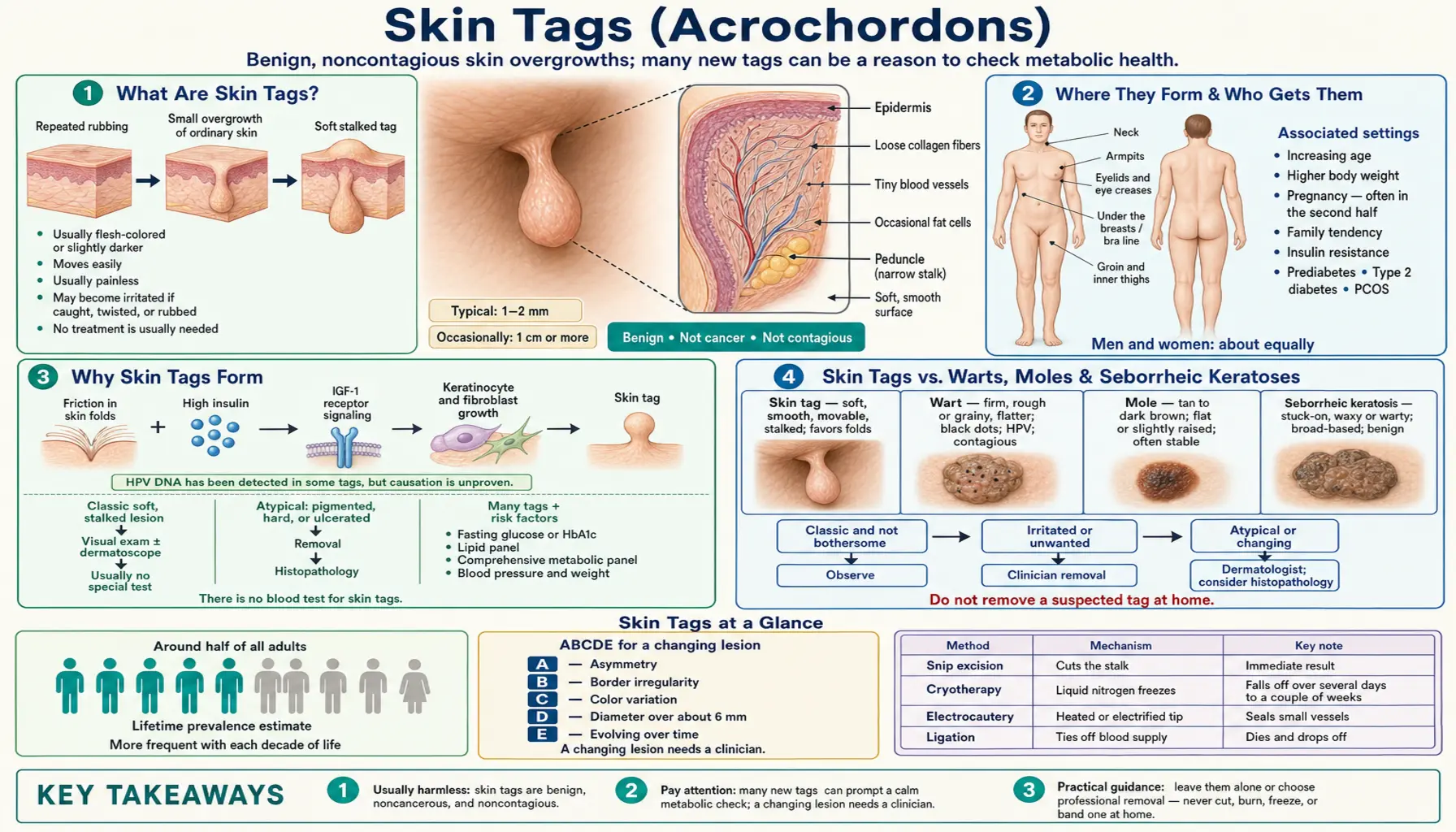
Skin tags — doctors call them acrochordons — are among the most common and most harmless growths the human skin ever produces. They are the soft little flaps of skin that dangle from a neck, catch on a shirt collar, snag a necklace clasp, or peek out from an armpit or eyelid. If you have found one and typed its description into a search bar with a knot in your stomach, here is the short version first: skin tags are benign. They are not cancer, they are not contagious, and they will not turn into cancer. The vast majority need no treatment at all. That said, skin tags are worth a second look for two grown-up reasons. First, a lesion that looks like a tag but bleeds, darkens, hardens, or grows quickly deserves a doctor's eye, because a few skin cancers can masquerade as an innocent flap. Second, having many skin tags can be a quiet flag from your body about blood sugar and metabolic health — a signal worth listening to, not fearing. This page walks through what skin tags are, why they form, how to tell them from things that aren't tags, when to get one checked, how they are safely removed by professionals, and why the do-it-yourself removal kits sold online are a bad idea.
Table of Contents
- What Are Skin Tags?
- Where They Form & Who Gets Them
- Why Skin Tags Form
- Skin Tags vs. Warts, Moles & Seborrheic Keratoses
- When to See a Doctor
- Diagnosis
- Removal Options
- Why You Should Not Remove Them Yourself
- Do They Come Back? & Prevention
- The Metabolic Health Angle
- Key Research Papers
- Connections
- Featured Videos
What Are Skin Tags?
A skin tag is a small, soft, benign overgrowth of ordinary skin. Anatomically it is a thin outer layer of epidermis wrapped around a loose core of collagen fibers, tiny blood vessels, and sometimes a few fat cells. Most tags hang from a narrow stalk (a peduncle), which is why they wobble when you touch them — a flat, firmly rooted lesion is usually something else. They are typically the color of your skin or a shade darker, and they range from a scarcely visible pinhead (1–2 mm) to occasionally the size of a grape (a centimeter or more), though most are a couple of millimeters across.
The important word is benign. Under the microscope a skin tag is boringly normal tissue — there is nothing malignant, pre-malignant, or infectious about it. It is not a tumor in the frightening sense of the word; it is closer to a tiny architectural quirk in how the skin folded and grew. Skin tags do not spread from person to person, and touching or scratching one will not "seed" more. They cause no symptoms unless they are caught, twisted, or rubbed — in which case they can become irritated, tender, or bleed a little. A tag whose stalk twists tightly can lose its blood supply, turn dark red or black, and then drop off on its own; that is the tissue dying (a harmless process), not cancer.
Where They Form & Who Gets Them
Skin tags favor warm, moist places where skin rubs against skin or against clothing. The classic locations are:
- The neck — especially the sides and back, and along a collar line.
- The armpits (axillae).
- The eyelids and the creases around the eyes.
- The groin and inner thighs.
- Under the breasts, along the bra line.
They are extraordinarily common. Skin tags become more frequent with each decade of life, and by later middle age a large fraction of people have at least one; population estimates commonly put lifetime prevalence somewhere around half of all adults. They affect men and women about equally, though they tend to appear in specific settings: increasing age, higher body weight, pregnancy (hormonal shifts, often with several appearing in the second half of pregnancy), a family tendency to develop them, and conditions of insulin resistance such as type 2 diabetes, prediabetes, and polycystic ovary syndrome. None of this means a skin tag is a disease — plenty of lean, healthy people grow them too — but the pattern of who gets them, and especially how many, is a clue to the biology behind them.
Why Skin Tags Form
There is no single cause, but a few threads run through the evidence, and they help explain both the harmless everyday tags and the crops of them that show up alongside metabolic problems.
Friction and mechanical rubbing
The oldest and most intuitive explanation is simple wear. Skin that repeatedly folds and rubs — neck against collar, thigh against thigh, skin against skin in a fold — is stimulated to grow a little extra tissue. This is why tags cluster exactly where friction is greatest, and why heavier people, whose skin has more and deeper folds, tend to have more of them.
Hormones and growth signals
Skin tags often multiply during pregnancy and are notably common in acromegaly, a disorder of excess growth hormone. Both point to the role of hormonal growth signals — particularly insulin and insulin-like growth factor 1 (IGF-1) — in nudging skin cells to proliferate.
The insulin-resistance and metabolic link
This is the part that is genuinely evidence-based and worth understanding. When the body becomes resistant to insulin, the pancreas compensates by pumping out more insulin, so blood levels of insulin run high (hyperinsulinemia). Insulin at high concentrations does more than manage blood sugar — it can switch on the IGF-1 receptors on skin cells (keratinocytes and fibroblasts), encouraging them to grow and divide. The leading hypothesis is that this growth-promoting environment helps drive the formation of skin tags, which is why numerous tags travel with insulin resistance, prediabetes, type 2 diabetes, obesity, and the whole cluster of the metabolic syndrome. Multiple case-control studies — summarized in the research section below — have found that people with many skin tags are more likely to have impaired glucose handling, higher fasting insulin, unfavorable cholesterol and triglyceride levels, and higher blood pressure than matched people without tags. The same insulin-driven mechanism is thought to underlie acanthosis nigricans, the velvety dark thickening of skin in the neck and armpits that frequently keeps skin tags company.
A note on HPV
Human papillomavirus (HPV) DNA has been detected in some skin tags, which has prompted speculation about a viral contribution. But detection is not causation, tags are not contagious in everyday life, and this remains an unproven side-note rather than an established cause.
The honest summary: skin tags are usually a mix of friction plus a growth-friendly hormonal background. In someone with just one or two, that background is nothing to worry about. In someone sprouting many, it can be a visible echo of what is happening with their insulin and metabolism.
Skin Tags vs. Warts, Moles & Seborrheic Keratoses
Most anxiety about a "skin tag" is really the question is this actually something else? Telling benign look-alikes apart is a job that ultimately belongs to a clinician, but the following features explain what each one typically looks like and why they are confused.
- Skin tag (acrochordon): soft, flesh-colored or slightly darker, usually dangling from a thin stalk, smooth, easily moved, painless. Lives in folds — neck, armpit, groin, eyelids.
- Wart (verruca): caused by HPV and therefore contagious. A wart is usually firm and rough or grainy on the surface, sits flatter against the skin (not on a stalk), and classically shows tiny black dots (clotted capillaries) within it. Common on hands, fingers, feet, and the genital area. See our Warts page for detail.
- Mole (melanocytic nevus): a pigmented spot, tan to dark brown, flat or slightly raised, usually present for years and stable. Moles matter because melanoma arises from pigment cells — so a pigmented lesion that changes gets watched closely (the ABCDE rule below), whereas a soft flesh-colored tag does not carry that concern.
- Seborrheic keratosis: a very common benign growth of older skin that looks "stuck on," waxy or warty, and is often tan, brown, or black with a slightly greasy or scaly surface. Unlike a tag it is broad-based rather than stalked, and unlike a mole it is not made of pigment cells. Benign, but its dark color leads people to fear melanoma.
The practical bottom line: a small, soft, wobbly, flesh-colored dangler in a skin fold is almost always a skin tag. A growth that is firmly pigmented, hard, rough, rapidly changing, or does not fit the "soft dangler" description is not automatically a tag and deserves a proper look.
When to See a Doctor
Skin tags themselves rarely require medical attention. What requires attention is a lesion behaving in a way that a benign tag should not. See a clinician — ideally a dermatologist — if a growth you thought was a tag shows any of these red flags:
- Bleeding that is spontaneous (not just after you snagged it).
- A change in color — especially turning brown, blue, or black, or developing several colors within one lesion.
- Rapid growth, or a lesion that keeps enlarging.
- An irregular or asymmetric shape, ragged or blurred borders.
- Hardness, a fixed base, ulceration (an open sore), crusting, or a wound that will not heal.
- Persistent pain, tenderness, or itching.
A useful memory aid for any pigmented or changing lesion is the melanoma ABCDE rule: Asymmetry, Border irregularity, Color variation, Diameter over about 6 mm, and Evolving (changing over time). Real skin tags do none of these things; a "tag" that does is exactly the kind of lesion a doctor wants to examine. Both melanoma and basal cell carcinoma can occasionally mimic a benign bump, which is the single best reason never to assume — and never to cut something off at home before it has been identified. Separately, if you suddenly develop many new skin tags, it is worth mentioning to your primary-care doctor, who may suggest checking your blood sugar and lipids (see the metabolic section below).
Diagnosis
Diagnosing a skin tag is usually quick and requires no special test. A clinician recognizes the characteristic soft, stalked, flesh-colored growth on sight, often confirming with a dermatoscope — a handheld magnifier with a light that reveals surface and vascular patterns. Because the diagnosis is visual, there is no blood test "for skin tags."
Two situations prompt more than a glance. First, if a lesion looks atypical — pigmented, hard, ulcerated, or otherwise not a classic tag — the doctor may remove it and send it to a pathology lab for histopathological examination under the microscope, which is the definitive way to rule out a skin cancer. This is a core reason removal is done by professionals: the tissue can be examined rather than discarded. Second, when someone has multiple tags together with risk factors, the clinician may order metabolic screening — typically a fasting glucose or HbA1c, a lipid panel, and the glucose and other markers found on a comprehensive metabolic panel — along with blood pressure and weight.
Removal Options
Because skin tags are harmless, removal is almost always elective and cosmetic, or done because a tag is repeatedly irritated, caught, or bleeding. Insurance often does not cover purely cosmetic removal. When a tag is removed, it is a fast in-office procedure performed by a physician, dermatologist, or trained clinician using one of several well-established methods, chosen by size, number, and location:
- Snip (scissor) excision: the clinician numbs the area if needed and simply cuts the tag off at the base with sterile fine scissors or a scalpel. Bleeding is controlled with pressure, a cautery tip, or a dab of an agent such as aluminum chloride or silver nitrate. This is the most common approach for small-to-medium tags and gives an immediate result.
- Cryotherapy: the tag is frozen with liquid nitrogen. It blisters and falls off over several days to a couple of weeks. Very fast, though color change to the surrounding skin is possible and larger tags may need a repeat.
- Electrocautery / electrodesiccation: a fine heated or electrified tip burns through the stalk and seals the small vessels at the same time, which limits bleeding.
- Ligation: the base of the tag is tied off (with suture material or a small band) to cut off its blood supply, so the tag dies and drops off on its own. Sometimes used for larger tags or where cutting is awkward.
All of these are quick, generally low-risk in trained hands, and leave little or no mark. The clinician also has the option — important for any lesion that looks even slightly atypical — of sending the removed tissue for microscopic confirmation.
Why You Should Not Remove Them Yourself
Search results are full of at-home "skin tag removers": freezing kits, tiny ligation bands, and acidic or caustic creams and pastes. It is tempting to skip a clinic visit, but doing this yourself is a genuinely bad trade. The problems:
- You might be destroying a cancer. This is the biggest reason. A lesion that is actually a melanoma or basal cell carcinoma can look like a tag to an untrained eye. Burning, freezing, or snipping it off at home destroys the evidence, delays a real diagnosis, and can let a treatable cancer advance. Only a professional can send the tissue for examination.
- Bleeding. Tags contain small blood vessels, and some carry a surprisingly generous one. A home cut can bleed more than expected and be hard to stop cleanly.
- Infection and scarring. Non-sterile tools, incomplete removal, and open wounds invite infection and can leave a worse mark than the tag ever was.
- Chemical burns and pigment changes. Over-the-counter acid or "mole and skin tag" pastes do not know where the tag ends and healthy skin begins. They can burn surrounding skin and leave dark or light patches, particularly on brown and black skin.
- Dangerous locations. Tags on the eyelids or right at the eye margin, or in the genital area, are especially risky to attack at home — these belong to a clinician.
The reassuring flip side is that professional removal is inexpensive, fast, and safe, and buys you the certainty that what came off was truly benign. If a tag bothers you, that is a reasonable reason to have it removed — just have it done properly.
Do They Come Back? & Prevention
A skin tag that is fully removed does not usually grow back in the same spot. But removal treats the tag, not the tendency to make them — so if the underlying factors are still in play (friction, weight, hormonal or insulin-resistant physiology), new tags can appear elsewhere over time. This is normal and does not mean a treatment "failed."
There is no proven cream, supplement, or routine that prevents skin tags outright, and any product promising to do so is overselling. What genuinely helps tilt the odds is addressing the conditions that favor them:
- Reduce friction: well-fitting clothing, keeping skin folds dry, and reducing skin-on-skin rubbing where you can.
- Weight management and physical activity: because higher body weight and insulin resistance are linked to more tags, improving these can reduce the tendency to form new ones (while helping far more important health outcomes).
- Blood-sugar control: better insulin sensitivity addresses one of the growth signals thought to drive tags.
Think of prevention less as "stopping skin tags" and more as improving the metabolic terrain — the tags are a minor cosmetic byproduct, and the terrain is what actually matters for your health.
The Metabolic Health Angle
Here is the one part of this page worth taking seriously even though skin tags themselves are trivial. Decades of dermatology research have repeatedly linked multiple skin tags — especially many of them, or tags together with acanthosis nigricans — to insulin resistance and its companions: prediabetes and type 2 diabetes, higher triglycerides and lower HDL cholesterol, higher blood pressure, higher body weight, and the overall picture of metabolic syndrome. Skin tags are one of the skin's visible, external hints about something internal.
What to do with that information — calmly:
- A single tag, or one or two, means nothing metabolic. Plenty of perfectly healthy people have them. Do not read a whole diagnosis into a lone tag.
- Many tags, or new crops of them, are a reasonable nudge to check the basics: fasting glucose or HbA1c, a lipid panel, blood pressure, and weight/waist measurement. A quick conversation with your primary-care doctor covers it.
- If those numbers are off, that is good news you found early. Insulin resistance, prediabetes, and early metabolic syndrome are among the most reversible conditions in medicine — responsive to activity, dietary change, weight loss, and, when appropriate, medication.
So the emotional arc of skin tags is the opposite of most things that send people searching: the growths are harmless and the cosmetic fix is easy, while the only meaningful message — a possible heads-up about metabolic health — is an opportunity, caught early and often reversible. That is a good deal, not a scary one.
Key Research Papers
The citations below are real, peer-reviewed sources; each links to the article via its DOI or PubMed record. Journal and author names are plain text; only the year/volume/pages are linked.
- Pandey A, Saleh HM. Skin Tag (Acrochordon). StatPearls [Internet]. Treasure Island (FL): StatPearls Publishing. — Search PubMed
- Rasi A, Soltani-Arabshahi R, Shahbazi N. Skin tag as a cutaneous marker for impaired carbohydrate metabolism: a case-control study. International Journal of Dermatology. 2007;46(11):1155-1159.
- Kahana M, Grossman E, Feinstein A, Ronnen M, Cohen M, Millet MS. Skin tags: a cutaneous marker for diabetes mellitus. Acta Dermato-Venereologica. Search PubMed
- Norris PG, McFadden J, Gale E, Griffiths WA. Skin tags are more closely related to fasting insulin than fasting glucose levels. Acta Dermato-Venereologica. 1988;68(4):367-368.
- Sari R, Akman A, Alpsoy E, Balci MK. The metabolic profile in patients with skin tags. Clinical and Experimental Medicine. 2010;10(3):193-197.
- Tamega Ade A, Aranha AM, Guiotoku MM, Miot LD, Miot HA. Association between skin tags and insulin resistance. Anais Brasileiros de Dermatologia. 2010;85(1):25-31.
- Barbato MT, Criado PR, da Silva AK, Averbeck E, Guerine MB, de Sa NB. Association of acanthosis nigricans and skin tags with insulin resistance. Anais Brasileiros de Dermatologia. 2012;87(1):97-104.
- Senel E, Salmanoglu M, Solmazgul E, Bercik Inal B. Acrochordons as a cutaneous sign of impaired carbohydrate metabolism, hyperlipidemia, liver enzyme abnormalities and hypertension: a case-control study. Journal of the European Academy of Dermatology and Venereology. 2023;37(9):1811-1814.
- Akpinar F, Dervis E. Association between acrochordons and the components of metabolic syndrome. European Journal of Dermatology. 2012;22(1):106-110.
- Jindal A, Patel NM, Shah R. Acrochordons as a cutaneous sign of metabolic syndrome: a case-control study. Annals of Medical and Health Sciences Research. 2014;4(2):202-205.
- Crook MA. Skin tags and the atherogenic lipid profile. Journal of Clinical Pathology. 2000;53(11):873-874.
- Banik R, Lubach D. Skin tags: localization and frequencies according to sex and age. Dermatologica. 1987;174(4):180-183.
Live PubMed Searches
These links open live PubMed searches — results refresh as new studies are indexed.
- Acrochordon / skin tag — PubMed search
- Skin tags & insulin resistance — PubMed search
- Acrochordon & metabolic syndrome — PubMed search
- Skin tags & diabetes mellitus — PubMed search
- Acrochordons & dyslipidemia — PubMed search
- Skin tags & obesity — PubMed search
- Acrochordons & acanthosis nigricans — PubMed search
Connections
- Dermatology
- Metabolic Syndrome
- Insulin Resistance
- Type 2 Diabetes
- Diabetes
- Prediabetes
- Obesity
- PCOS
- Hypertension
- Warts
- Melasma
- Melanoma
- Basal Cell Carcinoma
- Actinic Keratosis
- Comprehensive Metabolic Panel
- Lipid Panel
- Cryosurgery and Cryoablation (freezing skin lesions)