Pancreatic Cancer
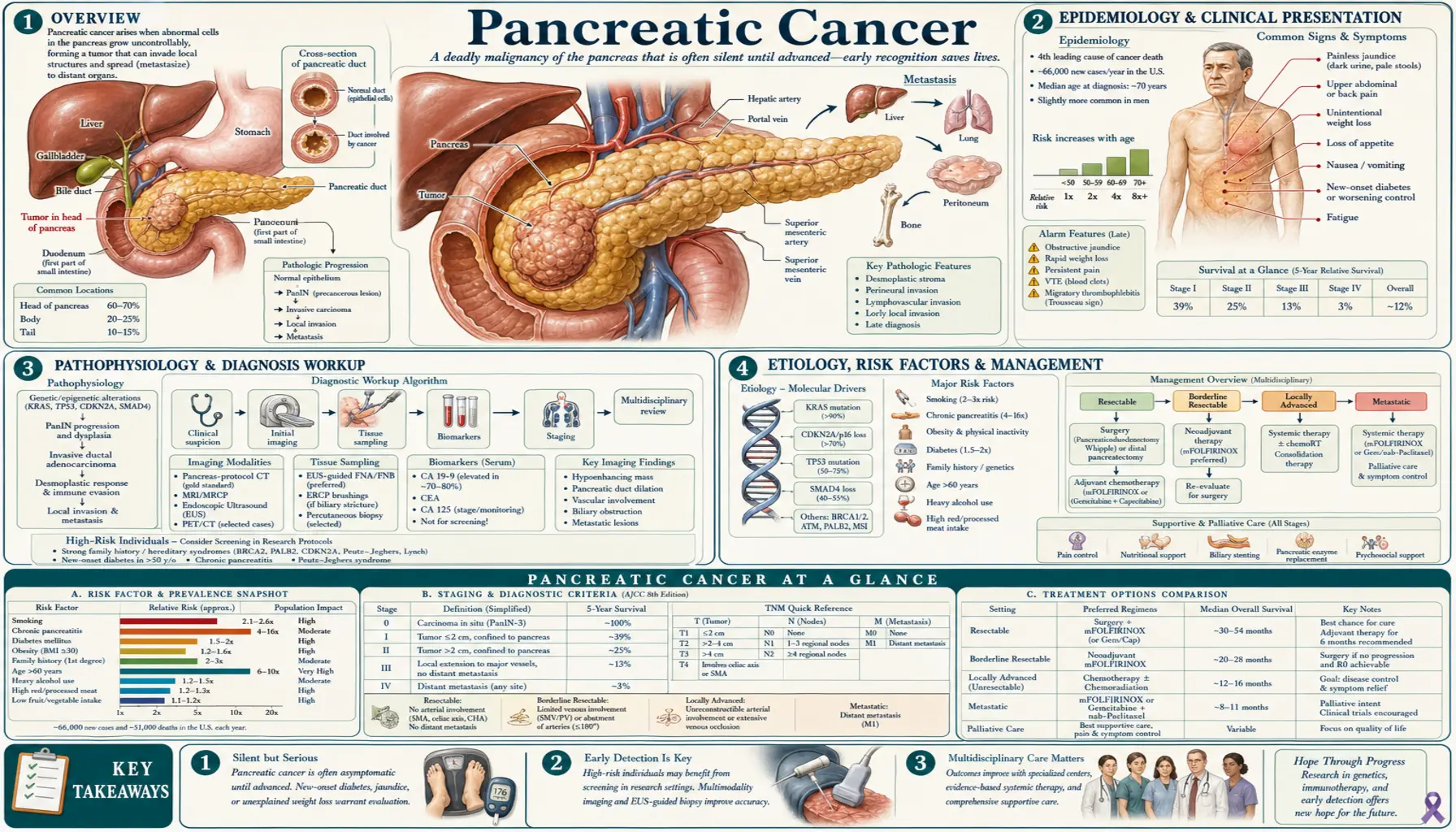
Table of Contents
- Overview
- Epidemiology
- Pathophysiology
- Etiology and Risk Factors
- Clinical Presentation
- Diagnosis
- Treatment
- Complications
- Prognosis
- Prevention
- Recent Research and Advances
- References & Research
- Research Papers
- Connections
- Featured Videos
1. Overview
Pancreatic cancer is a malignancy that begins in the pancreas, a fish-shaped gland tucked deep in the upper abdomen behind the stomach. The pancreas does two very different jobs: it makes digestive enzymes that break down the food you eat (its exocrine role), and it makes hormones such as insulin that control blood sugar (its endocrine role). The overwhelming majority of pancreatic cancers — roughly 90% — arise from the duct cells of the exocrine pancreas and are called pancreatic ductal adenocarcinoma (PDAC). When this page says "pancreatic cancer," it almost always means PDAC, because that is the form that makes this disease so feared.
There is no gentle way to say it: pancreatic cancer is one of the most difficult cancers to treat. It is currently the third leading cause of cancer death in the United States and is on a trajectory to become the second within the next decade, even though it is far from the most common cancer by diagnosis. The reason for that mismatch is the heart of this disease — most pancreatic cancers are found late, after they have already spread, when a cure is no longer possible.
But "difficult" is not the same as "hopeless." Survival has been slowly but genuinely climbing for two decades, driven by better chemotherapy combinations, more careful patient selection for surgery, and the first targeted therapies for inherited forms of the disease. There are also concrete, practical things patients and families can do — recognizing early warning signs, getting to a high-volume pancreatic-surgery center, replacing the digestive enzymes the cancer takes away, and protecting nutrition. This article walks through all of it honestly.
A small but important distinction: a separate, much rarer group of pancreatic tumors called pancreatic neuroendocrine tumors (PanNETs) arise from the hormone-making endocrine cells. These behave very differently — they are usually slower-growing and carry a far better prognosis than PDAC. The famous patient Steve Jobs had a PanNET, not the common adenocarcinoma. We contrast them briefly in the treatment section so the two are not confused.
2. Epidemiology
In the United States, pancreatic cancer accounts for roughly 3% of all new cancer diagnoses but about 8% of all cancer deaths — a stark illustration of how deadly it is relative to how often it occurs. Each year, more than 66,000 Americans are diagnosed and more than 51,000 die from it, according to the American Cancer Society's 2024 statistics.
Because screening and treatment have made huge strides against the more common cancers (breast, prostate, colon, lung), deaths from those have fallen, while pancreatic-cancer deaths have not fallen nearly as fast. That is why projections show pancreatic cancer overtaking colorectal and breast cancer to become the second-leading cause of cancer death in the U.S. by around the early 2030s — not because it is exploding in frequency, but because the others are being beaten back faster.
Key patterns in who develops it:
- Age: It is overwhelmingly a disease of older adults. The average age at diagnosis is about 70, and it is uncommon before age 45.
- Sex: It is slightly more common in men than women.
- Race: In the U.S., Black Americans have a modestly higher incidence and worse outcomes, reflecting a mix of risk-factor and access-to-care differences.
- Geography: Incidence is highest in higher-income countries, paralleling rates of smoking, obesity, and diabetes.
3. Pathophysiology
Pancreatic ductal adenocarcinoma does not appear overnight. It develops through a stepwise accumulation of genetic mutations that turn a normal duct cell into an invasive cancer over many years. Understanding this sequence explains both why the disease is so aggressive and why earlier detection is theoretically possible.
The driver mutation: KRAS. The single most important molecular event is mutation of the KRAS gene, found in roughly 90% of PDAC tumors — one of the highest rates of any cancer. KRAS normally acts like an on/off switch for cell growth signals; the mutation jams the switch permanently "on," so the cell keeps dividing. KRAS has historically been considered "undruggable," which is part of why progress has been slow, though that is finally beginning to change (see Recent Research).
Precursor lesions. Before invasive cancer forms, the duct lining passes through identifiable precancerous stages:
- PanIN (pancreatic intraepithelial neoplasia): microscopic abnormal areas in the small ducts. Low-grade PanIN is common with age and usually harmless; high-grade PanIN is the immediate precursor to PDAC.
- IPMN (intraductal papillary mucinous neoplasm): mucus-producing growths in the larger ducts that can sometimes be seen on imaging as cysts. Some IPMNs are benign and never progress; others slowly turn malignant. Because they are visible, IPMNs are one of the few pancreatic findings that can be watched over time and removed before they become cancer.
Beyond KRAS, three tumor-suppressor genes are commonly knocked out — CDKN2A, TP53, and SMAD4 — and large genomic studies have sorted PDAC into molecular subtypes that help explain why some tumors respond to chemotherapy and others do not. A defining biological feature of PDAC is its dense stroma — a thick, fibrous, poorly-blood-supplied scaffold around the cancer cells that acts like armor, blocking chemotherapy drugs and immune cells from reaching the tumor. This stromal barrier is a major reason pancreatic cancer resists treatments that work in other cancers. Critically, research tracing the genetic family tree of these tumors shows that the cells capable of spreading to distant organs appear relatively late in the cancer's evolution — meaning there may be a window of several years during which the disease is theoretically catchable before it metastasizes.
4. Etiology and Risk Factors
Most people who get pancreatic cancer have no obvious cause, but several factors clearly raise the risk. Knowing them matters because a few are modifiable, and one — new-onset diabetes — can be an early warning sign rather than just a risk factor.
Modifiable risk factors
- Smoking is the single biggest avoidable cause, roughly doubling the risk and responsible for an estimated 20–25% of cases. Risk falls after quitting and approaches that of never-smokers after about 10–20 years.
- Obesity and a sedentary lifestyle raise risk, likely through chronic inflammation and insulin resistance.
- Long-standing type 2 diabetes (present for more than 5 years) modestly increases risk.
- Heavy alcohol use raises risk mainly by causing chronic pancreatitis.
- Chronic pancreatitis — long-term inflammation of the pancreas — is a meaningful risk factor; hereditary pancreatitis raises it dramatically.
New-onset diabetes after 50 — a practical red flag
This deserves its own emphasis because it is one of the few early clues this otherwise silent cancer gives. There is a two-way relationship between diabetes and pancreatic cancer. Long-standing diabetes is a mild risk factor, but a sudden, brand-new diagnosis of diabetes in someone over 50 — especially a thin person, someone without a family history, or someone whose blood sugar control suddenly worsens for no clear reason — can be an early symptom of a pancreatic tumor that is quietly destroying insulin-producing tissue.
A landmark population study found that people newly diagnosed with diabetes after age 50 had about a 1% chance of being diagnosed with pancreatic cancer within three years — roughly eight times the background rate. That is still a small absolute number (most new diabetes is ordinary type 2 diabetes), so this is not a reason to panic over a routine diabetes diagnosis. But if new diabetes appears alongside unexplained weight loss, abdominal or back pain, or digestive changes, that combination warrants a conversation with a doctor about imaging the pancreas. Researchers are actively building risk models (such as the ENDPAC score) to identify the small subset of new-diabetics who should be scanned.
Inherited and family risk
- Family history: Having one first-degree relative with pancreatic cancer roughly doubles risk; two or more raises it further (familial pancreatic cancer).
- BRCA2 (and to a lesser extent BRCA1) mutations — the same genes linked to breast and ovarian cancer — increase pancreatic-cancer risk and, importantly, predict response to specific treatments.
- Lynch syndrome (hereditary mismatch-repair defects), familial atypical multiple mole melanoma (FAMMM/CDKN2A), Peutz-Jeghers syndrome, and hereditary pancreatitis all carry elevated risk.
If pancreatic cancer runs in your family, ask about genetic counseling. People with a strong inherited risk may qualify for a surveillance program (discussed under Prevention).
5. Clinical Presentation
The cruel reality of pancreatic cancer is that early disease usually causes no symptoms at all, or symptoms so vague they are easily blamed on something else. The pancreas sits deep in the back of the abdomen (the retroperitoneum), where a small tumor can grow for a long time without pressing on anything that hurts. By the time symptoms force a diagnosis, the cancer has often already spread.
Symptoms depend heavily on where in the pancreas the tumor sits. Tumors in the head of the pancreas (about two-thirds of cases) tend to block the nearby bile duct, producing jaundice relatively early — which can paradoxically lead to an earlier, more curable diagnosis. Tumors in the body and tail cause no jaundice and are often silent until much later.
Warning signs worth taking seriously
- Painless jaundice — yellowing of the skin and the whites of the eyes that comes on without the pain of a gallstone attack. This is the single most classic warning sign and should always be evaluated promptly.
- Dark urine (the color of tea or cola) and pale, clay-colored stools — these accompany jaundice when the bile duct is blocked and bile cannot reach the intestine.
- Itching all over (from bile salts building up in the skin).
- Pain in the upper abdomen that radiates straight through to the mid-back, often worse when lying down and eased by leaning forward.
- Unexplained weight loss and loss of appetite.
- New diabetes or sudden loss of blood-sugar control in someone over 50 (see above).
- Greasy, floating, foul-smelling stools (steatorrhea) — a sign that the pancreas can no longer release enough digestive enzymes.
- Nausea, early fullness, and fatigue.
None of these by itself proves pancreatic cancer — jaundice is far more often caused by gallstones or hepatitis, and most weight loss has benign causes. But painless jaundice, or several of these signs appearing together over weeks, deserves prompt medical attention rather than watchful waiting.
6. Diagnosis
When pancreatic cancer is suspected, the goals are to confirm the diagnosis, stage the disease (has it spread?), and decide whether the tumor can be surgically removed. This usually involves a combination of blood tests, specialized imaging, and a biopsy.
Blood tests and the CA 19-9 caveat
CA 19-9 is a tumor marker often elevated in pancreatic cancer, but it has real limitations and is not a screening test. It can be high in non-cancerous conditions (especially when the bile duct is blocked, which raises it artificially) and is normal in some cancers. Roughly 5–10% of people genetically cannot make CA 19-9 at all, so their level stays normal even with advanced cancer. CA 19-9 is most useful for tracking response to treatment over time rather than for making the initial diagnosis. Liver and bilirubin blood tests are also checked, since they reveal bile-duct blockage.
Imaging
- Pancreatic-protocol CT scan: the workhorse. This is a specialized multiphase CT timed precisely to show the pancreas, the tumor, and — critically — its relationship to the major blood vessels nearby. That vessel relationship determines whether surgery is possible.
- MRI/MRCP: useful for clarifying cysts, the bile and pancreatic ducts, and liver spots.
- Endoscopic ultrasound (EUS): a scope passed down to the stomach and duodenum places an ultrasound probe right next to the pancreas, giving the most detailed view of small tumors — and allowing a needle biopsy (EUS-guided fine-needle aspiration/biopsy) through the gut wall to confirm cancer.
- PET scan may be added to look for distant spread in selected cases.
Resectability — the decision that drives everything
Treatment hinges on whether the tumor can be surgically removed, judged mainly by how much it involves the nearby arteries and veins. Cases are sorted into four categories:
- Resectable: the tumor is confined and clear of the critical vessels — surgery is potentially curative.
- Borderline resectable: the tumor touches vessels enough that immediate surgery risks leaving cancer behind; chemotherapy (and sometimes radiation) is usually given first to shrink it.
- Locally advanced (unresectable): the tumor encases the major arteries but has not spread to distant organs; surgery is not initially possible.
- Metastatic: the cancer has spread (most often to the liver, then the lining of the abdomen and the lungs); treatment focuses on controlling the disease and quality of life.
Sadly, only about 15–20% of patients have resectable disease at diagnosis. This is the central reason survival is low — and the central reason finding it earlier matters so much.
7. Treatment
Pancreatic cancer is best managed by a multidisciplinary team at an experienced center — surgeons, medical oncologists, radiation oncologists, gastroenterologists, dietitians, and palliative-care specialists working together. One of the most important, evidence-backed things a patient can do is to be treated at a high-volume center: hospitals that perform many pancreatic surgeries have meaningfully lower complication and death rates than those that do them occasionally.
Surgery — and the Whipple, explained plainly
Surgery offers the only realistic chance of cure, and it is only possible when the tumor is resectable (or becomes resectable after chemotherapy). The operation depends on tumor location:
- Whipple procedure (pancreaticoduodenectomy): for tumors in the head of the pancreas. This is one of the biggest operations in general surgery. The surgeon removes the head of the pancreas, the duodenum (first part of the small intestine), the gallbladder, part of the bile duct, and sometimes part of the stomach — then reconnects the remaining pancreas, bile duct, and stomach to the intestine. It typically takes 6–8 hours.
- Distal pancreatectomy (often with spleen removal) for tumors in the body or tail.
The recovery reality: Patients should go in with clear expectations. A Whipple usually means about a week or more in the hospital and several months to recover energy. Many people need pancreatic enzyme pills with meals afterward, and some develop diabetes because insulin-making tissue was removed. Delayed stomach emptying, infections, and a leak at the surgical connection (pancreatic fistula) are the most common complications. It is a hard recovery — but it is also the operation that creates the possibility of long-term survival, and most patients who are good candidates come through it.
Chemotherapy — the modern backbone
Chemotherapy is central to nearly every stage. Two regimens dominate:
- FOLFIRINOX (a four-drug combination: 5-fluorouracil, leucovorin, irinotecan, oxaliplatin). It is the more intensive and more effective option but has significant side effects, so it is reserved for patients who are fit enough. In the landmark 2011 trial, FOLFIRINOX nearly doubled median survival in metastatic disease versus gemcitabine alone.
- Gemcitabine plus nab-paclitaxel: a gentler two-drug option, established by the MPACT trial, often chosen for patients who cannot tolerate FOLFIRINOX.
Adjuvant therapy (after surgery): Even when surgery removes all visible cancer, microscopic cells usually remain, so chemotherapy afterward is standard. The practice-changing PRODIGE 24 trial (2018) showed that a modified FOLFIRINOX after surgery extended median survival to about 54 months versus 35 months with gemcitabine — a major improvement for fit patients. Earlier trials (ESPAC-3, ESPAC-4, CONKO-001) established gemcitabine-based adjuvant therapy as the prior standard.
Neoadjuvant therapy (before surgery): For borderline-resectable tumors, giving chemotherapy first can shrink the cancer, treat hidden spread early, and improve the odds of a clean (margin-negative) resection.
Targeted therapy for inherited disease — the POLO breakthrough
For the subset of patients with an inherited BRCA1 or BRCA2 mutation (perhaps 5–7% of cases), a class of drugs called PARP inhibitors exploits the tumor's defective DNA repair. The POLO trial (2019) showed that maintenance olaparib roughly doubled the time before the cancer progressed in patients whose disease was controlled on platinum-based chemo. This is why everyone with pancreatic cancer should be offered germline genetic testing — it can open a treatment door. A small subset of tumors with mismatch-repair deficiency (MSI-high) can also respond to immunotherapy.
Newer regimens and supportive care
Newer combinations such as NALIRIFOX (in the NAPOLI-3 trial) are expanding first-line options. Beyond cancer-killing therapy, supportive treatments are essential: a stent placed endoscopically to relieve bile-duct blockage and clear jaundice, nerve blocks (celiac plexus block) for pain, and early palliative care, which studies show improves both quality of life and, in some settings, survival.
A brief contrast: neuroendocrine tumors
It bears repeating: pancreatic neuroendocrine tumors (PanNETs) are a different disease with a far better outlook. They grow more slowly, are often treatable with surgery, somatostatin analogs, or targeted agents, and many patients live for years or even decades. If your pathology report says "neuroendocrine," the grim PDAC statistics on this page do not apply to you — talk with your team about what your specific tumor means.
8. Complications
Pancreatic cancer and its treatment cause several problems that are themselves treatable — and managing them well is a big part of feeling better and staying strong enough for therapy.
- Bile-duct obstruction and jaundice: relieved with an endoscopically placed stent.
- Exocrine pancreatic insufficiency (EPI): the tumor or surgery reduces digestive-enzyme output, causing greasy stools, gas, bloating, weight loss, and malnutrition. This is treated with pancreatic enzyme replacement therapy (PERT) — see the nutrition note below.
- New or worsening diabetes: from loss of insulin-producing tissue.
- Pain: the tumor can invade the nerve plexus behind the pancreas, causing the characteristic deep back pain; this responds to medication, nerve blocks, or radiation.
- Cachexia (cancer wasting): profound loss of weight and muscle driven by the cancer's metabolism, not just poor appetite.
- Blood clots (DVT/pulmonary embolism): pancreatic cancer is one of the most clot-prone cancers.
- Gastric outlet obstruction: a tumor blocking the duodenum, sometimes needing a stent or bypass.
Practical note: enzymes and nutrition
This is something patients have real control over and is often under-treated. When the pancreas cannot release enough enzymes, food passes through undigested — you can be eating and still starving. Pancreatic enzyme replacement therapy (PERT) is taken as capsules with every meal and snack (and the dose often needs to be higher than people are first told). Taken correctly, it can stop the greasy stools, restore weight, and dramatically improve energy and quality of life. Pairing PERT with a registered dietitian who knows pancreatic cancer, eating smaller frequent meals, ensuring adequate protein and calories, and checking vitamin D and the fat-soluble vitamins (A, D, E, K) are all concrete, high-impact steps. If you have greasy or floating stools, ask specifically about enzyme dosing.
9. Prognosis
Here is the honest picture, with the encouraging context it deserves. Overall, the 5-year relative survival for pancreatic cancer in the U.S. is about 13%. That number is sobering — but it is also the highest it has ever been, having roughly tripled from around 4% in the 1990s, and it continues to inch upward year over year.
Crucially, that single overall figure hides enormous variation by stage at diagnosis:
- Localized disease (confined to the pancreas, the minority that can be removed surgically): about 44% 5-year survival.
- Regional disease (spread to nearby structures or lymph nodes): roughly 16%.
- Distant/metastatic disease: about 3%.
The contrast between 44% and 3% is the entire argument for earlier detection and for getting fit patients to surgery. Beyond stage, prognosis is better for patients who are younger and otherwise healthy, who have a complete surgical resection with clear margins, who can complete adjuvant chemotherapy, and whose CA 19-9 falls with treatment. Patients with BRCA mutations who respond to platinum chemotherapy now have an added treatment avenue. And a real minority of patients — including some with metastatic disease who respond unusually well to chemotherapy — live far longer than the averages would predict. Statistics describe populations, not individuals.
10. Prevention
There is no proven way to guarantee prevention, and — being honest — no routine screening test exists for the general public. But several steps genuinely lower risk, and a few targeted programs exist for the highest-risk people.
What lowers your risk
- Don't smoke — and if you do, quit. This is by far the most effective single step; risk drops steadily after quitting.
- Maintain a healthy weight and stay physically active.
- Manage diabetes and metabolic health; control blood sugar.
- Moderate alcohol to avoid chronic pancreatitis.
- Eat a diet rich in vegetables, fruit, and whole foods and limit processed and red meat — sensible for many cancers, with modest evidence here.
The honest truth about screening
For people at average risk, screening is not recommended — there is no test accurate enough to do more good than harm across the whole population, and false alarms can lead to risky procedures. Surveillance is reserved for people at high inherited risk: those with a strong family history or a known high-risk genetic syndrome (such as BRCA2, Peutz-Jeghers, FAMMM/CDKN2A, Lynch, or hereditary pancreatitis). For them, expert programs — guided by the International Cancer of the Pancreas Screening (CAPS) Consortium — offer annual surveillance with EUS and/or MRI, aiming to catch precursor lesions or small cancers while still curable. If pancreatic cancer runs in your family, the most useful preventive step is to ask for genetic counseling to find out whether you qualify.
11. Recent Research and Advances
Progress is real and accelerating, even if it remains incremental. The most active and promising directions include:
- Cracking "undruggable" KRAS: after decades of failure, the first drugs that directly inhibit specific KRAS mutations have reached patients, and broader KRAS inhibitors covering the common pancreatic mutation are in clinical trials — potentially the most important development in the field.
- Earlier detection: intense work on blood-based "liquid biopsy" tests (circulating tumor DNA, exosomes, protein panels) and on identifying the small slice of new-onset diabetics who harbor a hidden tumor (risk scores such as ENDPAC), so that screening could one day be targeted to those who would benefit.
- Smarter chemotherapy and sequencing: regimens like NALIRIFOX (NAPOLI-3) and refined use of neoadjuvant therapy for borderline-resectable disease are extending and improving treatment.
- Targeting the stroma and the immune environment: strategies to break down the tumor's protective fibrous shell and make the "cold," immune-resistant tumor visible to the immune system, including next-generation immunotherapies and personalized cancer vaccines that have shown early, encouraging signals in pancreatic cancer.
- Precision medicine and genetic testing: universal germline and tumor molecular profiling is now recommended, since it identifies BRCA, MSI-high, and rare actionable alterations that open targeted-therapy and clinical-trial doors.
For any patient, asking about clinical trials at a major cancer center is one of the most concrete ways to access these advances.
12. References & Research
Historical Background
The modern surgical treatment of pancreatic-head tumors dates to 1935, when Allen Oldfather Whipple described the multi-stage operation to remove the head of the pancreas and surrounding structures — the procedure that still bears his name. The tumor marker CA 19-9 was identified in the late 1970s–1980s and became the standard blood marker for following the disease. For decades, gemcitabine offered only modest benefit, and the field's first true turning point came in 2011, when the FOLFIRINOX combination nearly doubled survival in metastatic disease — opening the modern era of more effective combination chemotherapy that has since reshaped both metastatic and post-surgical (adjuvant) treatment.
Key Research Papers
- Siegel RL, Giaquinto AN, Jemal A. Cancer statistics, 2024. CA: A Cancer Journal for Clinicians. 2024;74(1):12-49.
- Kamisawa T, Wood LD, Itoi T, Takaori K. Pancreatic cancer. The Lancet. 2016;388(10039):73-85.
- Ryan DP, Hong TS, Bardeesy N. Pancreatic adenocarcinoma. New England Journal of Medicine. 2014;371(11):1039-1049.
- Park W, Chawla A, O'Reilly EM. Pancreatic cancer: a review. JAMA. 2021;326(9):851-862.
- Bailey P, Chang DK, Nones K, et al. Genomic analyses identify molecular subtypes of pancreatic cancer. Nature. 2016;531(7592):47-52.
- Buscail L, Bournet B, Cordelier P. Role of oncogenic KRAS in the diagnosis, prognosis and treatment of pancreatic cancer. Nature Reviews Gastroenterology & Hepatology. 2020;17(3):153-168.
- Yachida S, Jones S, Bozic I, et al. Distant metastasis occurs late during the genetic evolution of pancreatic cancer. Nature. 2010;467(7319):1114-1117.
- Chari ST, Leibson CL, Rabe KG, et al. Probability of pancreatic cancer following diabetes: a population-based study. Gastroenterology. 2005;129(2):504-511.
- Sharma A, Smyrk TC, Levy MJ, et al. Fasting blood glucose levels provide estimate of duration and progression of pancreatic cancer before diagnosis. Gastroenterology. 2018;155(2):490-500.e2.
- Conroy T, Desseigne F, Ychou M, et al. FOLFIRINOX versus gemcitabine for metastatic pancreatic cancer. New England Journal of Medicine. 2011;364(19):1817-1825.
- Von Hoff DD, Ervin T, Arena FP, et al. Increased survival in pancreatic cancer with nab-paclitaxel plus gemcitabine. New England Journal of Medicine. 2013;369(18):1691-1703.
- Conroy T, Hammel P, Hebbar M, et al. FOLFIRINOX or gemcitabine as adjuvant therapy for pancreatic cancer. New England Journal of Medicine. 2018;379(25):2395-2406.
- Neoptolemos JP, Palmer DH, Ghaneh P, et al. Comparison of adjuvant gemcitabine and capecitabine with gemcitabine monotherapy in patients with resected pancreatic cancer (ESPAC-4): a multicentre, open-label, randomised, phase 3 trial. The Lancet. 2017;389(10073):1011-1024.
- Golan T, Hammel P, Reni M, et al. Maintenance olaparib for germline BRCA-mutated metastatic pancreatic cancer. New England Journal of Medicine. 2019;381(4):317-327.
- Wainberg ZA, Melisi D, Macarulla T, et al. NALIRIFOX versus nab-paclitaxel and gemcitabine in treatment-naive patients with metastatic pancreatic ductal adenocarcinoma (NAPOLI 3): a randomised, open-label, phase 3 trial. The Lancet. 2023;402(10409):1272-1281.
- Tempero MA, Malafa MP, Al-Hawary M, et al. Pancreatic adenocarcinoma, version 2.2021, NCCN clinical practice guidelines in oncology. Journal of the National Comprehensive Cancer Network. 2021;19(4):439-457.
- Goggins M, Overbeek KA, Brand R, et al. Management of patients with increased risk for familial pancreatic cancer: updated recommendations from the International Cancer of the Pancreas Screening (CAPS) Consortium. Gut. 2020;69(1):7-17.
- Whipple AO, Parsons WB, Mullins CR. Treatment of carcinoma of the ampulla of Vater. Annals of Surgery. 1935;102(4):763-779.
Research Papers
Research on pancreatic cancer is advancing quickly. Use the live PubMed searches below to find the most current peer-reviewed studies on diagnosis, treatment, early detection, and survival. Each link opens current results in a new tab.
- Pancreatic ductal adenocarcinoma
- Pancreatic cancer early detection
- New-onset diabetes and pancreatic cancer
- KRAS inhibitors in pancreatic cancer
- FOLFIRINOX in pancreatic cancer
- Neoadjuvant therapy for pancreatic cancer
- Whipple procedure outcomes
- BRCA and PARP inhibitors in pancreatic cancer
- Pancreatic enzyme replacement therapy
- Familial pancreatic cancer surveillance
- Pancreatic cancer liquid biopsy
- Pancreatic neuroendocrine tumor prognosis
Connections
- Oncology
- Cancer (Overview)
- Metastatic Cancers
- Pancreatitis
- Diabetes
- Insulin Resistance
- Obesity
- Gallstones
- Gallbladder Disease
- Jaundice
- Dark Urine
- Pale Stool
- Loss of Appetite
- Abdominal Pain
- Nausea and Vomiting
- Fatigue