Chanca Piedra Active Compounds: Lignans, Ellagitannins, and the Bioavailability Story
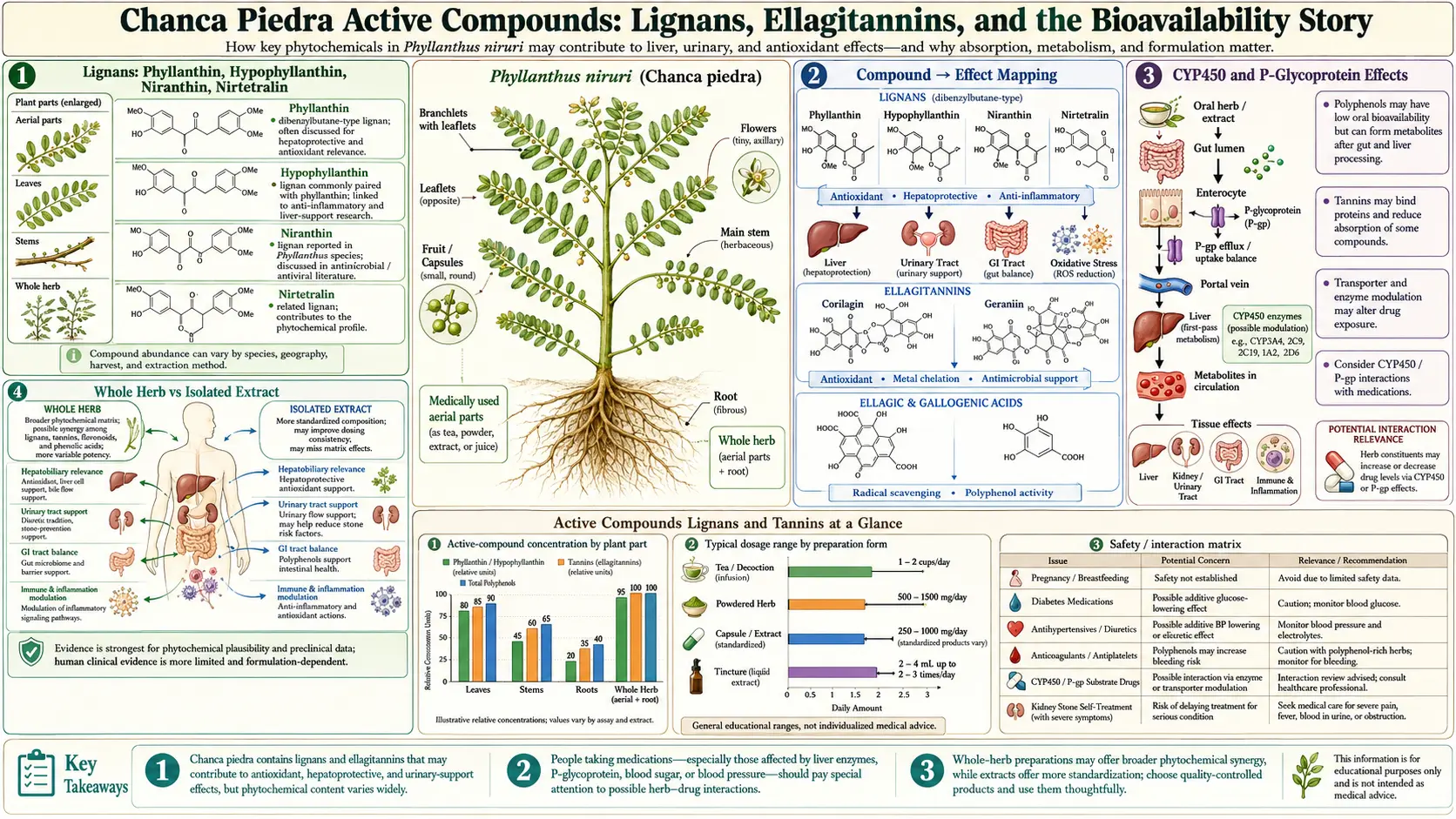
The pharmacology of Chanca Piedra is a story of two compound classes: lignans (phyllanthin, hypophyllanthin, niranthin, nirtetralin) and ellagitannins (geraniin, corilagin, ellagic acid). Each drives different effects, each has different bioavailability, and the synergies between them explain why isolated extracts of any single compound usually underperform whole-herb preparations. This page maps compound to effect, explains the gut-microbiota cascade that determines what actually reaches your bloodstream, and frames the cytochrome P450 issues that underlie the major drug interactions.
Table of Contents
- Lignans: Phyllanthin, Hypophyllanthin, Niranthin, Nirtetralin
- Ellagitannins: Geraniin, Corilagin, Ellagic Acid
- Flavonoids: Rutin, Quercetin, Niruretin
- Compound → Effect Mapping
- Bioavailability and Microbiota Activation
- CYP450 and P-Glycoprotein Effects
- Standardization Markers in Practice
- Species Chemotypes
- Whole Herb vs Isolated Extract
- Research Papers and References
- Connections
- Featured Videos
Lignans: Phyllanthin, Hypophyllanthin, Niranthin, Nirtetralin
The aryltetralin lignans are the most-cited class of Chanca Piedra actives, concentrated mostly in the leaves.
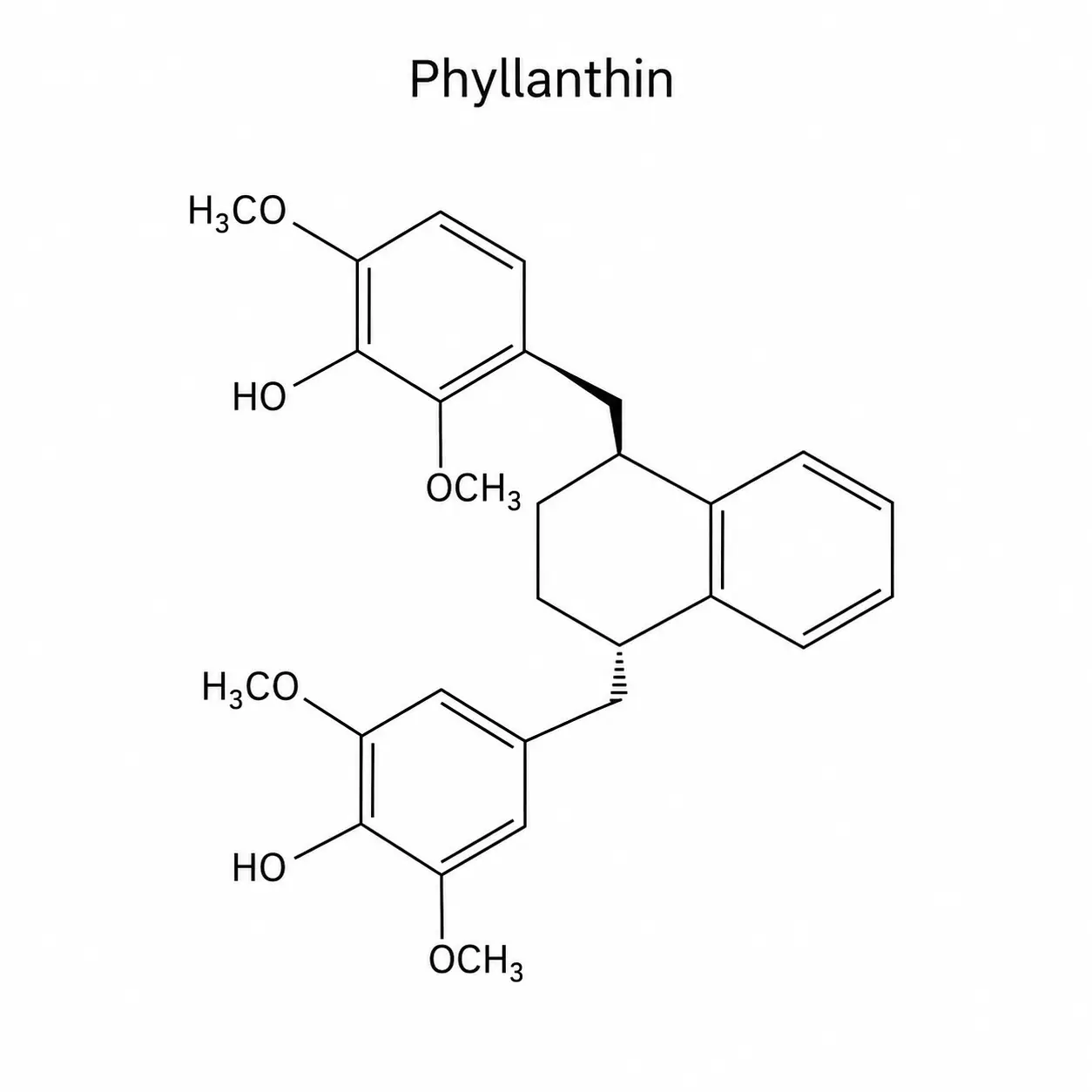
- Phyllanthin — the lead marker compound for standardization; hepatoprotective via membrane stabilization and TNF-alpha suppression; mechanism-based inhibitor of CYP3A4; direct P-glycoprotein inhibitor in Caco-2 cells (effect lost on washout, suggesting reversible binding); highly permeable (transcellular passive diffusion); plasma-detectable for >10 hours after oral dosing in rats.
- Hypophyllanthin — companion to phyllanthin; similar pharmacology with overlapping hepatoprotection; recent evidence of distinct contributions to anti-inflammatory pathways.
- Niranthin — the principal driver of HBV polymerase / reverse-transcriptase inhibition; also contributes to the uricosuric effect.
- Nirtetralin — supports the antiviral profile; less studied than the other three.
Lignan concentrations vary by species: P. amarus typically has the highest combined phyllanthin + hypophyllanthin + niranthin content, which is part of why it dominates the hepatitis B trial literature.
Ellagitannins: Geraniin, Corilagin, Ellagic Acid
The ellagitannins are large polyphenols that drive most of the antioxidant and anti-crystallization activity.
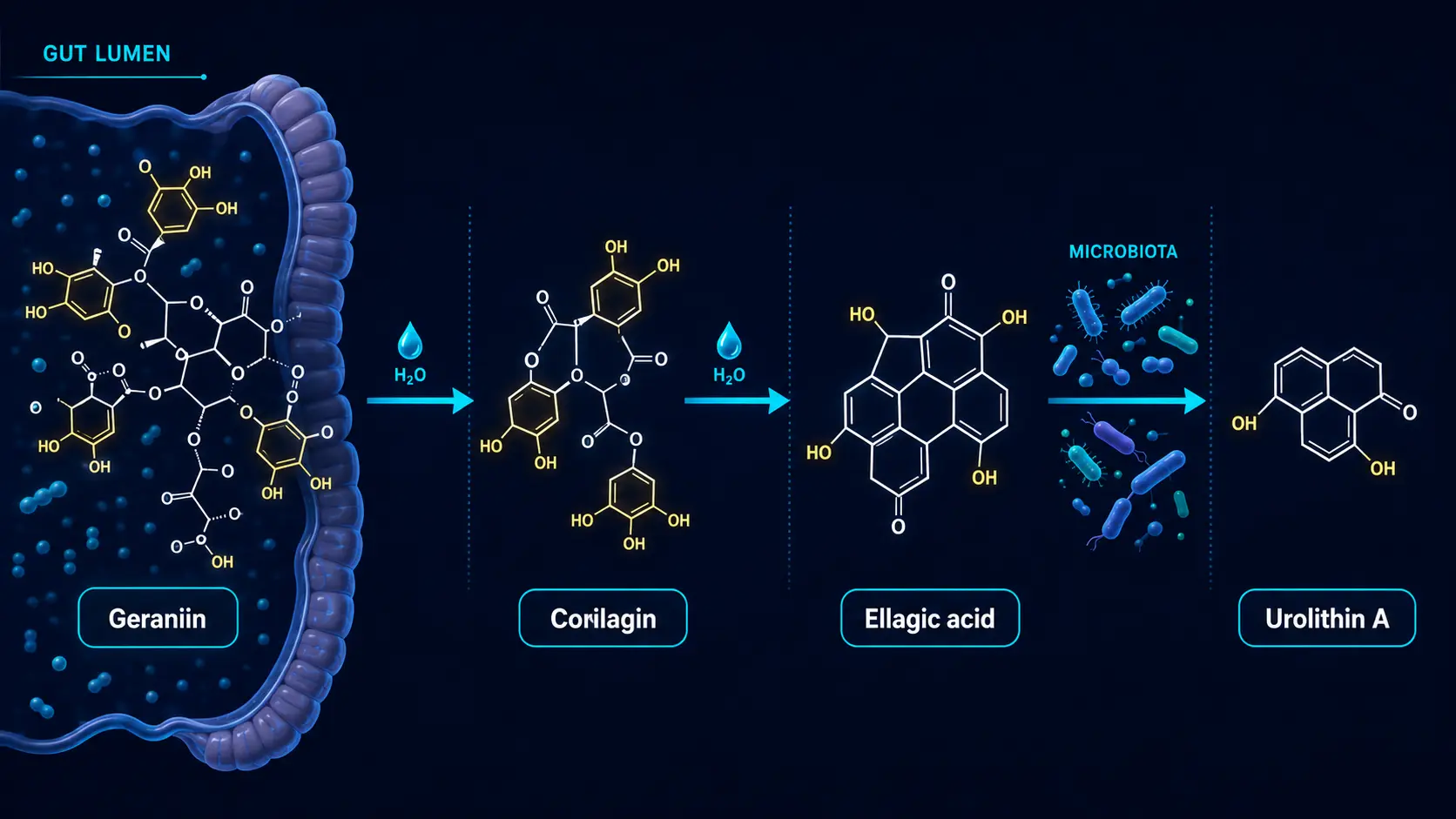
- Geraniin — the signature ellagitannin, approximately 1–4% dry weight in P. urinaria. Antioxidant powerhouse via its hexahydroxydiphenoyl (HHDP) and dehydrohexahydroxydiphenoyl (DHHDP) groups. Native bioavailability is poor (too polar/large to cross enterocytes); active forms are gut metabolites — geraniin hydrolyzes in the GI tract to corilagin, ellagic acid, brevifolin, and gallic acid, which are then further converted to urolithins by intestinal bacteria. Antiviral, anti-inflammatory.
- Corilagin — a primary geraniin breakdown product. Anti-inflammatory via NF-kappaB suppression; antiviral; inhibits calcium oxalate crystal aggregation — likely the primary kidney-stone effect driver alongside geraniin itself. Also anti-fibrotic in liver models.
- Ellagic acid and ellagitannins — antioxidant, anti-mutagenic. Like geraniin, much of the bioactivity is from microbiota-derived urolithins (urolithin A and B), not the parent compounds.
Flavonoids: Rutin, Quercetin, Niruretin
Secondary contributors to the overall pharmacology:
- Rutin — glycosylated quercetin; mild xanthine oxidase inhibition; capillary support and anti-edema effects.
- Quercetin glycosides — antioxidant, mast-cell stabilization, antihistamine activity.
- Niruretin — a Chanca Piedra-specific flavonoid; antioxidant; modest contribution to glucose-lowering via alpha-glucosidase inhibition and AMPK activation.
Compound → Effect Mapping
Which compound drives which effect:
- Kidney stones — corilagin + geraniin (crystal-aggregation inhibition); triterpenes (antilithogenic); lignans add a uricosuric push (urinary uric-acid clearance up to 11-fold in animal models)
- Hepatitis B — niranthin, nirtetralin, phyllanthin (HBV polymerase / reverse-transcriptase inhibition)
- Liver protection (non-viral) — phyllanthin + hypophyllanthin (membrane stabilization, antioxidant)
- Xanthine oxidase inhibition / uric acid — flavonoids (rutin, quercetin glycosides) drive XO inhibition; lignans add uricosuric effect
- Glucose lowering — flavonoids + corilagin (insulin-sensitizing); flavonoids drive alpha-glucosidase inhibition
- Hypertension / ACE-like activity — geraniin + corilagin via tannin-zinc chelation at the ACE active site
- Antioxidant capacity — geraniin and downstream urolithin metabolites; flavonoids contribute
Bioavailability and Microbiota Activation
Phyllanthus pharmacokinetics are a study in why "what's in the supplement bottle" doesn't equal "what reaches your bloodstream":
- Phyllanthin and hypophyllanthin are absorbed across the intestinal epithelium reasonably well via passive diffusion. They reach plasma but undergo extensive Phase I metabolism. Half-life is several hours in rats; human PK data are limited.
- Geraniin is too polar and large to cross enterocytes intact — native bioavailability is essentially zero. The active forms are downstream metabolites, produced by:
- Hydrolysis in stomach acid → corilagin + ellagic acid
- Further hydrolysis → brevifolin, gallic acid, smaller phenolics
- Intestinal microbiota conversion of ellagic acid → urolithin A and urolithin B (the actually-absorbed bioactive forms)
- Urolithin A in particular has its own developing research base for mitochondrial health, anti-inflammatory effects, and longevity. Chanca Piedra is one dietary source; pomegranate and walnuts are others.
This pathway has two important consequences. First, gut microbiota composition matters — not everyone produces urolithins efficiently, which may explain some inter-individual variability in response. Second, isolated geraniin or corilagin extracts are not the same as whole-herb preparations, because the gut conversion is part of the therapeutic activation.
CYP450 and P-Glycoprotein Effects
Phyllanthus modulates several drug-metabolizing systems in ways that matter clinically:
- CYP3A4 (mechanism-based inhibition) — phyllanthin and hypophyllanthin bind CYP3A4 in a way that produces irreversible enzyme suicide; effect persists until new enzyme is synthesized (hours to days). This is the most clinically important interaction pathway.
- CYP2C9 — inhibition; relevant for warfarin, NSAIDs, certain anticonvulsants
- CYP1A2, CYP2D6, CYP2E1 — lesser inhibition, but documented
- P-glycoprotein — phyllanthin and hypophyllanthin are direct P-gp inhibitors in Caco-2 cells (no MRP2 effect). P-gp inhibition raises plasma levels of P-gp-substrate drugs (digoxin, certain calcium-channel blockers, some antiretrovirals)
For the practical drug-interaction list, see Safety & Drug Interactions.
Standardization Markers in Practice
Reputable extracts are typically standardized to:
- 3–5% phyllanthin — most common
- "Total lignans 5%" (phyllanthin + hypophyllanthin combined) — alternative
- 10:1 full-spectrum extract — concentration ratio rather than marker compound
What's missing from most labels: ellagitannin / geraniin content. This is a meaningful gap because corilagin and geraniin drive much of the kidney-stone activity. Look for HPLC-verified phyllanthin ≥3% AND a stated tannin or geraniin specification when possible. Most products don't provide it; the buyer is left trusting that whole-herb sourcing has captured the tannin fraction along with the lignans.
Species Chemotypes
- P. amarus — highest phyllanthin, hypophyllanthin, niranthin (best for hepatoprotection / HBV claims)
- P. niruri (true) — high hypophyllanthin and phenolics
- P. urinaria — highest geraniin and corilagin; richer ellagitannin profile (best for stone prevention and antioxidant claims). One recent study suggests P. urinaria may also have the highest phyllanthin content, contradicting older literature
These are commonly conflated on commercial labels — "Chanca Piedra" can be any of the three, often without clear identification. See Phyllanthus Species Comparison.
Whole Herb vs Isolated Extract
For Chanca Piedra, the whole-herb argument is more than marketing rhetoric:
- The native geraniin → microbiota → urolithin cascade is the entire bioavailability pathway. Bypassing the intact ellagitannins (with isolated phyllanthin only) loses this
- Phyllanthin and hypophyllanthin act synergistically, not additively, in some pharmacological assays (e.g., doxorubicin re-sensitization studies)
- Corilagin's anti-fibrotic activity complements phyllanthin's hepatoprotection
- The flavonoid contribution to xanthine oxidase inhibition is lost in lignan-only extracts
For most clinical uses, a standardized whole-herb extract (3–5% phyllanthin from a quality-tested source) is the right balance of consistency and full pharmacology. Isolated phyllanthin or isolated geraniin products are research tools, not therapeutic forms.
Research Papers and References
- Phyllanthus pharmacokinetics — PubMed
- Phyllanthin and CYP3A4 — PubMed
- Geraniin bioavailability & urolithin — PubMed
- Corilagin & calcium oxalate — PubMed
- Niranthin and HBV — PubMed
- Phyllanthus uricosuric mechanism — PubMed
- P. urinaria ellagitannin chemotype — PubMed
- Phyllanthin and P-glycoprotein — PubMed
Connections
- All Herbs
- Chanca Piedra Overview
- Phyllanthus Species Comparison
- Kidney Stone Protocol
- Liver Protection and Hepatitis B
- Blood Sugar and Metabolic Effects
- Uric Acid, Gout and Hypertension
- Forms, Dosing and Standardization
- Safety and Drug Interactions
- Quercetin
- Oxidative Stress
- Kidney Stones
- Hepatitis B
- Milk Thistle
- Uric Acid
- Calcium
- History Traditional Use and Botany