Phyllanthus Species: niruri vs amarus vs urinaria - Why It Matters What's in the Bottle
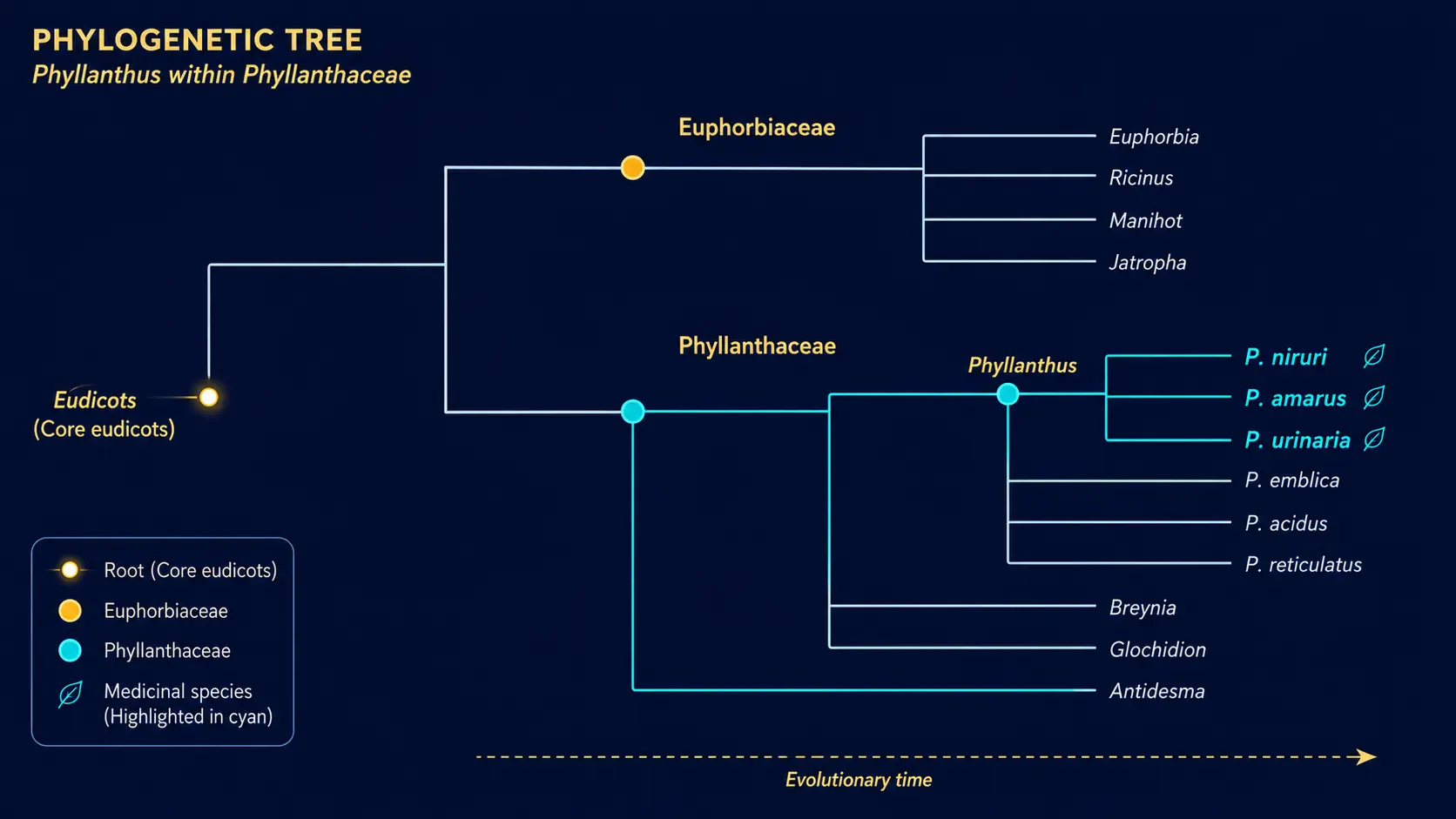
"Chanca Piedra" is a common name applied loosely to three closely related species in the Phyllanthaceae family: Phyllanthus niruri, Phyllanthus amarus, and Phyllanthus urinaria. They look almost identical, share many active compounds, and have substantially overlapping traditional uses — but their relative concentrations of lignans and ellagitannins differ enough to matter for some indications. Many supplement labels conflate the three, often without clear identification. This page maps the species to their dominant chemistry, traditional ranges, and the indications where each shines.
Table of Contents
The Three Species
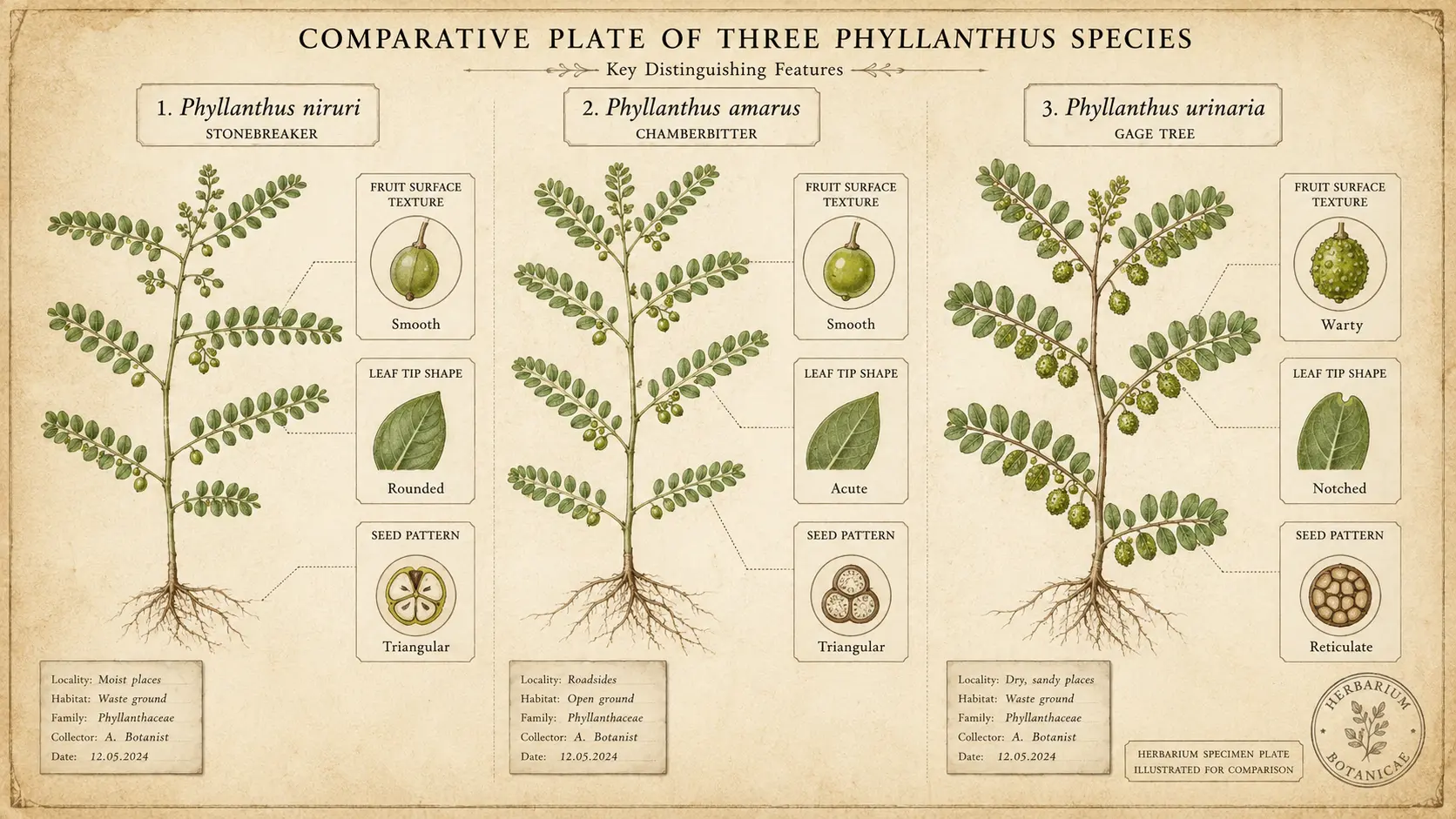
All three are small annual herbs in the genus Phyllanthus (Phyllanthaceae family), characterized by tiny seed capsules tucked under each leaf along thin branching stems. They overlap geographically across tropical and subtropical regions of the Americas, Asia, and Africa. Distinguishing them in the field requires close attention to fruit surface texture, leaf tip shape, and seed pattern — not trivial without botanical training.
Old taxonomy was inconsistent. Many papers from the 1970s through the early 2000s labeled their plant material "P. niruri" when it was actually P. amarus or a different species. Modern phytochemical analysis and DNA barcoding have helped clean this up, but the supplement industry has been slower to catch up.
Phyllanthus niruri
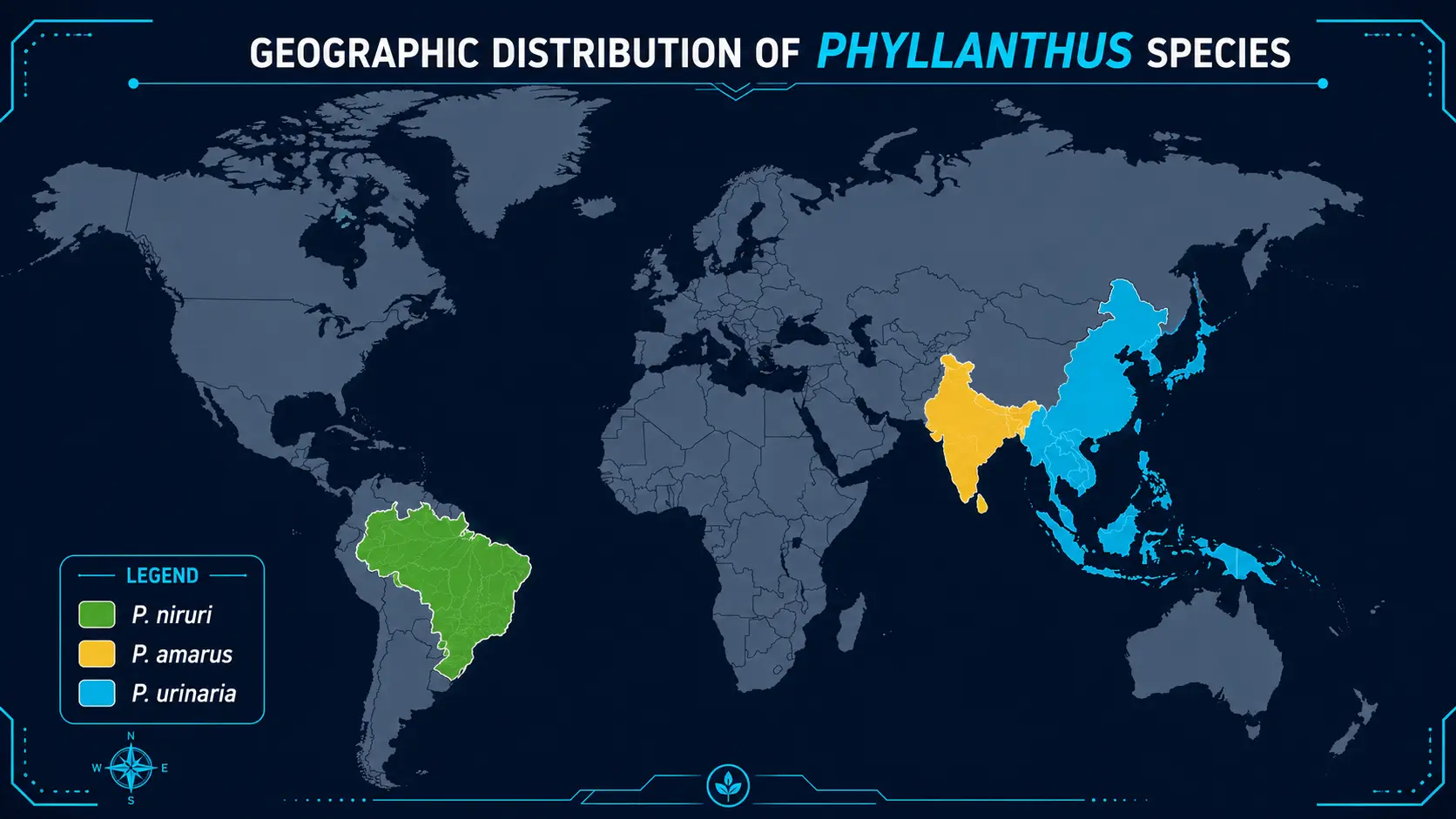
The species most commonly labeled "Chanca Piedra" in the United States and Latin America. Native range: tropical Americas (Amazon basin, Caribbean, Central America), with naturalized populations in tropical Africa and Asia. Traditional uses span Amazonian indigenous medicine (the original "stone breaker" tradition), Caribbean and Central American folk practice, and South American naturopathic protocols.
Chemistry: high in hypophyllanthin and phenolics; moderate phyllanthin content. Recent analyses suggest P. niruri has a richer ellagitannin profile than once thought, narrowing the gap with P. urinaria.
Best evidence base: kidney stones (the Brazilian Nishiura and Micali trials used P. niruri), urinary tract support, general detoxification.
Phyllanthus amarus
The species most heavily studied for hepatitis B. Native range: India, Southeast Asia, with secondary populations in tropical Africa and the Americas. The Ayurvedic tradition uses it under the name bhumi amla ("earth gooseberry") for liver, kidney, and digestive complaints. The Thyagarajan 1988 Lancet paper that ignited the modern HBV literature used P. amarus from Indian sources.
Chemistry: highest combined phyllanthin + hypophyllanthin + niranthin content among the three species. Strong antiviral lignan profile.
Best evidence base: hepatitis B (the entire Cochrane review's HBV trials center on P. amarus or P. amarus-dominant preparations), other viral hepatitis (HCV preliminary), drug-induced hepatotoxicity. Many older "P. niruri" hepatitis papers were taxonomically reclassified as P. amarus after the 1990s.
Phyllanthus urinaria
The species most studied in Chinese and Taiwanese pharmacology research. Native range: East and Southeast Asia, with tropical American populations. Traditional Chinese medicine uses it for urinary disorders, jaundice, and inflammation.
Chemistry: highest geraniin and corilagin content among the three species; richest ellagitannin profile. Substantial flavonoid content.
Best evidence base: in-vitro HBV polymerase inhibition (the strongest of the three species in lab assays), antioxidant activity, anti-inflammatory effects, kidney stone anti-crystallization (mechanism-driven by corilagin and geraniin). Also has the most cancer-related preclinical research.
Chemotype Comparison Table
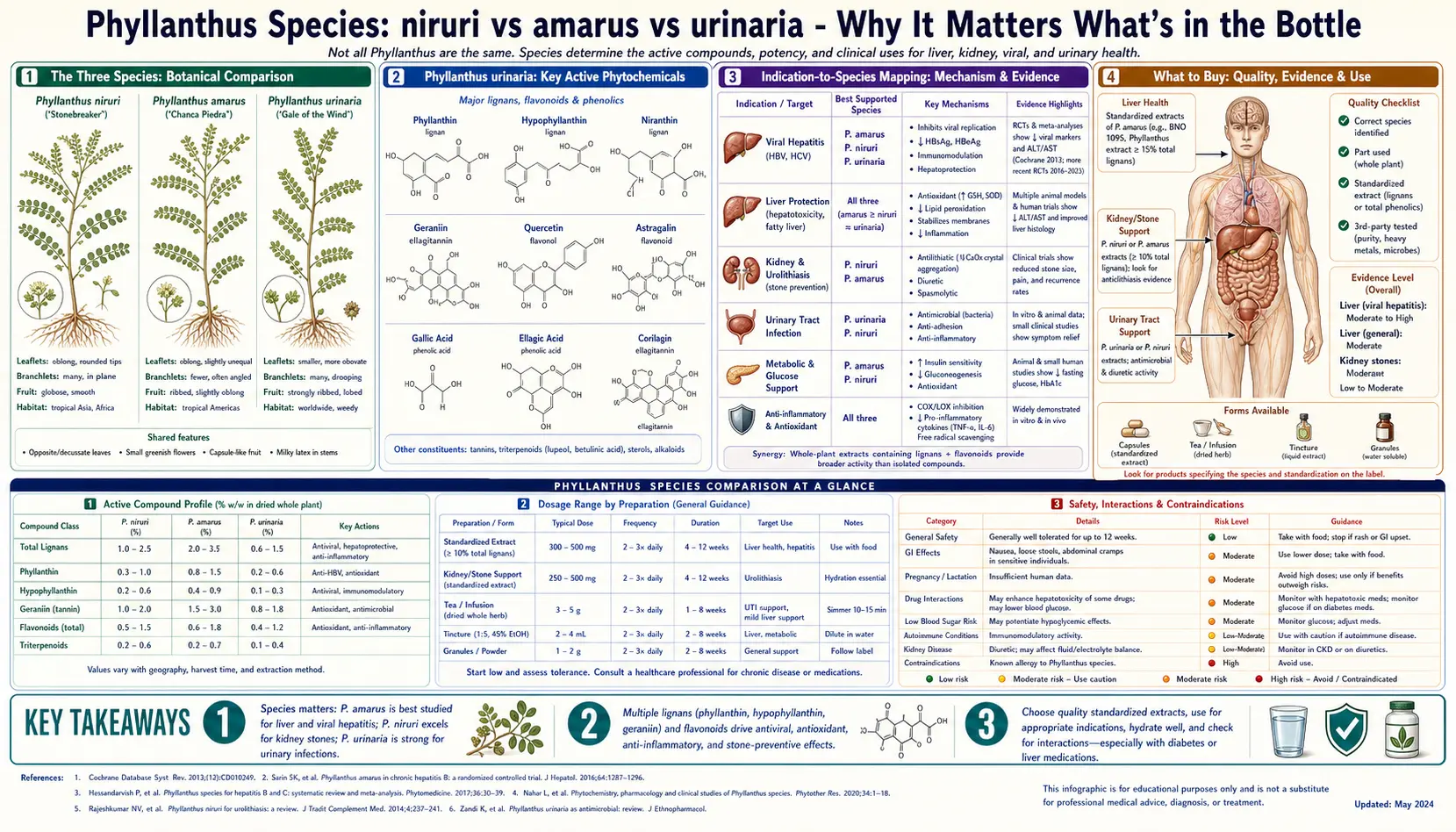
| Compound | P. niruri | P. amarus | P. urinaria |
|---|---|---|---|
| Phyllanthin | Moderate | High | Variable (some studies high) |
| Hypophyllanthin | High | High | Moderate |
| Niranthin | Low-moderate | High | Low |
| Geraniin | Moderate | Moderate | High (1-4% dry wt) |
| Corilagin | Moderate | Moderate | High |
| Ellagic acid | Moderate | Moderate | High |
| Rutin / Quercetin | Moderate | Moderate | Moderate-high |
This is a generalization — concentrations vary by growing conditions, plant age, harvest season, and processing method. A high-quality P. niruri from one source can have higher phyllanthin than a poorly-grown P. amarus.
Indication-to-Species Mapping
- Kidney stones: P. niruri has the strongest clinical trial base (Brazilian Nishiura and Micali studies). P. urinaria has the strongest mechanistic case (geraniin and corilagin-driven anti-crystallization). Either is reasonable; many products combine the two.
- Hepatitis B (adjunct only): P. amarus has the dominant trial base. The strongest in vitro HBV polymerase inhibition has been reported for P. urinaria, but this hasn't been confirmed in human trials. Look for "P. amarus" specifically.
- Non-viral liver protection (NAFLD, drug-induced): any of the three; the lignan profile drives most of this effect.
- Uric acid / gout / mild hypertension: any of the three; the active compounds (flavonoids, geraniin, corilagin) are present in all.
- Blood sugar / metabolic: any of the three; the effect size is modest regardless.
- General antioxidant / wellness: P. urinaria has the richest ellagitannin profile.
Why Labeling Is a Mess
Common labeling problems on commercial Chanca Piedra products:
- "Chanca Piedra" with no species — could be any of the three (or a mixture)
- "Phyllanthus niruri" with no DNA verification — commonly mis-IDed as P. amarus or other species
- "Phyllanthus extract" — even less specific
- Mixed species — some traditional preparations and some modern supplements deliberately combine all three; the synergy argument is plausible but the dosing of any single species becomes uncertain
- Geographic origin — Brazilian-sourced is more likely P. niruri; Indian-sourced is more likely P. amarus; Chinese-sourced is more likely P. urinaria. But this is a probability, not a guarantee.
The supplement industry has been slow to require DNA-verified species identification. Until it does, the consumer is left with a degree of uncertainty.
Botanical Identification Markers
For botanically-inclined readers, the three species can be distinguished by:
- P. niruri: smooth fruit capsules, leaves with rounded tips, seeds with longitudinal ribs
- P. amarus: smooth fruit capsules with smaller seeds, leaves with more pointed tips, seeds with transverse ridges
- P. urinaria: warty / verrucate fruit capsule surface (the most distinguishing feature), reddish-tinged stems often, leaves slightly larger
The fruit surface is the most reliable single field marker. Smooth = niruri or amarus; warty = urinaria.
What to Buy
For most general uses (kidney stone prevention, mild hypertension, general "Chanca Piedra benefits"), a quality P. niruri standardized to 3–5% phyllanthin from a USP/NSF/ConsumerLab-tested manufacturer is a reasonable choice. Brazilian and South American sources are most likely to be true P. niruri.
For hepatitis B adjunct use specifically, look for P. amarus or "P. niruri (syn. amarus)" with the same standardization. Indian sources are most likely true P. amarus.
For maximum ellagitannin / antioxidant content, P. urinaria is the strongest. Asian-sourced products are most likely true P. urinaria.
If a product label doesn't specify species, doesn't standardize, doesn't have third-party testing, and doesn't disclose source — choose a different product.
Key Research Papers
Connections
- All Herbs
- Chanca Piedra Overview
- Active Compounds
- Forms, Dosing and Standardization
- Kidney Stone Protocol
- Liver Protection and Hepatitis B
- History and Traditional Use
- Blood Sugar and Metabolic Effects
- Safety and Drug Interactions
- Uric Acid, Gout and Hypertension
- Hepatitis B
- Kidney Stones
- Hepatitis
- Hypertension
- Uric Acid
- Jaundice
- Milk Thistle
- Nhan Tran (Adenosma caeruleum) — the same what-is-actually-in-the-bottle problem in a Vietnamese liver herb: three unrelated plants across two families share the name nhân trần, and nearly all the published research belongs to only one of them.
Featured Videos