CAC Scan Cost, Insurance Coverage, and Access in the US
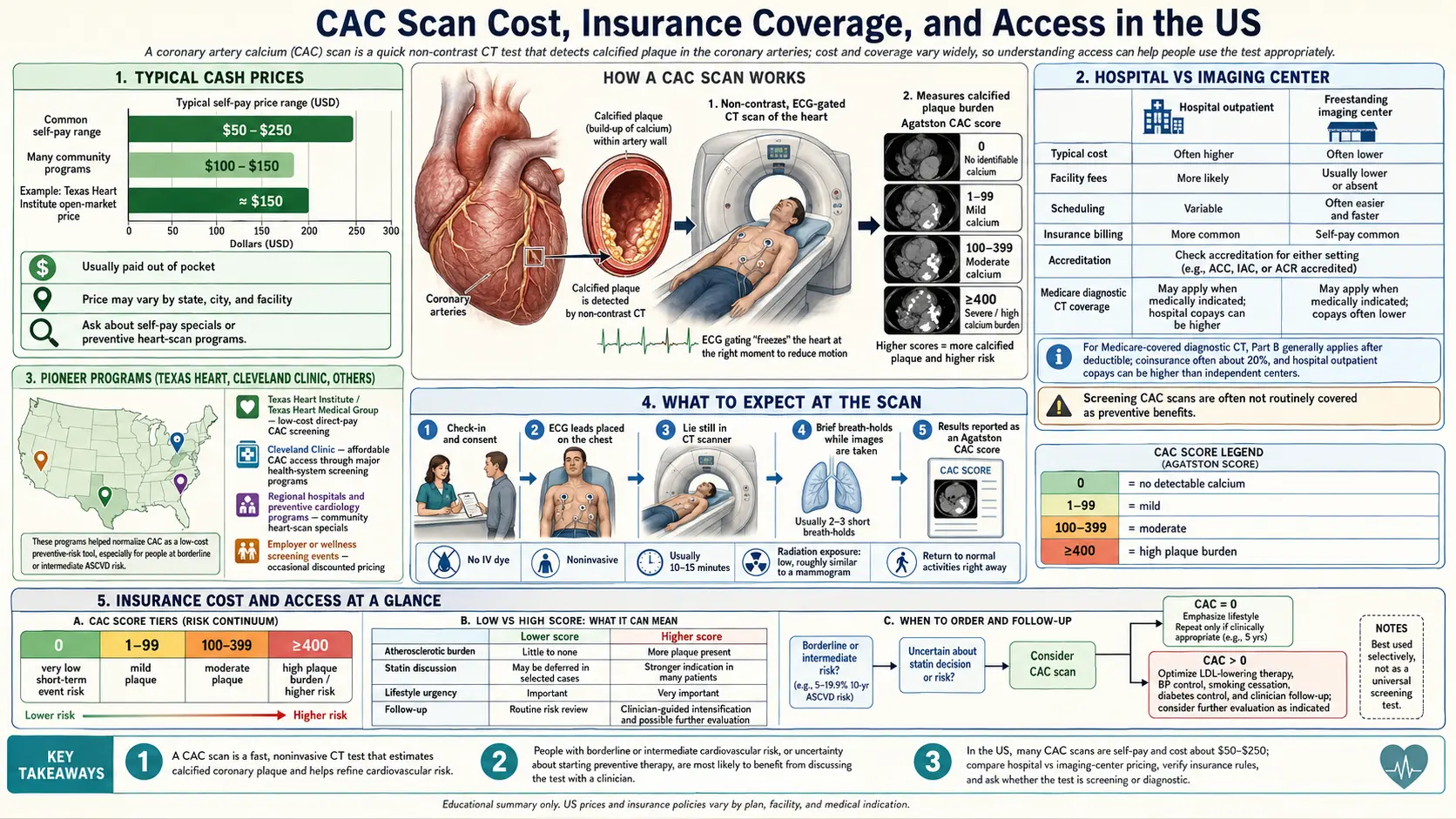
The coronary calcium scan is unusual in healthcare: it is one of the cheapest and most evidence-rich preventive imaging tests available, and it is also one of the most consistently uncovered by US insurance. Cash prices typically run $99 to $200, the test is HSA/FSA-eligible, and many imaging centers will perform it without a physician referral. This page covers what to expect at the imaging center, how to navigate the insurance landscape, where to actually schedule the test, and the situations where insurance coverage is more likely.
Table of Contents
- Typical Cash Prices
- Insurance Coverage Landscape
- HSA, FSA, and Tax Considerations
- Hospital vs Imaging Center
- Self-Referral Centers
- Pioneer Programs (Texas Heart, Cleveland Clinic, others)
- Medicare and CAC
- International Pricing
- What to Expect at the Scan
- Research Papers and References
- Connections
- Featured Videos
Typical Cash Prices
Cash prices for a coronary calcium scan in the United States as of 2025–2026:
- $99–$150 — promotional pricing at preventive cardiology centers (HeartHealth, HeartScan, regional hospital systems running heart-month specials)
- $150–$250 — standard imaging-center cash price
- $250–$500 — hospital outpatient pricing
- $500–$1,200 — hospital inpatient or anchor-of-care pricing (avoid)
The radiology technical work is essentially identical across these settings; the price differences reflect facility billing structure rather than scan quality. The same 64-slice CT scan with identical protocols generates the same Agatston score whether you pay $99 or $1,200.
Insurance Coverage Landscape
US insurance coverage for CAC has been frustrating for years. The pattern:
- Most commercial insurance: not covered for asymptomatic primary prevention. The USPSTF "I" rating (insufficient evidence to recommend for or against) gives insurers cover to deny.
- Some employer plans: coverage as a wellness benefit if specifically negotiated
- HMO networks (e.g., Kaiser): sometimes cover within their integrated systems
- Medicare: generally does not cover CAC for primary prevention; some local coverage decisions allow it under specific circumstances
- Medicaid: rarely covers
- Medicare Advantage: some plans include CAC as a wellness benefit
The lack of coverage is widely viewed as inconsistent with the evidence. ACC, AHA, and SCCT all support CAC's clinical utility, and the test would likely be cost-effective at the population level. As of 2025, multiple Congressional and CMS efforts have explored Medicare coverage; none have changed national policy yet.
HSA, FSA, and Tax Considerations
The good news on the financial side:
- HSA (Health Savings Account) — CAC is HSA-eligible. Use pre-tax dollars from an HSA to pay for the scan; effective discount of 22–37% for most patients depending on tax bracket.
- FSA (Flexible Spending Account) — same eligibility; use FSA funds for the scan
- HRA (Health Reimbursement Arrangement) — varies by plan; check with employer benefits
- Medical expense tax deduction — out-of-pocket CAC costs that, combined with other medical expenses, exceed 7.5% of AGI may be deductible (Schedule A)
Most imaging centers accept HSA/FSA debit cards directly. Save the receipt with the procedure code for documentation.
Hospital vs Imaging Center
The same scan can cost wildly different amounts at a hospital outpatient department vs a freestanding imaging center vs a self-referral cardiac scan center. Why:
- Hospital outpatient billing includes facility fees that imaging centers don't have
- Hospital scanners are often used for high-acuity inpatient cases; the equipment is amortized differently
- Self-referral scan centers run high-volume, single-protocol operations specifically for CAC
For a routine CAC in an asymptomatic patient, a freestanding imaging center or self-referral cardiac scan center is almost always the better choice. Check pricing transparency requirements: as of 2024, hospitals must publish negotiated rates and cash prices online.
Self-Referral Centers
Many cardiac imaging centers and some hospital systems offer "self-pay heart scans" without a physician referral. The patient schedules directly, pays cash, gets the scan, and receives the report. Examples:
- Cleveland Clinic Heart Health Plus (varies by location)
- HeartScan (Texas, multi-state)
- Mercy Health Heart Scan programs
- Many regional cardiology groups offering "heart month" promotions
Self-referral is appropriate for asymptomatic adults wanting risk stratification. The trade-off: there is no physician guidance on interpreting the result. Most centers include a follow-up letter and offer cardiology consultation if the score is high. For symptomatic patients, work with a physician rather than self-referring.
Pioneer Programs (Texas Heart, Cleveland Clinic, others)
Several US health systems have made CAC scoring widely accessible:
- Texas Heart Institute — offers $100 cash CAC scans through community programs
- Cleveland Clinic — offers structured CAC programs as part of preventive cardiology
- Mayo Clinic — CAC available within their preventive cardiology pathways
- Banner Health (AZ), Sentara (VA), Northwell (NY), Sutter (CA) — regional self-pay CAC programs at $99–$199
- Many non-academic imaging chains (RadNet, Akumin, Outpatient Imaging Affiliates) — offer self-pay CAC at competitive cash prices
The pioneer programs have demonstrated that high-quality CAC at low cash price is operationally feasible; the persistent lack of insurance coverage is increasingly out of step with both the evidence and the cost reality.
Medicare and CAC
Medicare's relationship with CAC is in flux. As of 2025–2026:
- National coverage for asymptomatic primary prevention CAC is not yet established
- Local Coverage Determinations vary by state; some allow CAC in specific clinical scenarios
- CAC during a lung-cancer screening LDCT (low-dose CT) is sometimes added at minimal incremental cost; some Medicare contractors cover the LDCT and report the CAC as a finding
- Medicare Advantage plans increasingly add CAC as a covered wellness benefit
- Medicare patients can pay cash for CAC at non-Medicare-billing imaging centers if their plan won't cover it
Asymptomatic Medicare beneficiaries who want CAC scoring should check their specific plan's Local Coverage Determinations and consider self-pay if not covered. The cost is the same modest cash price either way.
International Pricing
For comparison, CAC pricing in selected countries (cash, English-language imaging centers):
- Canada: CAD $300–$600 cash; not covered by most provincial plans for asymptomatic primary prevention
- UK: £200–£400 private; NHS does not routinely cover
- Australia: AUD $200–$400; may be partially Medicare-covered with appropriate referral
- Germany: €200–€400 private; statutory health insurance covers in specific clinical scenarios
- India, Mexico, Thailand: $50–$150 in major medical-tourism centers
- Japan, Singapore: $200–$400
What to Expect at the Scan
- No prep needed — you can eat, drink coffee, exercise normally that day
- No IV contrast — this is a non-contrast CT
- Wear loose, metal-free clothing — gown often not needed
- EKG leads placed — small electrodes on the chest for cardiac gating
- Lie still on the scanner bed — arms above head
- Hold breath for 10–15 seconds — one or two breath-holds during the actual scan
- Total time — 10–15 minutes; the scan itself is ~10 seconds
- Radiation dose — ~1 mSv (one year of background; one mammogram)
- Results — usually within 24–72 hours; many centers offer same-day reports
- Format — Agatston score, vessel breakdown, MESA percentile, brief interpretation
If the radiology report is hard to interpret on your own, the next step is a 15-minute telehealth consultation with a primary care physician or cardiologist who can integrate the score with your other risk factors.
Research Papers and References
- CAC cost-effectiveness analyses — PubMed search
- CAC insurance coverage — PubMed search
- CAC on lung-cancer screening LDCT — PubMed search
External Authoritative Resources
Connections
- All Lab Tests
- Coronary Calcium Score
- Agatston Score Calculation and Interpretation
- MESA Risk Calculator and Age Percentiles
- CAC Zero and the Power of Negative Result
- Statin Threshold and CAC
- CAC in Women and Younger Adults
- CAC vs Other Cardiac Tests
- Soft Plaque and CAC Limitations
- Reversal Plaque Stabilization and Lifestyle
- ApoB
- Lipoprotein(a)
- Lipid Panel
- Cancer