Gerson Juicing Recipes
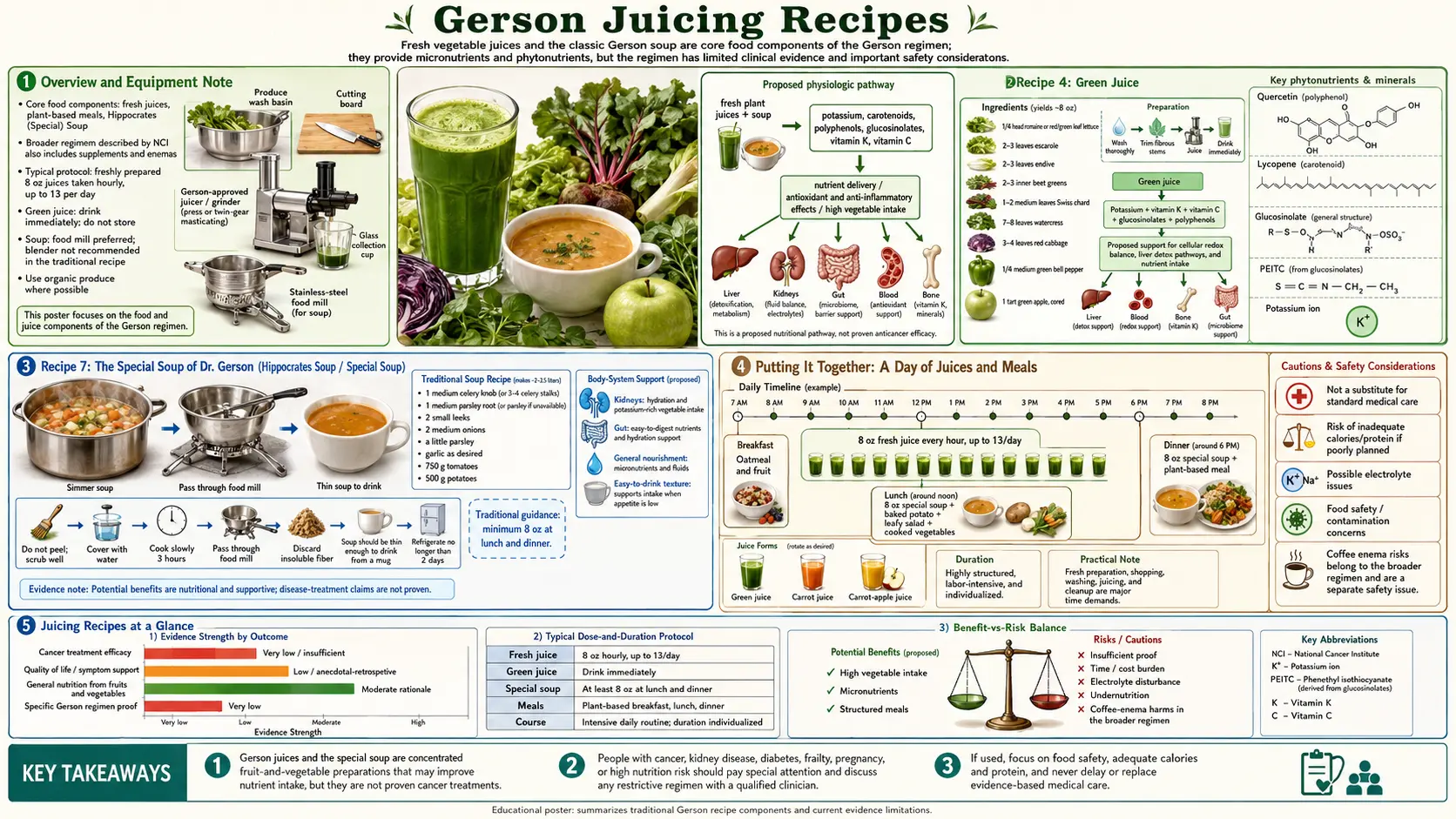
Table of Contents
- Overview and Equipment Note
- Recipe 1: Orange Juice (Breakfast)
- Recipe 2: Apple-Carrot Juice
- Recipe 3: Pure Carrot Juice
- Recipe 4: Green Juice
- Recipe 5: Grapefruit Juice (Optional)
- Recipe 6: Hippocrates Soup
- Recipe 7: The Special Soup of Dr. Gerson
- Recipe 8: Gerson Oatmeal
- Recipe 9: Baked Potato
- Recipe 10: Flax-Oil Salad Dressing
- Putting It Together: A Day of Juices and Meals
- Key Research and Sources
- Featured Videos
Overview and Equipment Note
Every juice on this page assumes a two-step grinder-and-press juicer (Norwalk, Pure Juicer, or a Champion grinder paired with a hydraulic press). Yields will be lower with single-stage masticating juicers and substantially lower with centrifugal juicers; see the Juicing page. All produce must be organic. All juices are drunk within 10 minutes of pressing. Volumes given are per glass (8 fluid ounces / 240 mL).
Recipe 1: Orange Juice (Breakfast)
- Yield: 1 glass (8 oz)
- Ingredients: 4–6 organic juice oranges (Valencia or navel), depending on size
- Method: Hand-squeezed in a glass or porcelain reamer. Do not use an aluminum citrus reamer. Strain through a fine non-metallic sieve. Drink immediately.
- Pairs with: oatmeal and fruit at the breakfast meal.
- Notes: The only juice in the protocol that is hand-squeezed rather than pressed. Citrus oils in the peel are mildly irritating and are kept out by avoiding excessive zest contamination.
Recipe 2: Apple-Carrot Juice
- Yield: 1 glass (8 oz)
- Ingredients: ~8 oz organic carrots, ~6 oz organic apples (a sweet variety such as Gala, Fuji, or Golden Delicious; not Granny Smith for this juice)
- Method: Wash carrots, scrub but do not peel. Quarter apples and remove the core (apple seeds contain trace amygdalin and are removed for the children’s version of the protocol; for adults the practice varies). Run carrots and apples together through the grinder, then press the combined pulp.
- Frequency: Three times per day in the standard schedule.
- Notes: The apple sweetens the juice and provides quercetin and pectin. Roughly 1:1 by volume of input produce yields the right balance.
Recipe 3: Pure Carrot Juice
- Yield: 1 glass (8 oz)
- Ingredients: ~1 pound (450 g) organic carrots per glass
- Method: Scrub carrots; do not peel; trim off green tops (the tops are bitter and contain alkaloids). Grind, press, drink within 10 minutes.
- Frequency: Three to four times per day.
- Notes: Beta-carotene-rich; chronic high intake may produce harmless skin yellowing (carotenodermia) which fades when intake decreases. Patients on high carrot intake should have liver function and vitamin A status checked periodically by their physician.
Recipe 4: Green Juice
- Yield: 1 glass (8 oz)
- Ingredients (per glass):
- 2 medium leaves of romaine lettuce
- 2 medium leaves of escarole
- 2 medium leaves of endive (Belgian or curly)
- 2–3 leaves of beet tops (the green leaves of beetroot)
- 4–5 sprigs of watercress
- 2 leaves of red cabbage
- 1/4 of a green bell pepper (not red; red is reserved for cooking)
- 1/4 of an organic apple
- Method: Wash all greens carefully. Roll the leaves into bundles, alternating with the apple wedge to push fibrous greens through the grinder. Press the resulting pulp.
- Frequency: Four times per day.
- Notes: The mineral and chlorophyll workhorse of the protocol. The apple is a sweetener and helps the leaves feed through the grinder; substitution with a more potent sweetener (carrot, beet) is not done because the green juice is meant to be the “low-sugar” juice of the day.
Recipe 5: Grapefruit Juice (Optional)
- Yield: 1 glass (8 oz)
- Ingredients: 2–3 organic ruby red or pink grapefruit
- Method: Hand-squeezed and strained.
- Use: Occasional substitute for orange juice in patients who tolerate it well and are not on hepatically metabolized medications. Important contraindication: grapefruit juice inhibits cytochrome P450 3A4 and significantly raises blood levels of many drugs (statins, certain calcium-channel blockers, immunosuppressants, several chemotherapy agents). Patients on any prescription medication must clear grapefruit with their physician.
Recipe 6: Hippocrates Soup
The cornerstone of the cooked-food side of the diet. Eaten at lunch and at dinner, ad libitum.
- Yield: About 2 quarts (1.9 L), 4–6 servings
- Ingredients:
- 1 medium parsley root (celeriac may be substituted if parsley root is unavailable)
- 1 small celeriac (or 3–4 stalks of celery if celeriac is unavailable)
- 2 medium leeks (white and light-green parts)
- 2 large onions
- 4–6 cloves of garlic
- 2 medium tomatoes (or one 14-oz can of organic tomatoes if winter forces it)
- 2 medium potatoes
- A small handful of flat-leaf parsley
- Distilled water to cover (about 6 cups)
- Method: Wash and quarter all vegetables. Place in a stainless-steel or enameled pot (no aluminum), cover with distilled water, bring to a boil, then reduce to a gentle simmer for 1.5 to 2 hours. Push the entire contents through a food mill (a fine-mesh sieve will work but will lose some solids). Discard fibrous remnants. Reheat to serve. No salt.
- Storage: Refrigerate up to 48 hours in covered glass containers. Do not freeze for the strict protocol.
Recipe 7: The Special Soup of Dr. Gerson
A kidney-supportive variant. The proportions emphasize parsley root and celeriac and reduce potato content.
- Ingredients: 1 large parsley root, 1 large celeriac, 2 leeks, 2 onions, 6 cloves of garlic, 2 tomatoes, 1 small potato, a handful of parsley, distilled water to cover.
- Method: Same as Hippocrates soup — simmer 1.5–2 hours, food-mill, serve.
- Use: For patients with kidney involvement or with high circulating potassium where the standard soup is too potato-heavy.
Recipe 8: Gerson Oatmeal
- Yield: 1 serving
- Ingredients: 1/2 cup organic rolled or steel-cut oats, 1.5 cups distilled water, no salt, no milk, no sugar.
- Method: Bring water to a boil, add oats, reduce heat, simmer until thick (5 minutes for rolled, 20 minutes for steel-cut). Serve with stewed fruit or fresh fruit on top, with a drizzle of organic honey or maple syrup if permitted at the patient’s stage.
- Notes: Eaten at breakfast with the orange juice. Provides slow-digesting carbohydrate, soluble beta-glucan fiber, and a hearty start to a day that will be largely liquid.
Recipe 9: Baked Potato
- Ingredients: 1 medium organic russet or Yukon Gold potato per person.
- Method: Wash and prick with a fork. Bake at 400°F (200°C) for about 60 minutes until the skin is crisp and the interior soft. Eat the skin (rich in potassium and resistant starch). No butter, no salt; a small amount of flax oil and chopped chives is permitted in the second-stage protocol.
- Use: Lunch and/or dinner. The potato is one of the few sources of dense complex carbohydrate in the diet and is an important satiety contributor.
Recipe 10: Flax-Oil Salad Dressing
- Yield: About 1/4 cup, enough for 2 servings of salad
- Ingredients: 2 tablespoons cold-pressed organic flax oil (refrigerated, used within 6 weeks of pressing), juice of 1/2 lemon, 1 small clove garlic minced fine, 1 tablespoon finely chopped fresh herbs (dill, parsley, basil), 1 teaspoon organic apple-cider vinegar (optional).
- Method: Combine and whisk briefly. Use immediately. Do not heat.
- Use: The two-tablespoon daily dose of flax oil is most often delivered through this dressing. Begin in the third week of the protocol; for the first two weeks no fat is consumed at all.
Putting It Together: A Day of Juices and Meals
Hourly schedule in a typical full-protocol day, juice times in bold:
- 8 AM — Coffee enema. Glass 1: Orange juice. Breakfast: oatmeal with stewed apple, slice of unsalted rye bread.
- 9 AM — Glass 2: Green juice. Supplements: pancreatic enzymes, niacin, B12 if scheduled today.
- 10 AM — Glass 3: Carrot-apple juice. Potassium compound mixed in.
- 11 AM — Glass 4: Carrot juice. Coffee enema.
- 12 PM — Glass 5: Green juice. Lunch: large mixed salad with flax dressing, Hippocrates soup, baked potato, side cooked vegetable, fruit dessert.
- 1 PM — Glass 6: Carrot-apple juice.
- 2 PM — Glass 7: Carrot juice.
- 3 PM — Glass 8: Green juice. Coffee enema.
- 4 PM — Glass 9: Carrot juice.
- 5 PM — Glass 10: Carrot-apple juice.
- 6 PM — Glass 11: Green juice. Dinner (same structure as lunch).
- 7 PM — Glass 12: Carrot juice. Coffee enema.
- 8 PM — Glass 13: Final juice (varies by patient; often a green or carrot-apple).
- 10 PM — Bed.
Key Research and Sources
- Gerson C, Walker S (2001). The Gerson Therapy. Kensington Publishing. — the most accessible recipe collection.
- Gerson C, Bishop B (2007). Healing the Gerson Way. — current Institute reference, includes recipes and timing.
- Gerson Institute recipe pages. gerson.org
- USDA FoodData Central. fdc.nal.usda.gov — nutrient density of the produce used.
- Mayo Clinic. “Grapefruit juice and medication interactions.” mayoclinic.org
- PubMed search: “carotenoid bioavailability vegetable juice”
- PubMed search: “flaxseed oil omega-3 ALA”