The Gerson Diet Protocol
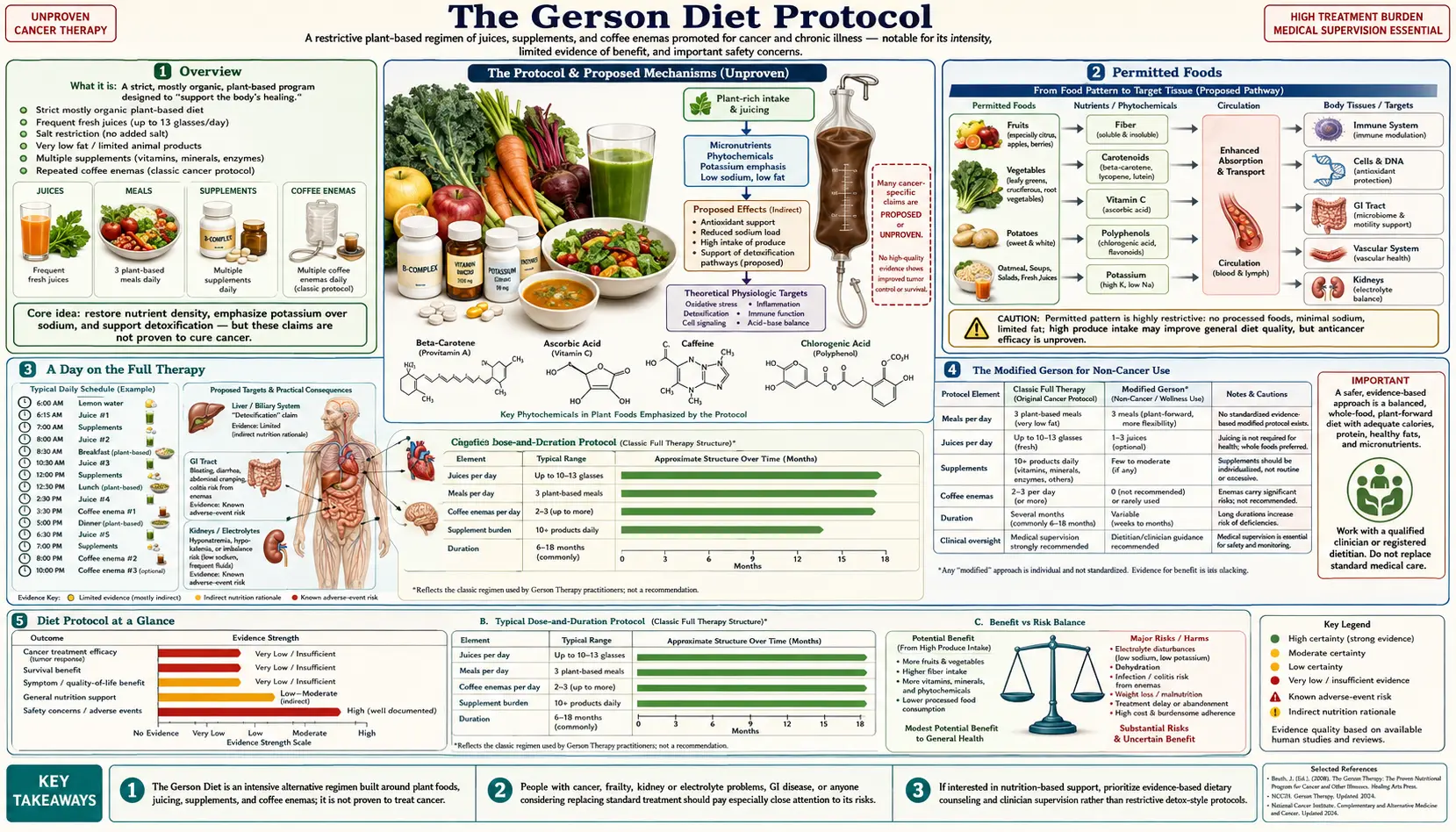
Table of Contents
- Overview
- The Three Pillars
- The Sodium–Potassium Theory
- Permitted Foods
- Forbidden Foods
- Hippocrates Soup and the Special Soup of Dr. Gerson
- A Day on the Full Therapy
- The Flax Oil Exception
- No Salt, No Fat, No Meat — Why?
- The Modified Gerson for Non-Cancer Use
- Key Research and Sources
- Featured Videos
Overview
The Gerson Diet is one of the most restrictive nutritional protocols in popular use. Patients on the full cancer protocol consume roughly 18 to 25 pounds of organic produce per day, mostly in the form of thirteen freshly pressed eight-ounce juices, plus three plant-based meals built around vegetables, fruit, oatmeal, baked potatoes, and the Hippocrates soup. There is no added salt, no animal protein for the first six weeks, no fats other than a measured amount of organic flax oil after the third week, no processed food of any kind, and no caffeine except for the coffee enemas.
This page describes the diet exactly as Charlotte Gerson and Beata Bishop document it in Healing the Gerson Way (2007), which is the modern Gerson Institute reference. Where the protocol has been modified since Max Gerson’s 1958 book, the changes are noted.
The Three Pillars
Gerson described his therapy as resting on three pillars, each meant to address one of three deficits he believed were present in chronic disease.
- Hyperalimentation. Far more nutrient density than ordinary diets, delivered as freshly extracted juices because the volume needed cannot be eaten as solid food.
- Detoxification. Coffee enemas and a salt-restricted, plant-based, low-fat diet to reduce hepatic workload while supporting Phase II conjugation.
- Metabolic restoration. Potassium repletion, thyroid and iodine supplementation, niacin, and B12, intended to correct what Gerson called the “tissue damage syndrome.”
The Sodium–Potassium Theory
The intellectual core of the diet is Gerson’s belief that chronic disease, and especially cancer, involves a generalized derangement of the cellular sodium–potassium balance. He argued that diseased tissue accumulates sodium and loses potassium, and that the way to restore normal cellular function is to flood the body with high-potassium plant food while withholding all added sodium. The diet therefore ranks foods primarily by their potassium-to-sodium ratio, and foods naturally high in sodium (celery is an exception used cautiously, beets are emphasized) are eaten in measured quantities.
Modern cell biology recognizes the importance of the Na/K-ATPase pump and of intracellular potassium for resting membrane potential, but the broad “cancer is a sodium–potassium imbalance” framing is not part of mainstream oncologic theory. The dietary advice that emerges from it — eat large quantities of potassium-rich produce, limit sodium — nevertheless coincides closely with current cardiovascular and kidney-health guidelines.
Permitted Foods
- Fresh organic vegetables of nearly all kinds, raw and cooked
- Fresh organic fruit, raw and cooked, especially apples, oranges, grapes, berries
- Whole oats (rolled or steel-cut), prepared without salt
- Baked potatoes (not fried; the skin is eaten)
- Whole-grain unsalted rye or other unsalted whole-grain bread, in moderation
- Onions, garlic, leeks (raw garlic is encouraged daily)
- Fresh herbs in moderate quantity
- Honey or maple syrup (limited; for cancer patients, restricted further)
- Distilled water for drinking and food preparation
- Organic flax oil, two tablespoons per day, raw, after the third week
Forbidden Foods
- Salt and all salt substitutes, including sea salt and Himalayan salt
- All animal protein for at least the first six weeks; in the cancer protocol, often longer
- All added fats and oils except the measured flax oil
- All processed and packaged foods
- Refined sugar, refined flour, white rice
- Soybeans and soy products (Gerson believed these contained inhibitors of nutrient absorption)
- Berries with high mold load (strawberries, blackberries, raspberries are restricted in the strict cancer protocol because of suspected aflatoxin and other mold contamination)
- Avocado, nuts, and seeds (high fat) for the first weeks
- Cucumbers (Gerson believed they inhibited oxidation of pancreatic enzymes; this restriction is sometimes relaxed)
- Tap water, fluoridated water, and bottled spring water with mineral content above the protocol limits
- Coffee taken orally (it goes through the rectum, not the mouth)
- Black or green tea, alcohol, soft drinks, fruit juices from concentrate
- All cookware containing aluminum, all microwave ovens, all non-stick coatings
Hippocrates Soup and the Special Soup of Dr. Gerson
The Hippocrates soup is a vegetable broth eaten twice a day, at lunch and dinner. The classic recipe (which appears on the recipes page) calls for parsley root, leeks, celeriac, a small amount of celery, garlic, tomatoes, onions, and potatoes simmered for two hours, then pushed through a food mill. It is unsalted. Gerson believed the soup’s combination of high potassium, organic minerals, and slow-cooked vegetable gel had a restorative effect on the kidneys and digestive tract. Patients describe it as comfort food once they adapt to the no-salt rule.
The Special Soup of Dr. Gerson is a kidney-supportive variant. The two soups together provide a substantial portion of the daily mineral intake.
A Day on the Full Therapy
The full cancer protocol is structured around the thirteen daily juices and the timing of coffee enemas. A representative day:
- 8:00 AM. First coffee enema. First juice (orange juice). Oatmeal breakfast with fruit.
- 9:00 AM. Green juice.
- 10:00 AM. Carrot-apple juice. Supplements with juice.
- 11:00 AM. Carrot juice. Coffee enema.
- 12:00 PM. Green juice. Lunch: salad, Hippocrates soup, baked potato, side vegetable, fruit dessert.
- 1:00 PM. Carrot-apple juice.
- 2:00 PM. Carrot juice.
- 3:00 PM. Green juice. Coffee enema.
- 4:00 PM. Carrot juice.
- 5:00 PM. Carrot-apple juice.
- 6:00 PM. Green juice. Dinner: same structure as lunch.
- 7:00 PM. Carrot juice. Coffee enema (last of day for most patients).
- Throughout: distilled water as desired, Hippocrates soup as desired.
This is a near-full-time job for the patient and an inevitable second full-time job for the caregiver who prepares the juices and the food. The kitchen workflow is described in the Practical Guide.
The Flax Oil Exception
Flax oil is the one fat permitted, beginning at the start of the third week, at a dose of two tablespoons per day, eaten raw on salad or stirred into food after cooking (never heated). The choice of flax was driven by Johanna Budwig’s research on essential fatty acids in cancer patients, which Gerson knew of from European literature. The dose drops to one tablespoon per day after the first month. Flax oil must be cold-pressed, organic, refrigerated, and used within six weeks of pressing.
Other vegetable oils — olive, sunflower, safflower, coconut — are not permitted in the strict cancer protocol because Gerson believed they competed with flax-oil omega-3 absorption. The modified protocol used for non-cancer indications relaxes this rule, typically permitting modest amounts of cold-pressed olive oil.
No Salt, No Fat, No Meat — Why?
No salt reflects the sodium–potassium theory and Gerson’s clinical observation, going back to the migraine diet, that low-sodium intake was a precondition for symptom resolution. It also reflects the fact that potassium-supplemented diets only achieve their intended intracellular shifts when sodium intake is simultaneously low.
No fat (except measured flax oil) reflects Gerson’s view that dietary fat slowed bile and pancreatic enzyme function, and that on a high-volume juice intake additional fat calories were not needed.
No animal protein for the first six weeks reflects Gerson’s belief that animal protein placed an undue load on hepatic detoxification, especially in patients with already-compromised liver function. After six weeks, small portions of organic, non-fat-containing animal foods (typically fat-free yogurt, cottage cheese, occasional fish) are sometimes reintroduced; the strict cancer protocol may delay this for many months.
The Modified Gerson for Non-Cancer Use
Most people who try the Gerson Therapy do not have cancer. They have autoimmune disease, chronic fatigue, fibromyalgia, migraine, or simply want a long-form detoxification reset. For these uses, a modified Gerson is more typical: six to eight juices a day rather than thirteen, one to two coffee enemas a day rather than four to five, fewer supplements, and earlier reintroduction of small amounts of fat and animal protein.
The modified Gerson lifts most of the burden that makes the full protocol impractical for working adults while preserving most of the elements that overlap with conventional anti-inflammatory and Mediterranean dietary advice. For chronic-disease prevention, the modified version is what most reasonable practitioners actually recommend.
Key Research and Sources
- Gerson C, Bishop B (2007). Healing the Gerson Way: Defeating Cancer and Other Chronic Diseases. Totality Books. The current authoritative manual.
- Gerson M (1958). A Cancer Therapy: Results of Fifty Cases. The original.
- Hildenbrand GL et al. (1995). Five-year survival rates of melanoma patients on Gerson diet therapy. Alternative Therapies in Health and Medicine. PMID: 9359807
- Sacks FM et al. (2001). “Effects on blood pressure of reduced dietary sodium and the DASH diet.” NEJM. Search PubMed — mainstream evidence supporting the low-sodium principle that Gerson reached by clinical observation in 1929.
- Gerson Institute. Diet handbook. gerson.org
- PubMed search: “Gerson diet” on PubMed
- PubMed search: “plant-based diet cancer”