Gerson Therapy Practical Guide
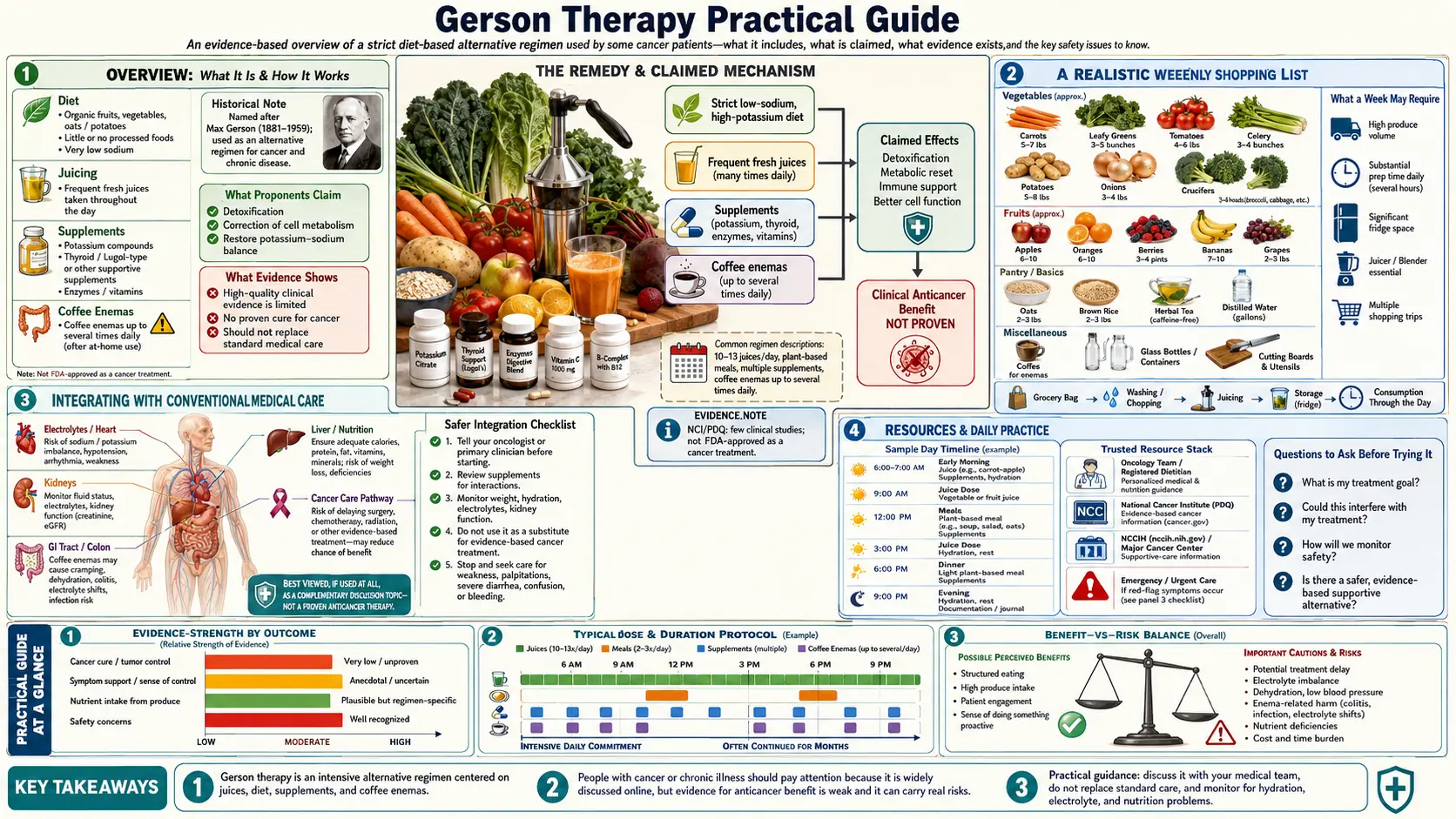
Table of Contents
- Overview
- Equipment Costs
- Produce Volume and Sourcing
- A Realistic Weekly Shopping List
- Kitchen Workflow: A Day in the Caregiver’s Life
- Travel and Disruption
- A Realistic Modified Protocol for Working Adults
- Integrating with Conventional Medical Care
- What to Track and Monitor
- Tapering and the Exit Plan
- Resources
- Featured Videos
Overview
The Gerson Therapy is feasible at home only with substantial advance planning, a competent caregiver, and a budget for equipment, organic produce, and supplements. The full cancer protocol effectively occupies one full-time caregiver and one mostly-recumbent patient. Even the modified non-cancer version requires a level of kitchen commitment that most working adults cannot sustain without dedicated support. This page lays out what the protocol actually costs and what it takes to run, so households can decide realistically before they start.
Equipment Costs
One-time equipment purchases for a Gerson household:
- Two-step grinder-and-press juicer: Norwalk ($2,500–$3,000 new, less used) or Pure Juicer ($2,400–$3,000). The Champion grinder ($300) plus a separate hydraulic press ($600–$1,200) is a budget alternative.
- Stainless-steel or enameled cookware: $200–$400 for a full set replacing aluminum or non-stick.
- Stainless-steel or glass enema bucket and silicone tubing: $40–$120.
- Distilled-water source: Countertop distiller ($150–$300) or weekly delivery ($30–$60/month).
- Refrigerator capacity: Most households need a second refrigerator dedicated to produce, ~$500–$900 used.
- Glass storage jars and bottles: $80–$150.
- Food mill, mandoline, fine-mesh strainers: $80–$150.
Total one-time setup: $3,500–$6,000 depending on choices. The juicer is the largest single item by a wide margin and is non-negotiable for the full protocol.
Produce Volume and Sourcing
The full cancer protocol requires roughly 18 to 25 pounds of organic produce per day. The volume breakdown is approximately:
- Carrots: 8–10 pounds per day
- Apples: 4–6 pounds per day
- Mixed greens (romaine, escarole, endive, watercress, beet tops): 3–4 pounds per day
- Other produce (potatoes, tomatoes, onions, leeks, parsley, oranges, etc.): 3–5 pounds per day
For organic produce at typical 2025–2026 U.S. prices, this is on the order of $80 to $150 per day, or $2,500 to $4,500 per month. Costs are lower in regions with strong farmers’ markets and CSA participation, and substantially lower if a household can grow some of its own produce. Sourcing strategies that have worked for Gerson families include direct-from-farm carrot deliveries (most economical), farmers’-market wholesale relationships, organic-grocery loyalty programs with bulk discounts, and seasonal community-supported-agriculture shares.
A Realistic Weekly Shopping List
For one patient on the full protocol for a 7-day week:
- Organic carrots: 50–60 lb
- Organic apples (sweet variety): 25–40 lb
- Organic romaine lettuce: 12–16 heads
- Organic escarole: 6–8 heads
- Organic endive (Belgian or curly): 6–8 heads
- Organic beet roots with tops: 12–16 bunches
- Organic watercress: 6–10 bunches
- Organic red cabbage: 3–4 heads
- Organic green bell peppers: 8–10
- Organic juicing oranges: 30–40
- Organic potatoes (russet or Yukon Gold): 10–14
- Organic parsley root, celeriac, leeks, onions, garlic, tomatoes, parsley: enough for 3–4 batches of Hippocrates soup
- Organic oats, flax oil, distilled water
This is the volume that fills a second refrigerator. Storage logistics — preventing wilt of greens, rotation of carrots, daily-fresh oranges — is a real planning problem.
Kitchen Workflow: A Day in the Caregiver’s Life
A typical day for the caregiver running the protocol for one patient:
- 6:30 AM: Wash and trim the morning’s produce. Boil distilled water for the morning’s coffee enema brew.
- 7:30 AM: Press first juice (orange). Prepare oatmeal. Set up first enema.
- 8:00 AM–7:00 PM: Press one 8-oz juice every hour (13 times total). Prepare lunch and dinner. Brew coffee enemas (morning and afternoon batch). Wash juicer, food mill, and prep surfaces three to four times. Replenish ingredients into the staging refrigerator.
- Estimated active kitchen time: 5 to 6 hours per day for the patient’s food alone, plus household meals for the rest of the family.
The juicer itself takes roughly 8 to 12 minutes per glass, including grinding, pressing, washing, and reassembling. Multiplied by 13 juices, that is most of an entire workday.
Travel and Disruption
The full protocol does not travel. Patients on the strict cancer schedule rarely leave home except for medical appointments. The juicer is heavy and not portable; pressed juice cannot be batched in advance; organic produce is not consistently available outside the home base. Most patients who attempt the protocol have built a 12- to 24-month period in which travel is suspended.
The modified protocol is more travel-tolerant. A few-day disruption can be absorbed by reverting to a simple plant-based diet with one to two oral juices a day from a slow masticating juicer (or even a high-quality juice-bar source as a last resort), then resuming on return.
A Realistic Modified Protocol for Working Adults
For non-cancer use by working adults, a sustainable modified Gerson typically looks like:
- Two pressed juices a day — typically a green juice in the morning and a carrot-apple in the afternoon — from a Champion or other slow masticating juicer.
- Three plant-based meals a day, mostly the Gerson food list, with some flexibility on salt for the working adult and small amounts of cold-pressed olive oil.
- One coffee enema 1 to 3 times per week (not daily), if the practice is being used at all.
- A simplified supplement schedule of B12, magnesium, potassium-rich foods (without prescription potassium compound), CoQ10 if desired, and vitamin D as indicated by serum levels.
- Standard medical care including primary-care follow-up and any indicated screening.
This version captures most of the diet-quality benefit of the full protocol while remaining compatible with employment, family life, and travel. It is also the version that has the strongest mainstream-medical compatibility.
Integrating with Conventional Medical Care
Patients running any version of the Gerson Therapy should have, at minimum:
- A primary-care physician who knows about the protocol and is willing to monitor labs.
- An oncologist if the indication is cancer; the oncologist may not endorse the protocol but should know the patient is doing it.
- Regular blood-work: comprehensive metabolic panel, thyroid panel, CBC, vitamin D, B12.
- A clear, written list of all supplements being taken (potassium compound, Lugol’s, thyroid extract, niacin, B12, pancreatic enzymes, CoQ10, flax oil) shared with every clinician encountered.
- Awareness of which prescription drugs interact with which protocol components (see Supplements).
What to Track and Monitor
A simple home log should cover:
- Daily weight (same time, same scale).
- Daily blood pressure if hypertension is in the picture.
- Energy and symptom score, 1–10, in the morning and evening.
- Bowel-function notes (separate from enema-related output).
- Any flares, headaches, fatigue spells, or unusual symptoms (these may be Gerson’s “healing reactions” or may be genuine adverse reactions; the log is for distinguishing them later).
- Lab values from each blood draw, in a single document so trends are visible.
Tapering and the Exit Plan
The full Gerson cancer protocol is designed for 18 to 24 months at full intensity, followed by gradual tapering to a maintenance phase. Tapering is not optional — a patient cannot stay on 13 juices a day and 5 enemas a day indefinitely without progressive social, financial, and physiological costs.
The Institute’s tapering schedule reduces juice frequency to 6 to 8 per day in months 13 through 18, then to 3 to 4 per day during months 19 through 24, then to 1 to 2 per day for long-term maintenance. Coffee enemas reduce from 4–5 daily to 1 daily over the same window, then to 2–3 per week, and then are typically stopped entirely or used occasionally. Animal protein returns gradually after the first six months. Salt remains restricted but no longer eliminated. The exit phase is itself a multi-month process and should be planned at the start, not improvised at the end.
Resources
- Gerson Institute — equipment list and supplier directory. gerson.org
- Gerson Institute — finding a certified practitioner. The Institute maintains a directory of trained practitioners and an inpatient referral service to its Tijuana-affiliated clinic.
- Gerson C, Bishop B (2007). Healing the Gerson Way. — the most current practical reference.
- Norwalk Juicer. norwalkjuicers.com
- Pure Juicer. purejuicer.com
- Local Harvest CSA directory. localharvest.org — for sourcing organic produce.
- USDA Organic certification database. ams.usda.gov