Juicing in the Gerson Therapy
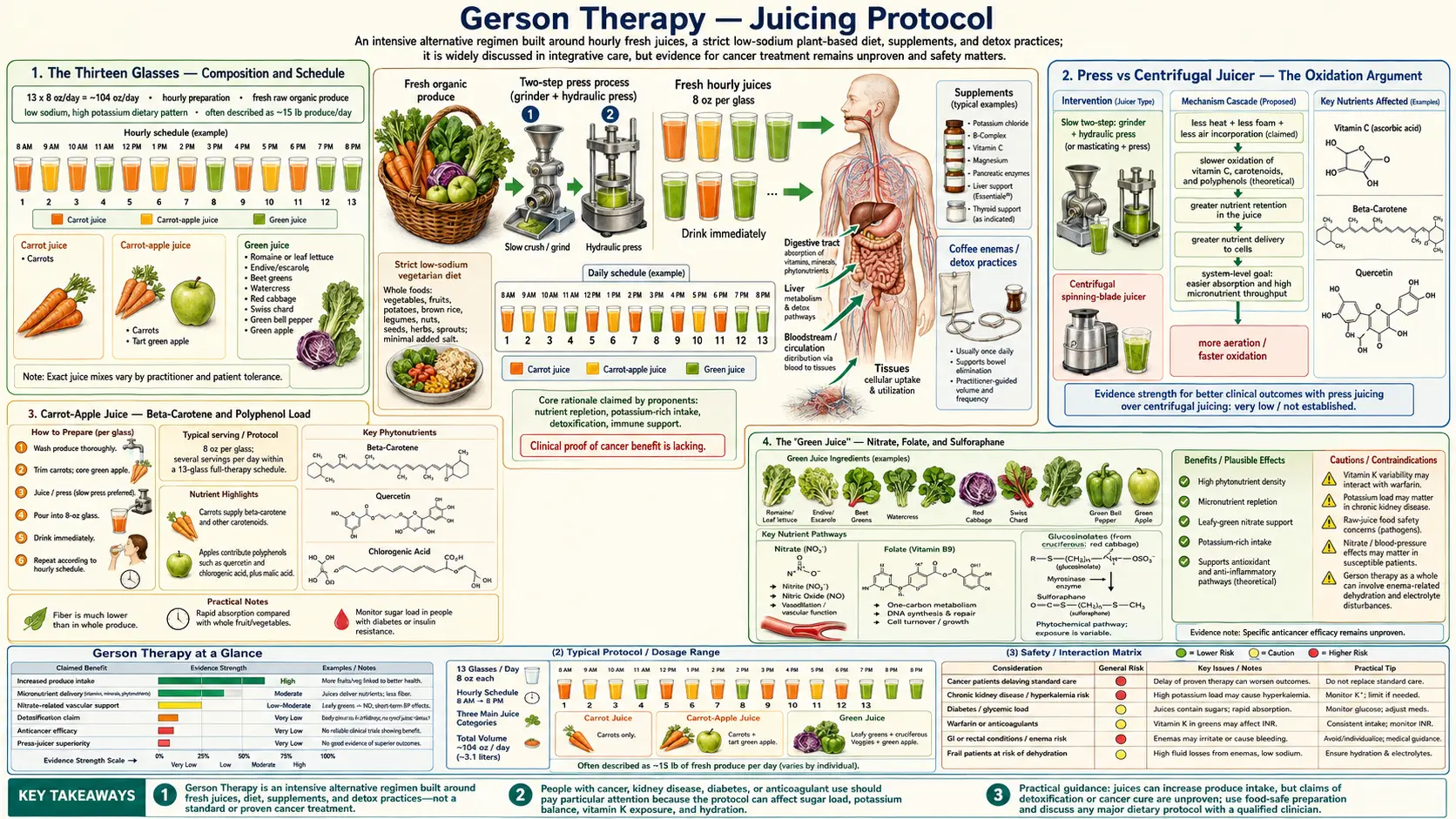
Table of Contents
- Overview
- Why Thirteen Juices a Day
- The Two-Step Grinder-and-Press Hydraulic Juicer
- Why Centrifugal Juicers Are Not Used
- Oxidation Chemistry: Why Juices Are Drunk Immediately
- Live Enzymes and Phytochemicals
- Organic Produce, Soil Quality, and Pesticide Load
- The Five Juice Types
- Timing, Spacing, and Pairing with Supplements
- Juicing Beyond the Gerson Therapy
- Key Research and Sources
- Featured Videos
Overview
Juicing is the single most defining feature of the Gerson Therapy. The patient drinks an eight-ounce glass of fresh-pressed juice every hour, thirteen times a day, made from organic vegetables and fruit. This is not a smoothie protocol; the pulp is removed and discarded, leaving only the cellular liquid. The total volume of produce processed each day — about 18 to 25 pounds — is impossible to chew, digest, or even fit into the stomach as solid food, which is the entire reason the juices exist.
The juices are intended to do three things at once: deliver hyperphysiologic doses of potassium, vitamins, and plant phytochemicals; spare digestive energy by removing the fibrous matrix; and provide what Gerson considered the “living” element of food — intact plant enzymes that he believed survived rectal portal absorption when consumed within minutes of pressing.
Why Thirteen Juices a Day
Thirteen is not a magic number; it is what fits in a waking day at one juice per hour. Gerson found in clinical practice that smaller volumes of juice did not produce the cellular potassium shifts he was looking for, and that bolus doses of much larger volumes caused gastric overload and reflux. Spaced hourly, the eight-ounce glass arrives slowly enough to be absorbed and infrequently enough to be tolerated. The schedule is also why the therapy effectively requires a full-time caregiver; preparation, cleanup, and pressing take roughly six hours per day in the kitchen.
For non-cancer use, the thirteen-juice schedule is usually trimmed to six or eight, and most of the practical principles still apply.
The Two-Step Grinder-and-Press Hydraulic Juicer
The Gerson Institute specifies a two-step juicer: a separate grinding stage that reduces produce to a fine pulp, followed by a hydraulic press that compresses the pulp inside a cloth bag and forces the juice out under thousands of pounds of pressure. The most commonly used machine is the Norwalk Juicer, a 1936 design by Norman Walker that has been continuously refined and is still manufactured. The Pure Juicer, made in California, is a more recent two-step press of similar design at a comparable price point.
The two-step approach matters because of two specific effects. First, grinding ruptures cell walls more thoroughly than slicing or chopping, which increases the percentage of intracellular contents that end up in the liquid. Second, the press extracts juice without spinning, which means there is no centrifugal cavitation, no aeration, no heat from friction, and minimal foam. The resulting juice is darker, denser, more shelf-stable for the few minutes before drinking, and yields about 25 to 40 percent more juice per pound of produce than a single-stage extractor.
Why Centrifugal Juicers Are Not Used
Gerson rejected centrifugal juicers (the typical home appliance with a spinning shredder disc) for both theoretical and practical reasons. Theoretically, the high-speed spinning generates heat by friction and forces air through the juice as it exits, which Gerson believed accelerated oxidation of the very polyphenols and enzymes the juice was supposed to deliver. Practically, the yield from centrifugal machines is significantly lower, particularly for leafy greens, which makes the daily produce target prohibitive.
Modern slow-masticating (single-auger) juicers, including the Champion (a single-stage masticating juicer Gerson himself sometimes used as a grinding stage paired with a separate press), are an acceptable compromise for the modified protocol but are not the Institute’s preferred equipment.
Oxidation Chemistry: Why Juices Are Drunk Immediately
Once a fruit or vegetable cell wall is ruptured, the contents are exposed to atmospheric oxygen and to the cell’s own polyphenol oxidase enzymes. Enzymatic browning begins in seconds, ascorbic acid (vitamin C) begins to oxidize within minutes, and chlorophyll and carotenoids degrade more slowly over hours. The Gerson rule is that juice must be drunk within ten to fifteen minutes of pressing. Beyond that, both the visible color and the analytical phytochemical content drop measurably.
Two practical consequences. First, juice cannot be batched in the morning and refrigerated for the day; each juice is pressed at the time it is drunk. Second, freezing destroys cell structure further and is not used. The exception some patients make — pressing a half-day of juice at once and storing in airtight, completely-filled glass jars at refrigerator temperature, kept under four hours — is an Institute-tolerated compromise but the freshness penalty is real.
Live Enzymes and Phytochemicals
The “living enzymes” framing in popular Gerson literature is biologically loose. Plant proteases and oxidases are denatured by stomach acid; very few intact enzymes reach the small intestine, let alone the bloodstream. What does survive ingestion in usable form is the spectrum of small-molecule phytochemicals: carotenoids (beta-carotene, lutein, zeaxanthin), polyphenols (quercetin, kaempferol, myricetin), glucosinolates and isothiocyanates (from Brassica greens, especially), nitrate (which the body converts to nitric oxide), folate, vitamin C, vitamin K1, and the full mineral profile.
The defensible biological claim of Gerson juicing is not that drinking enzymes is curative, but that the daily intake of these small-molecule phytochemicals at the dose delivered by 18 to 25 pounds of organic produce is several-fold higher than any practical eating pattern can match. Whether that hyperphysiologic intake produces clinical benefit is a separate empirical question.
Organic Produce, Soil Quality, and Pesticide Load
The produce must be organic, for two reasons. First, the volume consumed means that conventional pesticide residues, even at within-tolerance levels, would compound to a substantial daily dose — potentially counterproductive on a protocol whose stated aim is hepatic detoxification. Second, Gerson believed (and modern soil science partly supports) that mineral content of produce reflects the mineral content of the soil it was grown in, and that intensively farmed soils produce produce of lower trace-mineral density. Whether the difference is large enough to matter clinically is debated, but the produce-cost implication for a Gerson household is not.
Patients who cannot source fully organic produce are advised to prioritize organic for the highest-volume items (carrots, leafy greens, apples) and accept conventional for the lower-volume items where pesticide residues are typically lower.
The Five Juice Types
The thirteen daily juices are drawn from five recipes, repeated in a fixed pattern. The full recipes are on the Recipes page; here is the schematic.
- Orange juice — one glass at breakfast, hand-squeezed from organic oranges. Provides vitamin C, folate, and natural sugars to ease the transition into the day.
- Apple-carrot juice — three glasses per day. Equal volumes of carrot and apple. The apple sweetens an otherwise heavy carrot drink and contributes pectin and quercetin.
- Carrot juice — three to four glasses per day. Pure pressed carrot, the highest-volume single juice in the protocol.
- Green juice — four glasses per day. A specific blend of romaine, escarole, endive, beet tops, watercress, red cabbage, green pepper, with one quarter of an apple. The mineral and chlorophyll concentration is the highest in the day.
- Grapefruit juice (occasional) — sometimes substituted in patients tolerating it well; restricted in patients on hepatically metabolized drugs because of CYP3A4 inhibition.
Timing, Spacing, and Pairing with Supplements
Most supplements are taken with juices: potassium compound is dissolved into juice and divided across the day; thyroid and Lugol’s iodine are taken with morning juices; niacin is given with selected juices to control flushing. Pancreatic enzymes are usually taken on an empty stomach between juices because their target is systemic, not digestive (this is the von Klieber theory of systemic enzyme therapy that Gerson incorporated).
Coffee enemas are scheduled between juices and meals so that the patient is never asking the gut to absorb a juice while simultaneously evacuating an enema. The full schedule on the Diet Protocol page shows how juices, meals, and enemas interleave.
Juicing Beyond the Gerson Therapy
The juicing principles in the Gerson Therapy — fresh, organic, two-step pressed, drunk immediately, mostly vegetable, supplemented with juices that pair carrot or apple for sweetness with leafy green for mineral density — are directly applicable outside the cancer protocol. A practical adaptation for general health is one or two pressed juices a day (a green juice in the morning and an apple-carrot in the afternoon), not as a meal replacement but as a nutrient-density supplement to an otherwise balanced diet.
This use has overlap with the modern celery-juice movement (see Celery Juice), though the Gerson framing is older, more conservative on celery (because of its sodium content), and more balanced across produce categories. Either way, the equipment and oxidation principles are the same.
Key Research and Sources
- Gerson C, Bishop B (2007). Healing the Gerson Way. — the juicing chapter is the most detailed practical reference.
- Walker NW. Original 1936 patent and design of the Norwalk Juicer (US Patent 2,232,876).
- Gil MI et al. (2006). “Improving the storage and microbiological quality of fresh-cut spinach by a combination of high-oxygen atmospheres and low-temperature storage.” Postharvest Biology and Technology. — on oxidation rates of leafy-green phytochemicals.
- Boeing H et al. (2012). “Critical review: vegetables and fruit in the prevention of chronic diseases.” European Journal of Nutrition. PMID: 22684631
- Gerson Institute juicing handbook. gerson.org
- PubMed search: “fresh vegetable juice phytochemicals”
- PubMed search: “carrot juice beta-carotene bioavailability”