Food Additives Banned in Other Countries But Legal in the United States
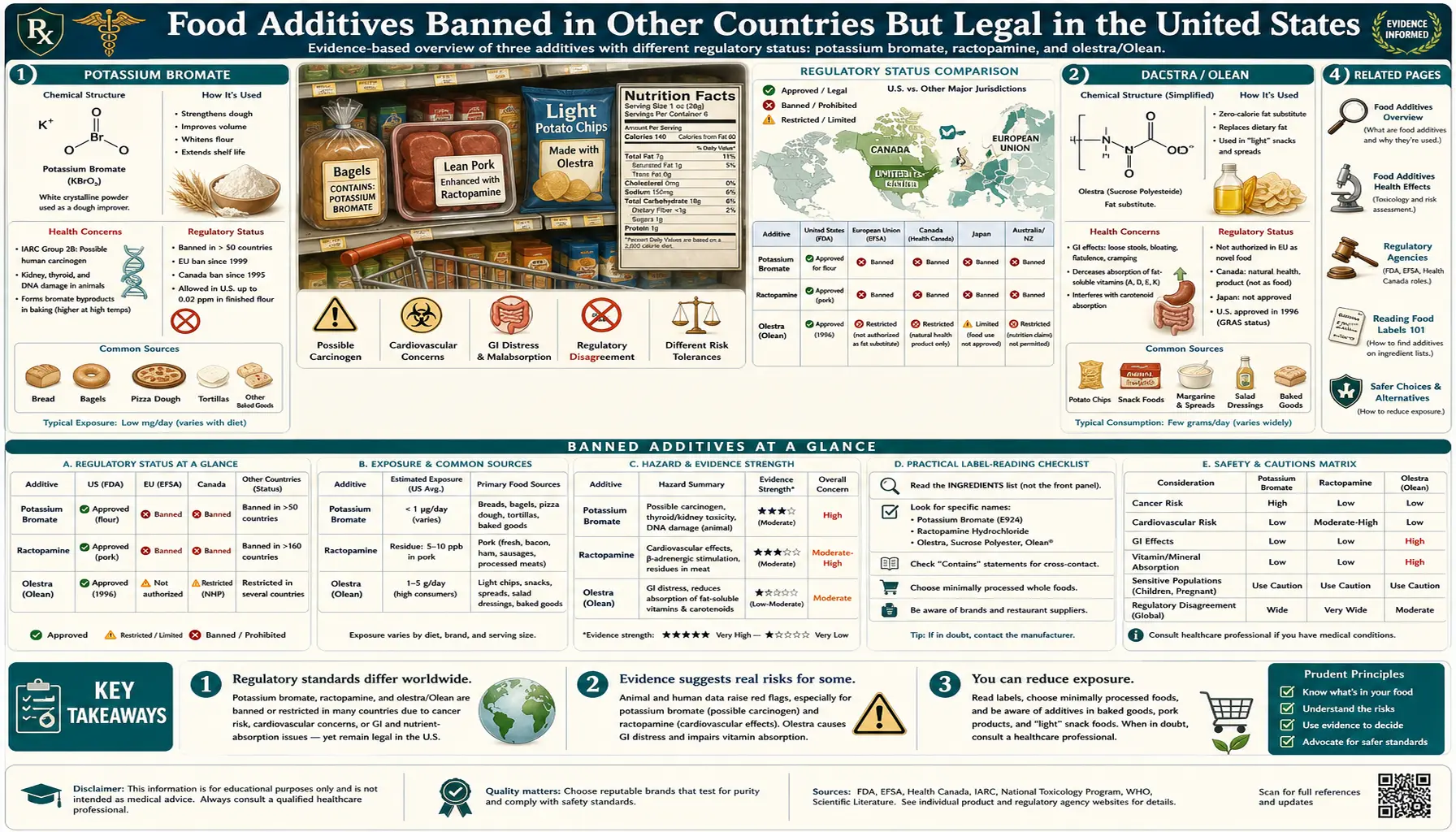

Table of Contents
- Potassium Bromate
- Brominated Vegetable Oil (BVO)
- Azodicarbonamide (ADA)
- BHA (Butylated Hydroxyanisole)
- rBGH/rBST (Recombinant Bovine Growth Hormone)
- Ractopamine
- Titanium Dioxide (E171)
- Artificial Food Dyes (with EU Warning Labels)
- Chlorine-Washed Chicken
- Atrazine
- Olestra/Olean
- Partially Hydrogenated Oils (Trans Fats)
- The Precautionary Principle vs. "Prove Harm"
- What You Can Do
- The Bottom Line
- Related Pages
- Connections
- Featured Videos
The United States allows dozens of food additives, growth hormones, pesticides, and processing aids that are banned, restricted, or require warning labels in other developed nations. This is not a matter of opinion or cultural preference — it reflects a fundamental difference in regulatory philosophy. The European Union, Canada, Japan, Australia, and many other countries apply the precautionary principle: if credible scientific evidence suggests a substance may be harmful, it is restricted or banned until its safety can be conclusively demonstrated. The United States takes the opposite approach, generally permitting substances until there is definitive proof of harm in humans — a standard that is extraordinarily difficult to meet and that effectively places the burden of proof on consumers rather than manufacturers.
The result is that Americans are routinely exposed to chemicals in their food that the rest of the developed world has deemed too risky for human consumption. What follows is a comprehensive accounting of the most significant of these substances.
Potassium Bromate
- What it is: A chemical oxidizing agent (KBrO3) added to flour and bread dough to strengthen the dough, help it rise higher, and give the finished bread a white, fluffy appearance.
- Where it is found: White bread, rolls, buns, pizza dough, and other baked goods made with bromated flour. Fast food chains and commercial bakeries are major users. It may appear on labels as "potassium bromate" or "bromated flour."
- Why it is banned elsewhere: Potassium bromate is classified as a Group 2B possible human carcinogen by the IARC. It causes kidney tumors, thyroid tumors, and peritoneal mesothelioma in animal studies. The EU banned it in 1990. It is also banned in the United Kingdom, Canada, Brazil, China, India, Nigeria, Peru, and Sri Lanka, among other countries.
- Why the US still allows it: The FDA has asked bakers to voluntarily stop using potassium bromate but has never issued a ban. The agency's position is that bromate is converted to harmless potassium bromide during baking if done properly, but studies have shown that measurable residues of unconverted bromate remain in finished products.
- Health effects: Kidney cancer, thyroid tumors, oxidative DNA damage, and potential neurotoxicity. California requires a cancer warning label on products containing potassium bromate under Proposition 65, and the California Food Safety Act of 2023 banned it effective 2027.
Brominated Vegetable Oil (BVO)
- What it is: Vegetable oil (usually soybean oil) that has been chemically bonded with bromine atoms. Used as an emulsifier to keep citrus flavoring evenly distributed in soft drinks and sports drinks.
- Where it is found: Historically found in Mountain Dew, Sun Drop, Squirt, Fresca, and various store-brand citrus-flavored beverages, as well as some sports drinks.
- Why it is banned elsewhere: BVO is banned in the European Union, Japan, India, and many other countries. Bromine is a heavy element that accumulates in body tissues, and BVO consumption has been linked to memory loss, skin lesions, and neurological symptoms in case reports.
- US regulatory status: In 2024, the FDA finalized a ban on BVO in food, effective August 2024, after decades of allowing it. This came after California banned BVO under the California Food Safety Act of 2023. While this is a welcome step, it illustrates how far behind other nations the US has been — BVO was banned in Europe and Japan decades ago.
- Health effects: Bioaccumulation of bromine in fatty tissues including the brain, heart, and liver. Animal studies showed heart lesions, fatty changes in the liver, impaired fertility, and behavioral changes. Case reports in humans documented headaches, fatigue, loss of muscle coordination, and memory problems from excessive BVO-containing beverage consumption.
Azodicarbonamide (ADA)
- What it is: A synthetic chemical (C2H4N4O2) used as a dough conditioner in bread and a foaming agent in the production of plastics and rubber. The fact that this same chemical is used in yoga mats and shoe soles earned it the nickname "the yoga mat chemical."
- Where it is found: Commercial breads, burger buns, tortillas, pastries, and other baked goods. Major fast food chains have used azodicarbonamide in their bread products. It may appear on labels as "azodicarbonamide" or under its E number E927a.
- Why it is banned elsewhere: Banned in the European Union, Australia, and Singapore. The EU classifies it as a respiratory sensitizer that may induce asthma. In Singapore, the use of azodicarbonamide can result in a fine of up to $450,000 and imprisonment of up to 15 years. The UK's Health and Safety Executive has identified it as a cause of occupational asthma.
- Why the US still allows it: The FDA considers azodicarbonamide safe at concentrations up to 45 parts per million (ppm) in flour. The agency argues that ADA breaks down during baking into trace amounts of other substances (semicarbazide and urethane), though notably urethane is itself classified as a Group 2A probable carcinogen.
- Health effects: Occupational exposure causes respiratory sensitization and asthma. The breakdown product semicarbazide has shown tumor-promoting activity in some studies. Urethane (ethyl carbamate), another breakdown product, is classified as a probable human carcinogen.
BHA (Butylated Hydroxyanisole)
- What it is: A petroleum-derived synthetic antioxidant used to prevent fats and oils from going rancid.
- Where it is found: Cereals, snack chips, chewing gum, butter, shortening, baked goods, dehydrated foods, cosmetics, and animal feed.
- Why it is banned/restricted elsewhere: Banned in Japan as a food additive. Restricted in the EU to specific food categories with maximum levels. Not permitted in infant and young children's food in the EU. The US National Toxicology Program classifies BHA as "reasonably anticipated to be a human carcinogen."
- Why the US still allows it: BHA retains its GRAS (Generally Recognized as Safe) status with the FDA despite the NTP carcinogen classification — a remarkable contradiction within the US government's own agencies.
- Health effects: Stomach and liver tumors in animal studies, endocrine disruption with estrogenic activity, reproductive toxicity. Read our detailed article on BHA and BHT.
rBGH/rBST (Recombinant Bovine Growth Hormone)
- What it is: A genetically engineered growth hormone (recombinant bovine somatotropin) injected into dairy cows to increase milk production by 10-15%. Developed by Monsanto (now Bayer) under the brand name Posilac.
- Where it is found: Conventional (non-organic) milk, cheese, yogurt, ice cream, and other dairy products from US dairy farms that use rBGH. An estimated 17% of US dairy cows receive rBGH.
- Why it is banned elsewhere: Banned in the European Union, Canada, Australia, New Zealand, Japan, and Israel. The Canadian government's review found that rBGH increased the risk of mastitis (udder infections) in cows by 25%, leading to increased antibiotic use. The EU Scientific Committee found health concerns for both animals and potentially humans.
- Why the US still allows it: The FDA approved rBGH in 1993, determining that milk from rBGH-treated cows was substantially equivalent to conventional milk. The FDA initially attempted to prevent dairy producers from labeling their products as "rBGH-free," though this position was later reversed after legal challenges.
- Health effects: rBGH-treated cows produce milk with elevated levels of insulin-like growth factor 1 (IGF-1), a hormone that promotes cell growth and has been associated with increased risk of breast, prostate, and colorectal cancers in epidemiological studies. rBGH also increases mastitis in cows, requiring more antibiotic treatment, which contributes to antibiotic-resistant bacteria.
Ractopamine
- What it is: A beta-agonist drug added to animal feed in the final weeks before slaughter to promote lean muscle growth and reduce fat in pigs (Paylean), cattle (Optaflexx), and turkeys (Topmax).
- Where it is found: Conventionally raised pork, beef, and turkey in the United States. An estimated 60-80% of US pigs receive ractopamine before slaughter.
- Why it is banned elsewhere: Banned in 160 or more countries, including the entire European Union, China, Russia, Taiwan, and most of the rest of the world. The EU banned ractopamine based on insufficient safety data and concerns about cardiovascular effects. China's ban led to trade disputes when US pork shipments tested positive for ractopamine residues. Russia and China have rejected US meat imports over ractopamine contamination.
- Why the US still allows it: The FDA approved ractopamine in 1999 based largely on studies submitted by the manufacturer, Elanco (a division of Eli Lilly). Codex Alimentarius, the UN's food standards body, adopted maximum residue limits for ractopamine by a narrow vote in 2012, but most major importing countries rejected those standards.
- Health effects: Ractopamine is linked to elevated heart rate, heart palpitations, and cardiovascular stress in animals. Pigs given ractopamine have been observed to be more stressed, hyperactive, and aggressive, and some have become unable to walk — a condition called "downer pig syndrome." Limited human safety data exists because ractopamine was studied in only a small number of human subjects (one study involved just six people, one of whom was hospitalized with heart palpitations). Ractopamine residues in meat can affect people with cardiovascular conditions and may interact with asthma medications (beta-agonists).
Titanium Dioxide (E171)
- What it is: A white pigment used to brighten and whiten foods. Made from titanium ore processed into microscopic particles, including nanoparticles smaller than 100 nanometers.
- Where it is found: Candy, chewing gum, frosting, coffee creamer, salad dressings, white sauces, powdered sugar, marshmallows, and many other white or brightly colored foods. Also used extensively in toothpaste, sunscreen, and paint.
- Why it is banned elsewhere: The European Union banned titanium dioxide as a food additive (E171) in 2022, following a safety assessment by the European Food Safety Authority (EFSA) that concluded it could no longer be considered safe. The EFSA cited concerns about genotoxicity — the ability to damage DNA — particularly from titanium dioxide nanoparticles, which can accumulate in organs.
- Why the US still allows it: The FDA considers titanium dioxide safe as a food additive at concentrations up to 1% by weight. The agency has not conducted a comprehensive reassessment in response to the EFSA's findings.
- Health effects: Titanium dioxide nanoparticles can cross the intestinal barrier and accumulate in organs including the liver, spleen, and kidneys. Animal studies have shown intestinal inflammation, immune system disruption, pre-cancerous lesion development in the colon, and potential genotoxicity. Concerns are especially acute for nanoparticle-sized titanium dioxide, which is more biologically reactive than larger particles.
Artificial Food Dyes (with EU Warning Labels)
- What they are: Synthetic petroleum-derived colorants used to make food more visually appealing. The most commonly used include Red 40 (Allura Red, E129), Yellow 5 (Tartrazine, E102), Yellow 6 (Sunset Yellow, E110), Blue 1 (Brilliant Blue, E133), Blue 2 (Indigo Carmine, E132), and Green 3 (Fast Green, E143). Red No. 3 (Erythrosine, E127) was banned by the FDA effective 2027.
- Where they are found: Candy, cereal, snack foods, soft drinks, sports drinks, baked goods, ice cream, yogurt, salad dressings, macaroni and cheese, medications, and vitamins. American children consume an estimated 3-4 times more artificial food dyes than they did 50 years ago.
- Why they require warning labels elsewhere: Since 2010, the EU has required products containing six specific artificial dyes (Red 40, Yellow 5, Yellow 6, Quinoline Yellow, Carmoisine, and Ponceau 4R) to carry the warning label: "May have an adverse effect on activity and attention in children." This requirement was prompted by the Southampton Study (2007), published in The Lancet, which found that mixtures of artificial colors and the preservative sodium benzoate increased hyperactive behavior in children.
- Why the US does not require warnings: Despite multiple citizen petitions and an FDA advisory committee meeting in 2011 that acknowledged the evidence of behavioral effects, the FDA concluded that a causal relationship between food dyes and hyperactivity had not been definitively established in the general population and declined to require warning labels. The committee voted 8-6 that the evidence did not support a causal link, though the vote's closeness reflected genuine scientific uncertainty.
- Health effects: Behavioral effects including hyperactivity and inattention in children, allergic reactions, hypersensitivity, and potential carcinogenicity (Red No. 3 was shown to cause thyroid tumors in rats, leading to its 2023/2027 ban). Multiple studies have found that removing artificial colors from children's diets improves behavior, and adding them back worsens it.
Chlorine-Washed Chicken
- What it is: The practice of washing poultry carcasses in chlorinated water (antimicrobial rinses containing chlorine dioxide, acidified sodium chlorite, trisodium phosphate, or peroxyacetic acid) at the end of the slaughter process to kill bacteria like Salmonella and Campylobacter.
- Where it is found: Virtually all conventionally processed chicken in the United States undergoes some form of antimicrobial wash.
- Why it is banned elsewhere: The European Union has banned the import of chlorine-washed poultry since 1997. The EU's position is not primarily about the safety of chlorine residues on the meat itself (which are minimal) but about the principle that chemical washes should not be used to compensate for poor hygiene throughout the production process. The EU requires a "farm to fork" approach with higher hygiene standards at every stage of production, whereas the US system tolerates lower standards throughout and relies on the final chemical wash as a kill step.
- Why the US still uses it: The USDA considers antimicrobial washes safe and effective. The US poultry industry argues that chlorine washing is more practical and cost-effective than the EU approach of maintaining higher hygiene standards throughout the entire production chain. Chlorine-washed chicken became a major point of contention in US-UK trade negotiations following Brexit.
- Health effects: The direct health risk from chlorine residues on chicken is likely minimal. The larger concern is systemic: the US approach of tolerating dirtier processing conditions and relying on a chemical wash to fix the problem at the end may mask underlying food safety issues. US rates of Salmonella infection remain significantly higher than those in many EU countries.
Atrazine
- What it is: A triazine herbicide and one of the most widely used agricultural chemicals in the United States, applied primarily to corn, sugarcane, and sorghum crops. While technically a pesticide rather than a food additive, atrazine enters the food supply through contaminated crops, water, and animal products.
- Where it is found: Residues are found on corn and corn products, in drinking water (especially in agricultural regions), and in the tissues of animals raised on contaminated feed or water. Atrazine is the most commonly detected pesticide contaminant in US drinking water.
- Why it is banned elsewhere: The European Union banned atrazine in 2004 due to persistent groundwater contamination and health concerns. Switzerland (where atrazine manufacturer Syngenta is headquartered) also banned it. The EU determined that atrazine could not be used without unacceptable levels of groundwater contamination.
- Why the US still allows it: The EPA continues to permit atrazine use, though it has periodically reviewed and modified usage restrictions. The US corn industry relies heavily on atrazine, and an estimated 70-80 million pounds are applied to US crops annually. Industry lobbying has been intense; internal documents revealed that Syngenta conducted a campaign to discredit scientists whose research showed atrazine's harmful effects.
- Health effects: Atrazine is an endocrine disruptor that affects sex hormones. Research by Dr. Tyrone Hayes at UC Berkeley demonstrated that atrazine causes chemical castration and feminization of male frogs at concentrations found in US waterways. Human epidemiological studies have linked atrazine exposure to birth defects, low birth weight, premature birth, reduced fertility, and increased risk of ovarian and breast cancer. It has also been associated with impaired immune function and thyroid disruption.
Olestra/Olean
- What it is: A synthetic fat substitute made from sucrose and fatty acids. Olestra molecules are too large to be digested or absorbed, so they pass through the body without contributing calories or fat. Developed by Procter & Gamble and marketed under the brand name Olean.
- Where it is found: Fat-free snack chips (most notably certain varieties of Lay's, Pringles, and Ruffles), though its use has declined significantly since its peak popularity in the late 1990s and early 2000s.
- Why it is restricted elsewhere: Olestra was never approved for use in the EU or Canada due to concerns about its effects on nutrient absorption and gastrointestinal side effects. The UK Food Standards Agency and other regulators determined that the risks outweighed the benefits.
- Why the US still allows it: The FDA approved olestra in 1996 for use in snack foods. Initially, products containing olestra were required to carry a warning label about potential gastrointestinal effects ("abdominal cramping and loose stools") and depletion of fat-soluble vitamins, but the FDA removed the warning label requirement in 2003.
- Health effects: Olestra causes gastrointestinal distress (cramping, diarrhea, flatulence, and fecal urgency) in many consumers. More importantly, olestra inhibits the absorption of fat-soluble vitamins (A, D, E, and K) and carotenoids, which are important antioxidants associated with reduced cancer and heart disease risk. Manufacturers are required to add vitamins A, D, E, and K to olestra-containing products, but this does not compensate for the loss of carotenoids.
Partially Hydrogenated Oils (Trans Fats)
- What they are: Artificially created fats produced by adding hydrogen to liquid vegetable oils, converting them to solid or semi-solid fats. This process creates trans fatty acids, which have been conclusively linked to cardiovascular disease.
- Where they were found: Margarine, shortening, fried foods, baked goods, snack foods, coffee creamers, and thousands of other processed food products.
- Why they were banned: The EU began restricting trans fats in 2019, limiting industrially produced trans fats to 2 grams per 100 grams of fat. Denmark was the pioneer, effectively banning artificial trans fats in 2003. The US FDA finally revoked the GRAS status of partially hydrogenated oils in 2015, with a compliance deadline of June 2018 (later extended to January 2020 in some cases).
- Why the US was late: Despite overwhelming evidence dating back decades that trans fats cause heart disease, the US did not begin requiring trans fat labeling until 2006 and did not ban PHOs until 2015/2018 — more than 15 years after Denmark acted. Industry lobbying and the GRAS loophole delayed action for years while an estimated 30,000-100,000 Americans per year died from cardiovascular disease attributable to trans fat consumption.
- Health effects: Trans fats increase LDL ("bad") cholesterol, decrease HDL ("good") cholesterol, promote systemic inflammation, increase the risk of heart attack and stroke, contribute to insulin resistance and type 2 diabetes, and may increase the risk of Alzheimer's disease. The WHO estimated that trans fat consumption causes approximately 500,000 premature deaths annually worldwide.
The Precautionary Principle vs. "Prove Harm"
The fundamental reason so many substances are legal in the United States but banned elsewhere comes down to a philosophical difference in how governments approach chemical safety in the food supply.
The EU Precautionary Principle
The European Union's regulatory framework is built on the precautionary principle, enshrined in the Treaty on the Functioning of the European Union. Under this principle:
- The burden of proof lies with the manufacturer — Companies must demonstrate that a substance is safe before it can be used in food.
- Reasonable suspicion is sufficient for action — If credible scientific evidence suggests a substance may be harmful, regulators can restrict or ban it even if absolute proof of human harm does not yet exist.
- Absence of evidence is not evidence of absence — The lack of definitive studies proving harm does not mean a substance is safe. Unknown risks are treated as potential risks.
- Safety is re-evaluated regularly — Previously approved substances are subject to ongoing review as new scientific evidence emerges, and approvals can be revoked.
The US "Prove Harm" Approach
The United States regulatory framework, particularly for food additives, effectively operates on the opposite principle:
- The burden of proof lies with regulators — The FDA must demonstrate that a substance is harmful before it can be banned, and the standard of evidence required is extremely high.
- The GRAS loophole — Substances classified as Generally Recognized as Safe (GRAS) can be used in food without pre-market approval by the FDA. Companies can even self-certify substances as GRAS without informing the FDA, a practice known as "self-affirmed GRAS." An estimated 1,000 or more food chemicals have never been reviewed by the FDA.
- Industry-funded safety studies — Most safety data submitted to the FDA comes from studies funded by the companies that manufacture and profit from the substances being evaluated, creating inherent conflicts of interest.
- Regulatory capture — The revolving door between the food/chemical industry and regulatory agencies means that former industry executives often make regulatory decisions, and former regulators often move to lucrative industry positions.
For a detailed examination of these regulatory differences, see our page on US vs EU Food Safety Regulation Compared.
What You Can Do
- Read labels religiously — Become familiar with the names of banned-elsewhere additives and avoid products that contain them.
- Choose organic when possible — USDA Organic standards prohibit most synthetic additives, artificial colors, and preservatives, and prohibit the use of growth hormones, ractopamine, and most synthetic pesticides.
- Buy from companies that voluntarily reformulate — Many US companies already sell safer versions of their products in Europe. Some have begun reformulating their US products as well in response to consumer pressure.
- Eat whole, unprocessed foods — The simplest way to avoid banned-elsewhere additives is to eat foods that have no ingredient list: fresh fruits, vegetables, whole grains, legumes, nuts, seeds, and fresh (unprocessed) meats.
- Filter your water — A quality water filter can remove atrazine and other pesticide contaminants from drinking water.
- Choose rBGH-free dairy — Look for labels stating "rBGH-free," "rBST-free," or "from cows not treated with artificial growth hormones."
- Demand better regulation — Support organizations advocating for food safety reform, contact elected representatives, and support state-level initiatives like California's Food Safety Act.
- Vote with your wallet — Every purchase is a vote for or against the current system. When consumers choose products free of harmful additives, the industry responds.
The Bottom Line
The gap between US and international food safety standards is not a minor regulatory disagreement — it is a chasm that exposes hundreds of millions of Americans to substances that the scientific consensus of other developed nations has determined are too dangerous for their citizens' food. The US regulatory system is structurally biased toward permitting chemicals and structurally incapable of responding quickly to emerging evidence of harm. Until fundamental reform occurs, the responsibility for avoiding these substances falls on individual consumers.
The good news is that consumer awareness and advocacy are growing. California's Food Safety Act, the FDA's belated ban on BVO, and the increasing number of companies voluntarily removing harmful additives all suggest that change is possible. But it requires vigilance, education, and sustained pressure from an informed public.
Related Pages
- US vs EU Food Safety Regulation Compared
- Food Preservatives: Extending Shelf Life at What Cost?
- BHA and BHT: Petroleum-Derived Preservatives in Your Food
- Sodium Nitrite: The Processed Meat Preservative Linked to Cancer
Connections
- All Toxins
- US vs EU Food Safety
- Preservatives
- BHA and BHT
- Sodium Nitrite
- Food Additives
- Azodicarbonamide
- Potassium Bromate
- Brominated Vegetable Oil
- rBGH
- Ractopamine
- Titanium Dioxide
- Food Dyes
- Trans Fats
- Pesticides
- Cancer
- Asthma
- Milk
- Pork