BHA and BHT: Petroleum-Derived Preservatives in Your Food
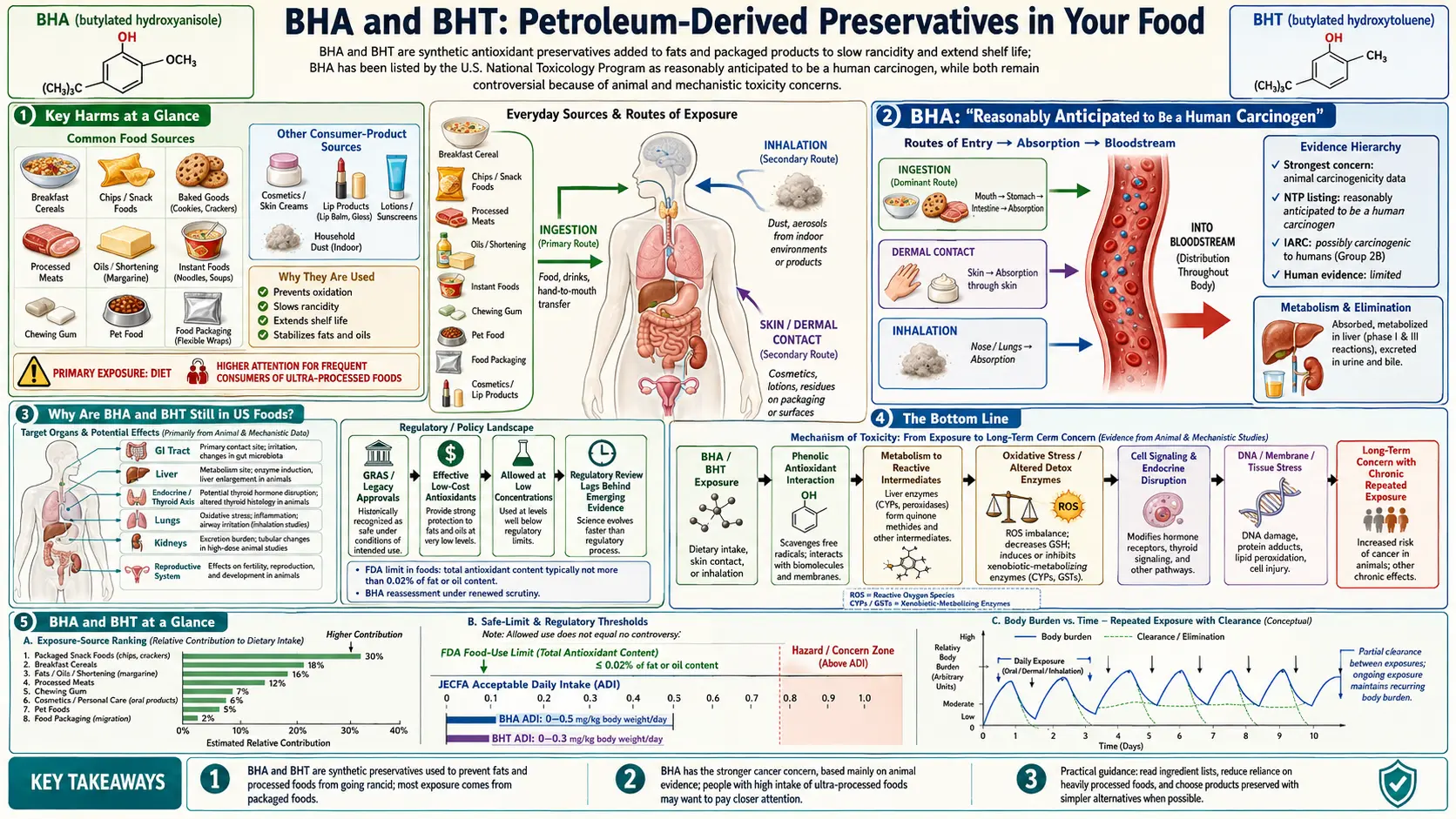
Butylated hydroxyanisole (BHA) and butylated hydroxytoluene (BHT) are two of the most widely used synthetic antioxidant preservatives in the food supply. Both are derived from petroleum and both have been the subject of intense scientific debate for decades. Despite mounting evidence of serious health risks — including cancer, endocrine disruption, and organ toxicity — these chemicals remain legal and prevalent in hundreds of everyday food products in the United States.
Table of Contents
- Key Harms at a Glance
- What Are BHA and BHT?
- Where They Are Found (Exposure Routes)
- BHA: Reasonably Anticipated Human Carcinogen
- BHT: Slightly Less Concerning, Still Debated
- International Bans and Restrictions
- Why Are BHA and BHT Still in US Foods?
- Safety Thresholds & ADI
- How to Avoid BHA and BHT
- Research Papers
- Connections
- Featured Videos
Key Harms at a Glance
- BHA is classified by the US NTP as “reasonably anticipated to be a human carcinogen.” IARC classifies BHA as Group 2B (possibly carcinogenic to humans).
- Endocrine disruption – BHA binds estrogen receptor-alpha and exhibits both estrogenic and anti-androgenic effects in cell-based assays.
- Forestomach tumors – Consistent animal findings in rats, mice, and hamsters.
- BHT organ toxicity – Liver and kidney enlargement, possible tumor promotion, and anti-androgenic effects in animal studies.
- Fat-soluble accumulation – Both compounds accumulate in adipose tissue and are slowly eliminated.
- Banned in Japan (BHA) since 1958; restricted in the EU, especially in infant/children’s foods.
What Are BHA and BHT?
BHA (butylated hydroxyanisole, E320) and BHT (butylated hydroxytoluene, E321) are synthetic antioxidants created from petroleum-derived chemicals. They were introduced into the food supply in the 1940s and 1950s to prevent the oxidation of fats and oils, which causes rancidity — the unpleasant smell and taste that develops when fatty foods go stale. By donating hydrogen atoms to free radicals, BHA and BHT interrupt the chain reaction of lipid oxidation, thereby extending the shelf life of products containing fats.
BHA is a waxy solid that is a mixture of two isomers: 3-tert-butyl-4-hydroxyanisole and 2-tert-butyl-4-hydroxyanisole. BHT is a crystalline solid with the chemical name 2,6-di-tert-butyl-4-methylphenol. Both are fat-soluble, meaning they accumulate in fatty tissues and are not easily excreted from the body.
Where Are BHA and BHT Found?
BHA and BHT are pervasive in the modern food supply, personal care products, and even industrial products. They are found in:
- Breakfast cereals — Many popular brands add BHT directly to the cereal or to the packaging material to prevent the cereal's oils from going rancid. Check the ingredient list or the phrase "BHT added to packaging to preserve freshness."
- Snack foods and chips — Potato chips, tortilla chips, crackers, and other fried or oil-containing snacks frequently contain BHA or BHT.
- Chewing gum — BHT is a standard ingredient in many major chewing gum brands, used to preserve the gum base.
- Butter and margarine — Added to prevent the fats from becoming rancid.
- Baked goods — Cookies, pie crusts, and other baked goods containing fats or oils often include BHA or BHT.
- Instant and dehydrated foods — Instant mashed potatoes, soup mixes, and dehydrated meals commonly contain these preservatives.
- Cooking oils and shortening — Some vegetable oils and shortenings include BHA or BHT as stabilizers.
- Beer — Some beers use BHA to preserve hop oil flavors.
- Cosmetics and personal care products — Lipstick, moisturizers, sunscreen, and other products containing fats or oils frequently use BHA or BHT as preservatives.
- Rubber and petroleum products — BHT is used industrially as a stabilizer in rubber, jet fuel, transformer oil, and embalming fluid, illustrating its chemical rather than nutritional origins.
- Animal feed — BHA and BHT are added to commercial animal feed, meaning exposure can occur indirectly through meat and dairy products.
- Pharmaceutical products — Some medications use BHA or BHT as excipients to preserve active ingredients.
BHA: "Reasonably Anticipated to Be a Human Carcinogen"
BHA carries the most serious official designation of any commonly used food preservative. The US National Toxicology Program (NTP), a division of the Department of Health and Human Services, has classified BHA as "reasonably anticipated to be a human carcinogen" based on extensive animal studies. This classification has been maintained in every edition of the NTP's Report on Carcinogens since it was first listed.
The International Agency for Research on Cancer (IARC), part of the World Health Organization, classifies BHA as a Group 2B agent, meaning it is "possibly carcinogenic to humans."
Animal Study Evidence
- Forestomach tumors — BHA consistently produces tumors in the forestomach of rats, mice, and hamsters. While humans do not have a forestomach, toxicologists note that the mechanism of action (chronic irritation and cell proliferation) is relevant to other tissues in the human digestive tract, including the esophagus and stomach lining.
- Liver tumors — Some studies have found increased incidence of liver tumors in animals exposed to BHA, though results have been less consistent than forestomach findings.
- Dose-response relationship — The carcinogenic effects of BHA show a clear dose-response relationship, with higher doses producing more tumors. However, effects have been observed at doses that are not dramatically higher than potential human exposure levels when cumulative intake from multiple sources is considered.
Endocrine Disruption
BHA is a confirmed endocrine disruptor with estrogenic activity. Research has demonstrated that BHA:
- Binds to estrogen receptors — BHA can interact with estrogen receptor alpha (ER-alpha), mimicking the effects of the body's natural estrogen.
- Stimulates estrogen-responsive genes — In cell studies, BHA activates genes that are normally turned on by estrogen, potentially disrupting normal hormonal signaling.
- Affects reproductive development — Animal studies have shown that BHA exposure can reduce fertility, lower sperm counts, and affect the development of reproductive organs in offspring.
- Disrupts thyroid function — Some studies suggest BHA may interfere with thyroid hormone metabolism, which is crucial for growth, development, and metabolic regulation.
- Mimics or blocks hormones at very low doses — Like many endocrine disruptors, BHA may exert effects at doses far lower than those that cause acute toxicity, following a non-monotonic dose-response curve that challenges traditional toxicology assumptions.
BHT: Slightly Less Concerning, Still Debated
BHT has not received the same carcinogen classification as BHA, and some studies have even suggested it may have anti-cancer properties in certain contexts. However, BHT is far from harmless, and the scientific picture remains unsettled.
Health Concerns Associated with BHT
- Organ toxicity — Animal studies have shown that BHT can cause liver and kidney enlargement, and at higher doses, liver damage. Long-term feeding studies have produced mixed results, with some showing liver tumors and others not.
- Developmental and reproductive effects — BHT has demonstrated anti-androgenic effects in some studies, meaning it can interfere with male sex hormones. Animal studies have shown reduced fertility and altered offspring development at doses achievable through dietary exposure.
- Behavioral effects — Studies have linked BHT consumption to behavioral changes in animals, and some researchers have suggested it may contribute to hyperactivity and other behavioral issues in children, particularly in combination with artificial colors and other preservatives.
- Thyroid effects — BHT may interfere with thyroid hormone metabolism, similar to BHA, potentially affecting metabolic function.
- Blood coagulation effects — BHT has been shown to affect blood clotting mechanisms, which could be problematic for individuals taking anticoagulant medications.
- Tumor promotion — While BHT has shown some anti-cancer activity in certain models, in other studies it acts as a tumor promoter, enhancing the carcinogenic effects of other chemicals. This dual nature makes risk assessment particularly challenging.
The "BHT Is an Antioxidant, So It Must Be Good" Fallacy
Some proponents argue that because BHT is an antioxidant, it should be beneficial to health, similar to natural antioxidants like vitamins C and E. This reasoning is flawed. While BHT does neutralize free radicals in food products, its behavior in the human body is far more complex. BHT is metabolized by the liver into various breakdown products, some of which may themselves be reactive and potentially harmful. The fact that a chemical functions as an antioxidant in a test tube does not mean it acts as a healthful antioxidant inside a living organism.
International Bans and Restrictions
The regulatory treatment of BHA and BHT varies dramatically around the world, reflecting different approaches to chemical safety:
- Japan — BHA has been banned as a food additive since 1958, after early animal studies showed carcinogenic potential. Japan acted on this evidence decades before the US National Toxicology Program's carcinogen classification.
- European Union — BHA is restricted to specific food categories and maximum levels under EU Regulation 1333/2008. It is not permitted in foods for infants and young children. BHT is similarly restricted. The EU's approach reflects the precautionary principle: when evidence of harm exists, regulators restrict the substance rather than waiting for definitive proof of human harm.
- California Food Safety Act (2023) — In a landmark move, California became the first US state to ban several food additives, though BHA and BHT were not included in the final version of the bill (they were in earlier drafts). The law did ban Red No. 3, potassium bromate, brominated vegetable oil, and propylparaben, signaling a shift toward more precautionary state-level regulation.
- United States (federal) — Despite the NTP's carcinogen classification, the FDA continues to allow BHA and BHT as GRAS (Generally Recognized as Safe) food additives. The FDA limits the total antioxidant content of food to 0.02% of the fat or oil content, but this limit is difficult to enforce and does not account for cumulative exposure across multiple products.
Why Are BHA and BHT Still in US Foods?
The continued use of BHA and BHT in the US food supply, despite a government agency's own carcinogen classification, is a case study in regulatory failure. Several factors contribute:
- The GRAS loophole — BHA and BHT were classified as GRAS before modern toxicology testing standards existed. Once a substance has GRAS status, there is no automatic mechanism to revoke it, even when new evidence emerges.
- Industry resistance — BHA and BHT are cheap, effective, and well-established in food manufacturing processes. Reformulating thousands of products to use natural alternatives would cost the food industry billions.
- Regulatory inertia — The FDA faces enormous backlogs and limited resources. Reassessing thousands of GRAS substances is a task that far exceeds the agency's capacity, and the burden of proof falls on regulators to demonstrate harm rather than on manufacturers to demonstrate safety.
- Industry-funded science — Much of the research cited to defend BHA and BHT safety has been funded by food industry interests, creating conflicts of interest that can bias study design, data interpretation, and publication.
Safety Thresholds & ADI
- JECFA ADI for BHA – 0–0.5 mg/kg body weight/day.
- JECFA ADI for BHT – 0–0.25 mg/kg body weight/day (re-evaluated 2012).
- US FDA – Permits BHA and BHT at up to 0.02% of the fat/oil content of the food (21 CFR 172.110, 172.115).
- EU – Regulation (EC) No 1333/2008 restricts BHA (E320) and BHT (E321) to specific food categories at maximum levels of 25–400 mg/kg depending on product; excluded from foods for infants and young children.
- NTP classification (BHA) – “Reasonably anticipated to be a human carcinogen,” Report on Carcinogens.
How to Avoid BHA and BHT
- Read ingredient labels carefully — Look for "BHA," "BHT," "butylated hydroxyanisole," or "butylated hydroxytoluene" in ingredient lists. Also check for statements like "BHT added to packaging to preserve freshness."
- Choose organic products — USDA Organic standards prohibit the use of BHA and BHT.
- Look for products preserved with tocopherols — Many brands now use "mixed tocopherols" (vitamin E) as a natural antioxidant preservative. This is a safe and effective alternative.
- Look for rosemary extract — Another natural antioxidant that many brands have adopted as a BHA/BHT replacement.
- Avoid highly processed snack foods — Chips, crackers, and other shelf-stable snack foods are among the most common sources of BHA and BHT.
- Choose BHT-free cereals — Several cereal brands have voluntarily removed BHT from both their products and packaging. Look for these alternatives.
- Check cosmetics and personal care products — BHA and BHT exposure is not limited to food. Check labels on lip products, moisturizers, and sunscreens, as these are absorbed through the skin.
- Support reformulation efforts — When brands remove BHA and BHT from their products, support them with your purchasing power. Consumer demand is the most powerful driver of industry change.
The Bottom Line
BHA is classified by the US government's own National Toxicology Program as a substance reasonably anticipated to cause cancer in humans. It is a confirmed endocrine disruptor with estrogenic activity. It is banned in Japan and restricted in the EU. BHT, while somewhat less concerning, is still associated with organ toxicity, reproductive effects, and behavioral impacts. Both are derived from petroleum and have safe, natural, readily available alternatives.
The continued widespread use of BHA and BHT in the American food supply is a failure of regulation, not a reflection of their safety. Until federal regulators act, consumers must protect themselves by reading labels and choosing products preserved with safer alternatives.
Research Papers
- National Toxicology Program. Butylated Hydroxyanisole (BHA). Report on Carcinogens, 15th Edition. NIEHS.
- IARC Monograph Vol. 40 (1986): Butylated hydroxyanisole (BHA) evaluated as Group 2B.
- PubMed topic search: BHA butylated hydroxyanisole carcinogenicity
- PubMed topic search: BHT butylated hydroxytoluene toxicity
- PubMed topic search: BHA estrogenic endocrine disruption
- PubMed topic search: BHA forestomach tumor rat
- PubMed topic search: BHT tumor promoter liver
- PubMed topic search: tert-butylhydroquinone TBHQ safety
- PubMed topic search: phenolic antioxidant food genotoxicity
- EFSA Panel on Food Additives. Scientific Opinion on the re-evaluation of butylated hydroxytoluene (E 321) as a food additive. EFSA Journal. 2012;10(3):2588.
- PubMed topic search: mixed tocopherols natural antioxidant food preservation
- FDA Food Additive Status List (includes BHA, BHT entries).
Connections
- All Toxins
- Preservatives
- Vitamin E
- Sodium Nitrite
- Potassium Sorbate
- Nisin
- Natamycin
- US vs EU Food Safety
- Banned Additives
- Food Dyes Banned Worldwide
- BHA
- BHT
- Food Additives
- Cancer
- TBHQ
- Potassium Bromate
- Detox Protocols
- Brominated Vegetable Oil
- Azodicarbonamide