rBGH/rBST: Recombinant Bovine Growth Hormone in US Dairy
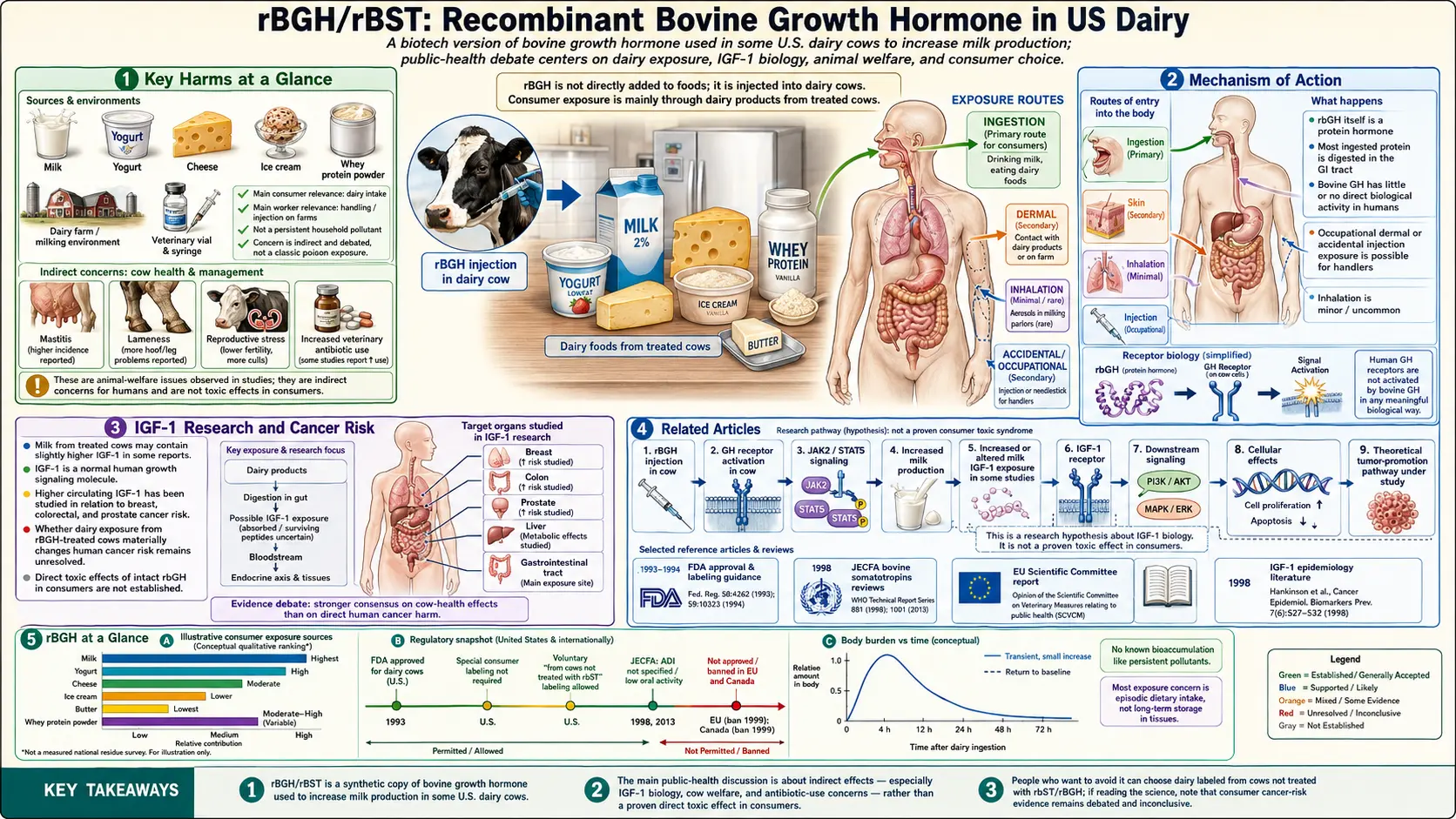
Recombinant bovine growth hormone (rBGH), also known as recombinant bovine somatotropin (rBST), is a genetically engineered version of the natural growth hormone produced by the pituitary gland of cattle. When injected into dairy cows every two weeks, it stimulates the liver to produce additional insulin-like growth factor 1 (IGF-1), which in turn drives increased milk production of 10 to 15 percent. Approved by the US Food and Drug Administration in 1993 under the brand name Posilac and manufactured by Monsanto (later acquired by Eli Lilly and then Elanco), rBGH remains one of the most contested drug approvals in FDA history. It is banned by the European Union, Canada, Australia, New Zealand, Japan, Israel, and dozens of other nations. The United States stands virtually alone among wealthy nations in permitting its use.
Table of Contents
- Key Harms at a Glance
- Overview
- Regulatory History
- Mechanism of Action
- Health Effects
- Animal Welfare Concerns
- IGF-1 Research and Cancer Risk
- Labeling Controversy
- Market Trends and Consumer Rejection
- Related Articles
- Research Papers and References
- Connections
- Featured Videos
Key Harms at a Glance
- Elevated IGF-1 in milk — biologically active in humans; associated with breast, prostate, and colorectal cancer risk in epidemiology.
- Banned in EU, Canada, Australia, Japan, Israel — virtually every wealthy nation except the US.
- Mastitis in cows — documented increased infection rates, leading to heavier antibiotic use.
- Lameness and reduced pregnancy rates — animal-welfare concerns in treated herds.
- Suppressed dissent — Health Canada whistleblowers testified that Monsanto pressured approval without adequate safety data.
- Labeling ambiguity — 'rBGH-free' labels survived regulatory challenges only after consumer lawsuits.
- Declining US market share — major dairies (Walmart, Starbucks, Dannon) have voluntarily phased out rBGH milk.
1. Overview
Bovine somatotropin (BST) is a protein hormone naturally produced by the anterior pituitary gland of cattle. It plays a central role in regulating metabolism, growth, and milk production. Recombinant bovine somatotropin (rBST) is produced by inserting the bovine gene for somatotropin into Escherichia coli bacteria using recombinant DNA technology; the bacteria are then cultured in fermentation vats to produce large quantities of the hormone, which is purified and formulated for injection.
- Brand name — Posilac, marketed by Monsanto until 2008 when it was sold to Eli Lilly's animal health division, which later became Elanco.
- FDA approval — November 5, 1993, following a review process that began in the late 1980s. The approval covered use in lactating dairy cows to increase milk production.
- Administration — injected subcutaneously (under the skin) every 14 days beginning at 57 to 70 days after calving and continuing throughout the lactation cycle.
- Production increase — treated cows produce approximately 10 to 15 percent more milk per lactation cycle. Because the US already faced dairy surpluses, critics questioned the economic rationale from the beginning.
- Structural difference — rBST has one additional amino acid at its N-terminus compared to the natural bovine hormone, a structural difference that some researchers argue contributes to altered biological activity.
- Not approved for human use — rBGH/rBST is approved only for use in cattle, but the IGF-1 it elevates in cow's milk is a human health concern because it is biologically active in humans.
2. Regulatory History
United States: FDA Approval
The FDA's 1993 approval of rBST was, and remains, the most controversial drug approval in the agency's history. The review process was marked by accusations of industry influence, suppression of dissenting scientific opinion, and revolving-door employment between the FDA and Monsanto.
- 1985–1993 — Monsanto conducted clinical trials and submitted a New Animal Drug Application. The FDA's review concluded that rBST was safe for both animals and humans, and that milk from treated cows was compositionally equivalent to milk from untreated cows — a conclusion disputed by independent scientists.
- Revolving door controversy — Michael Taylor, the FDA official who oversaw the rBST review and approval, had previously worked as a lawyer for Monsanto and later returned to a senior role at Monsanto. Margaret Miller, FDA deputy director in the Bureau of Veterinary Medicine, had been a Monsanto scientist conducting rBST research before joining the FDA. These conflicts of interest were documented by the Government Accountability Project and widely reported.
- Suppressed internal FDA report — two FDA veterinary scientists, Richard Burroughs and Alexander Apostolou, raised concerns about the adequacy of Monsanto's animal safety data. Burroughs was fired; internal dissent was not reflected in the final approval documents.
- Congressional scrutiny — Senator Russell Feingold and Representative David Obey led repeated congressional investigations into the approval process between 1990 and 1999, with limited effect on FDA policy.
International Bans
- European Union — the EU imposed a moratorium on rBST use in 1990, pending scientific review. In 1999, the EU's Scientific Committee on Veterinary Measures Relating to Public Health (SCVMPH) issued a comprehensive report concluding that rBST use significantly increased animal health risks and raised credible human health concerns, particularly regarding IGF-1. The EU ban was made permanent in 2000 and has not been revisited since.
- Canada — Health Canada rejected the rBST application in January 1999 after a thorough multi-year review. Its decision cited both animal welfare concerns (increased mastitis, lameness, reproductive disorders) and human health uncertainty regarding IGF-1. The Veterinary Drugs Directorate concluded there was insufficient evidence of safety for animal health. Canada's rejection was notable because the Canadian Bureau of Veterinary Drugs had initially been inclined to approve the drug before the health concerns became clear.
- Australia and New Zealand — Australia New Zealand Food Standards (ANZFA) declined to approve rBST for use in dairy cattle. Both countries maintain prohibitions and do not permit importation of dairy products from rBST-treated cows without disclosure.
- Japan — Japan has not approved rBST for use and prohibits its administration to dairy cattle. Milk produced with rBST cannot be marketed in Japan.
- Israel — despite significant dairy industry lobbying, Israel banned rBST use in dairy cattle, citing animal welfare concerns as the primary rationale.
- Codex Alimentarius failure — the Codex Alimentarius Commission, the joint FAO/WHO food standards body, attempted to set international Maximum Residue Limits (MRLs) for rBST from the mid-1990s through the 2000s. The effort ultimately failed to produce a consensus standard. In 1999, Codex adopted by consensus a decision to effectively defer setting a MRL, which was widely interpreted as a rejection of the US position. The absence of a Codex standard means there is no internationally recognized safe level for rBST residues in dairy products.
3. Mechanism of Action
Understanding how rBGH works requires understanding the endocrine cascade it initiates, and why the downstream effects extend beyond the cow to consumers of the milk.
- Direct effect on lactation — rBST binds to growth hormone receptors in the mammary gland and liver, directly stimulating milk synthesis and increasing blood flow to the udder. It also promotes the uptake of glucose and amino acids by mammary tissue.
- Induction of IGF-1 — the most significant indirect effect is rBST's stimulation of hepatic (liver) production of insulin-like growth factor 1 (IGF-1). IGF-1 is the primary mediator of growth hormone's anabolic effects. In rBST-treated cows, circulating IGF-1 levels increase substantially, and elevated IGF-1 concentrations are measurably present in the milk of treated animals.
- IGF-1 levels in milk — independent research has documented that milk from rBST-treated cows contains IGF-1 concentrations 2 to 10 times higher than milk from untreated cows. Estimates vary by study, but concentrations of 100–1000 ng/mL have been reported in treated cow milk compared to 30–200 ng/mL in untreated milk. Monsanto and the FDA have disputed the higher end of these estimates.
- IGF-1 survives pasteurization — unlike many hormones, IGF-1 is relatively heat-stable. Studies by Prosser et al. (1989) and others established that pasteurization at standard temperatures (72°C for 15 seconds) does not fully destroy IGF-1 activity. Approximately 90 percent of biological activity is retained after standard pasteurization.
- IGF-1 survives digestion — ordinarily, protein hormones ingested orally would be expected to be destroyed by digestive proteases in the stomach and small intestine. However, IGF-1 forms stable complexes with milk casein proteins, which protect it from protease degradation. Research by Kimura et al. (1997) demonstrated that casein-bound IGF-1 can survive passage through the gastrointestinal tract and be absorbed intact through the intestinal epithelium.
- Human IGF-1 identity — bovine IGF-1 is structurally identical to human IGF-1 at the amino acid level. Once absorbed, it is biologically active in human tissues, capable of binding human IGF-1 receptors with the same affinity as endogenously produced human IGF-1.
- Cell proliferation — IGF-1 is a potent mitogen (cell-division stimulator). It promotes the proliferation of cells, inhibits programmed cell death (apoptosis), and stimulates tissue growth. These properties are beneficial in normal physiological amounts but potentially harmful when levels are chronically elevated, particularly in the context of cancer initiation and promotion.
4. Health Effects
IGF-1 and Cancer Risk
The association between elevated circulating IGF-1 and cancer risk is one of the most extensively studied links in nutritional epidemiology. The concern is not merely theoretical.
- Breast cancer (Hankinson 1998) — Susan Hankinson and colleagues at Harvard published a landmark study in The Lancet in 1998 demonstrating that premenopausal women in the highest quintile of plasma IGF-1 concentration had a 7-fold greater risk of breast cancer compared to those in the lowest quintile. This association was independent of other known breast cancer risk factors. The authors explicitly noted the relevance of rBST-elevated milk IGF-1 as a dietary exposure pathway.
- Prostate cancer (Chan 1998) — in the same year, June Chan and colleagues at Harvard published a study in Science showing that men with the highest IGF-1 levels had a 4.3-fold increased risk of prostate cancer compared to those with the lowest levels. This was the first major prospective study to identify elevated IGF-1 as a prostate cancer risk factor independent of prostate-specific antigen (PSA) levels.
- Colorectal cancer — Ma et al. (1999) in the Journal of the National Cancer Institute reported that men with the highest IGF-1 levels had a 2.5-fold increased risk of colorectal cancer. Subsequent meta-analyses confirmed that elevated IGF-1 is associated with increased colorectal cancer risk across multiple populations.
- Lung cancer — although the association is less studied, elevated IGF-1 has also been implicated in lung cancer promotion, as IGF-1 receptors are overexpressed in many non-small cell lung cancer cell lines.
Increased Antibiotic Use
- Mastitis rate increase — rBST treatment is associated with a 25 to 40 percent increase in mastitis (udder infection) in dairy cows. Mastitis is the most common and economically costly disease in the US dairy industry. Infected cows require antibiotic treatment, primarily with beta-lactam antibiotics (penicillins, cephalosporins) and aminoglycosides.
- Somatic cell count — rBST-treated cows consistently show elevated somatic cell counts (SCC) in their milk. Somatic cells are primarily white blood cells (pus cells) shed into milk as part of the immune response to udder infection. Higher SCC is a direct indicator of more infectious mastitis and worse animal health. The FDA's own package insert for Posilac acknowledged increased SCC as an expected adverse effect.
- Antibiotic residues — the increased antibiotic use in rBST-treated herds raises the risk of antibiotic residues appearing in milk. While the FDA sets tolerance levels for antibiotic residues, the increased treatment burden in rBST herds means greater opportunity for residue violations, contributing to antimicrobial resistance pressure in both animals and the humans who consume their milk.
- FDA's own warning label — the Posilac product label included a lengthy list of adverse effects including increased mastitis, increased somatic cell counts, reproductive disorders, nutritional disorders, and reduced pregnancy rates. The label advised veterinary consultation before use in cows already experiencing health problems — an implicit acknowledgment that the drug exacerbates pre-existing conditions.
5. Animal Welfare Concerns
The animal welfare consequences of rBST use were a primary driver of the Canadian ban and have been a sustained criticism from veterinary scientists, animal welfare organizations, and organic dairy farmers.
- Mastitis — a 25 percent increase in mastitis was documented in multiple independent studies and acknowledged in Monsanto's own product labeling. Mastitis is painful and causes chronic suffering in affected animals.
- Lameness — rBST-treated cows have higher rates of lameness, including laminitis (inflammation of the hoof tissue). Laminitis is acutely painful and can result in permanent disability. The metabolic demands of increased milk production stress structural tissues throughout the body.
- Reproductive failure — rBST use is associated with reduced conception rates, increased days open (the interval between calving and successful conception), and higher rates of cystic ovaries and other reproductive disorders. These effects substantially reduce a cow's reproductive value and accelerate culling from the herd.
- Shortened productive lifespan — the cumulative physiological burden of rBST treatment — metabolic stress, increased infection rates, reproductive failure, and lameness — shortens the productive and total lifespan of treated dairy cows. Industry data indicate that rBST-treated cows are culled earlier than untreated cows.
- Canada's decision — Health Canada's veterinary reviewers concluded in their 1999 report that rBST use posed unacceptable risks to animal health and welfare. The report stated explicitly that the drug caused an increased risk of clinical mastitis, infertility, and other disorders and that these risks could not be adequately mitigated. Animal welfare — not human health alone — was the official primary basis for the Canadian rejection.
- EU veterinary report — the EU's SCVMPH 1999 report similarly emphasized animal welfare: "The use of rBST causes substantially and markedly increased risks of a number of serious welfare-related conditions." The report listed 16 specific health conditions aggravated by rBST use, concluding that no satisfactory solution to the animal welfare problems had been demonstrated.
6. IGF-1 Research and Cancer Risk
The body of epidemiological and laboratory evidence linking elevated IGF-1 to cancer development has continued to grow since the initial landmark studies of the late 1990s. The concern is not limited to the question of whether rBGH-treated milk raises IGF-1 levels in humans (a contested empirical question) but also encompasses the broader scientific consensus that IGF-1 is a mitogenic and anti-apoptotic signaling molecule capable of driving cancer progression.
- IGF-1 receptor signaling — when IGF-1 binds to the IGF-1 receptor (IGF1R), it activates intracellular signaling cascades including the PI3K/AKT and RAS/MAPK pathways. Both pathways are among the most commonly dysregulated in human cancer. The PI3K/AKT pathway in particular promotes cell survival, growth, and resistance to apoptosis.
- Samuel Epstein's research — Dr. Samuel Epstein, professor of occupational and environmental medicine at the University of Illinois School of Public Health, was among the earliest and most persistent critics of rBGH. In a series of peer-reviewed articles beginning in the early 1990s and culminating in his book What's in Your Milk? (2006), Epstein documented evidence that rBGH-elevated milk IGF-1 constituted a credible cancer risk to consumers. Epstein argued that the FDA had failed to conduct an adequate carcinogenicity assessment for chronic exposure to elevated milk IGF-1.
- IGF-1 elevation in humans from dairy consumption — multiple studies have documented that dairy consumption, independent of the rBST question, elevates circulating IGF-1 in humans. Outwater et al. (1997) and Giovannucci (1999, Nutrition) reviewed evidence that dietary IGF-1 and dairy-stimulated endogenous IGF-1 both contribute to cancer risk, suggesting that rBST-treated milk compounds an already-existing dietary exposure.
- Meta-analyses — subsequent meta-analyses of the IGF-1–cancer literature have confirmed the associations identified in the 1998 studies. A 2004 meta-analysis by Renehan et al. in The Lancet found statistically significant positive associations between circulating IGF-1 and risks of breast, prostate, and colorectal cancer across 21 independent studies.
- 2 to 10 times elevation in rBGH milk — independent analysis by Epstein, Mepham, and others established that rBGH-treated cow milk contains IGF-1 concentrations 2 to 10 times above baseline. Given that IGF-1 can survive pasteurization and digestion, chronic daily consumption of elevated-IGF-1 milk represents a long-term dietary exposure whose full carcinogenic consequences are unknown.
- Scientific consensus in non-US bodies — the EU, Canada, and WHO scientific reviews all identified IGF-1 elevation as a legitimate human health concern that warranted either rejection of rBST approval or further study before approval could be considered. Only the US FDA concluded the evidence was insufficient to restrict use.
7. Labeling Controversy
Even as rBGH faced international bans, a parallel battle was being fought in the United States over whether dairy producers could inform consumers that their products came from untreated cows. Monsanto pursued an aggressive legal and lobbying strategy to prevent "rBGH-free" labeling, arguing that such labels implied its product was unsafe.
- Monsanto's legal strategy — Monsanto sent cease-and-desist letters to dairy producers using "rBGH-free" or "rBST-free" labels, arguing that such labels were misleading because FDA had concluded rBGH milk was indistinguishable from conventional milk. Some small dairies capitulated under legal pressure; others fought back.
- FDA guidance — in 1994, the FDA issued voluntary labeling guidance that discouraged use of the term "rBGH-free" and required producers using "rBST-free" claims to add a disclaimer stating: "The FDA has determined that no significant difference has been shown between milk derived from rBST-supplemented and non-rBST-supplemented cows." Critics argued this disclaimer was itself misleading given the IGF-1 evidence.
- Ohio labeling ban (2008) — the Ohio Department of Agriculture, under industry pressure, issued regulations in 2008 banning dairy producers from using hormone-free labels on milk. The International Dairy Foods Association and Monsanto supported the ban. The 6th US Circuit Court of Appeals struck down the Ohio ban in 2010, ruling in International Dairy Foods Association v. Boggs that there was in fact a compositional difference between rBST and non-rBST milk (specifically, elevated IGF-1) and therefore the state could not compel producers to refrain from truthful labeling.
- Pennsylvania attempted ban (2007) — the Pennsylvania Department of Agriculture proposed regulations banning "rBGH-free" claims, but the proposal was withdrawn after a public outcry and after the incoming governor Tom Corbett reversed the policy of his predecessor Ed Rendell.
- Current label standard — following the Ohio court decision and consumer pressure, the dominant voluntary label in the US market became "from cows not treated with rBST" accompanied by the FDA-mandated disclaimer about equivalence. The disclaimer language remains contested by consumer advocates who argue it misleads consumers about the IGF-1 evidence.
8. Market Trends and Consumer Rejection
Despite FDA approval and the absence of a US ban, rBGH has faced sustained consumer rejection and declining industry use driven by voluntary retailer commitments and organic dairy growth.
- Major retailer commitments — Walmart announced in 2008 that its store-brand Great Value milk would be rBST-free. Kroger, the largest US supermarket chain by revenue, pledged to transition to rBST-free private-label milk in 2007. Starbucks announced in 2007 that it would use only rBST-free milk in its beverages. Dannon and Yoplait announced transitions to rBST-free dairy ingredients in their yogurt products.
- Declining use — USDA surveys documented significant declines in rBST use among US dairy operations. In 2007, approximately 17 percent of US dairy cows were treated with rBST; by 2014 this figure had declined substantially, and Elanco reported decreasing Posilac revenues. By the early 2020s, the vast majority of US dairy sold through major retail channels came from non-rBST-treated cows.
- Organic dairy growth — USDA organic certification prohibits the use of rBST, and organic dairy sales have grown steadily throughout the rBGH controversy. Consumer concern about rBGH has been identified in market research as a primary driver of organic milk purchase decisions.
- Elanco's challenges — Elanco, which acquired Posilac in 2008 from Monsanto, has faced declining revenues as market conditions shifted against rBST. The product continues to be sold and used in some operations, but its market penetration is a fraction of what it was at peak.
- Remaining use — rBST use continues primarily in large confined animal feeding operations where economic pressure to maximize per-cow production is greatest. It is not widely used in herds certified for major retail chains that have made rBST-free commitments.
9. Related Articles
- Food Additives Overview
- Banned Additives: US vs. the World
- Ractopamine: The Growth Promoter Banned in 160 Countries
10. Research Papers and References
Key research papers and authoritative sources. Links resolve to DOI, PubMed, or the issuing agency.
- Hankinson SE, Willett WC, Colditz GA, et al. Circulating concentrations of insulin-like growth factor-I and risk of breast cancer. Lancet. 1998;351(9113):1393–1396.
- Chan JM, Stampfer MJ, Giovannucci E, et al. Plasma insulin-like growth factor-I and prostate cancer risk: a prospective study. Science. 1998;279(5350):563–566.
- Ma J, Pollak MN, Giovannucci E, et al. Prospective study of colorectal cancer risk in men and plasma levels of insulin-like growth factor (IGF)-I and IGF-binding protein-3. J Natl Cancer Inst. 1999;91(7):620–625.
- Renehan AG, Zwahlen M, Minder C, O'Dwyer ST, Shalet SM, Egger M. Insulin-like growth factor (IGF)-I, IGF binding protein-3, and cancer risk: systematic review and meta-regression analysis. Lancet. 2004;363(9418):1346–1353.
- Prosser CG, Fleet IR, Corps AN, Heap RB, Froesch ER. Increase in milk secretion and mammary blood flow by intra-arterial infusion of insulin-like growth factor-I into the mammary gland of the goat. J Endocrinol. 1989;126(3):437–443.
- Kimura T, Murakawa Y, Ohno M, Ohtani S, Higaki K. Gastrointestinal absorption of recombinant human insulin-like growth factor-I in rats. J Pharmacol Exp Ther. 1997;283(2):611–618. PMID: 9353380.
- Epstein SS. What's in Your Milk? An Expose of Industry and Government Cover-Up on the DANGERS of the Genetically Engineered (rBGH) Milk You're Drinking. Victoria, BC: Trafford Publishing; 2006. ISBN: 978-1425101503.
- European Union Scientific Committee on Veterinary Measures Relating to Public Health. Assessment of Potential Risks to Human Health from Hormone Residues in Bovine Meat and Meat Products. Brussels: European Commission; 1999.
- Health Canada, Bureau of Veterinary Drugs. Report of the Canadian Veterinary Medical Association Expert Panel on rBST. Ottawa: Health Canada; 1999.
- Outwater JL, Nicholson A, Barnard N. Dairy products and breast cancer: the IGF-I, estrogen, and bGH hypothesis. Med Hypotheses. 1997;48(6):453–461.
- Giovannucci E. Insulin-like growth factor-I and binding protein-3 and risk of cancer. Horm Res. 1999;51(suppl 3):34–41.
- Mepham TB, Schofield PN, Zumkeller W, Cotterill AM. Safety of milk from cows treated with bovine somatotropin. Lancet. 1994;344(8934):1445–1446.
- International Dairy Foods Association v. Boggs, 622 F.3d 628 (6th Cir. 2010). United States Court of Appeals for the Sixth Circuit. September 24, 2010.
- Collier RJ, Bauman DE. Update on human health concerns of recombinant bovine somatotropin use in dairy cows. J Anim Sci. 2014;92(4):1800–1807.
- USDA National Agricultural Statistics Service. Dairy 2007: Facility Characteristics and Cow Comfort on U.S. Dairy Operations. Fort Collins, CO: USDA APHIS; 2009. APHIS publication
- Dohoo IR, DesCoteaux L, Leslie K, et al. A meta-analysis review of the effects of recombinant bovine somatotropin. 2. Effects on animal health, reproductive performance, and culling. Can J Vet Res. 2003;67(4):252–264. PMID: 14620929.
- Bauman DE. Bovine somatotropin: review of an emerging animal technology. J Dairy Sci. 1992;75(12):3432–3451.
- PubMed — rBGH rBST IGF-1 cancer search
Connections
- All Toxins
- Ractopamine
- Food Additives
- Banned Additives
- Milk
- Yogurt
- Prostate Conditions
- Glyphosate
- Cancer
- Infertility
- Sodium Nitrite
- BHA
- US vs EU Food Safety
- E. coli