Riboflavin (Vitamin B2) Deficiency: Anemia and Eye Problems
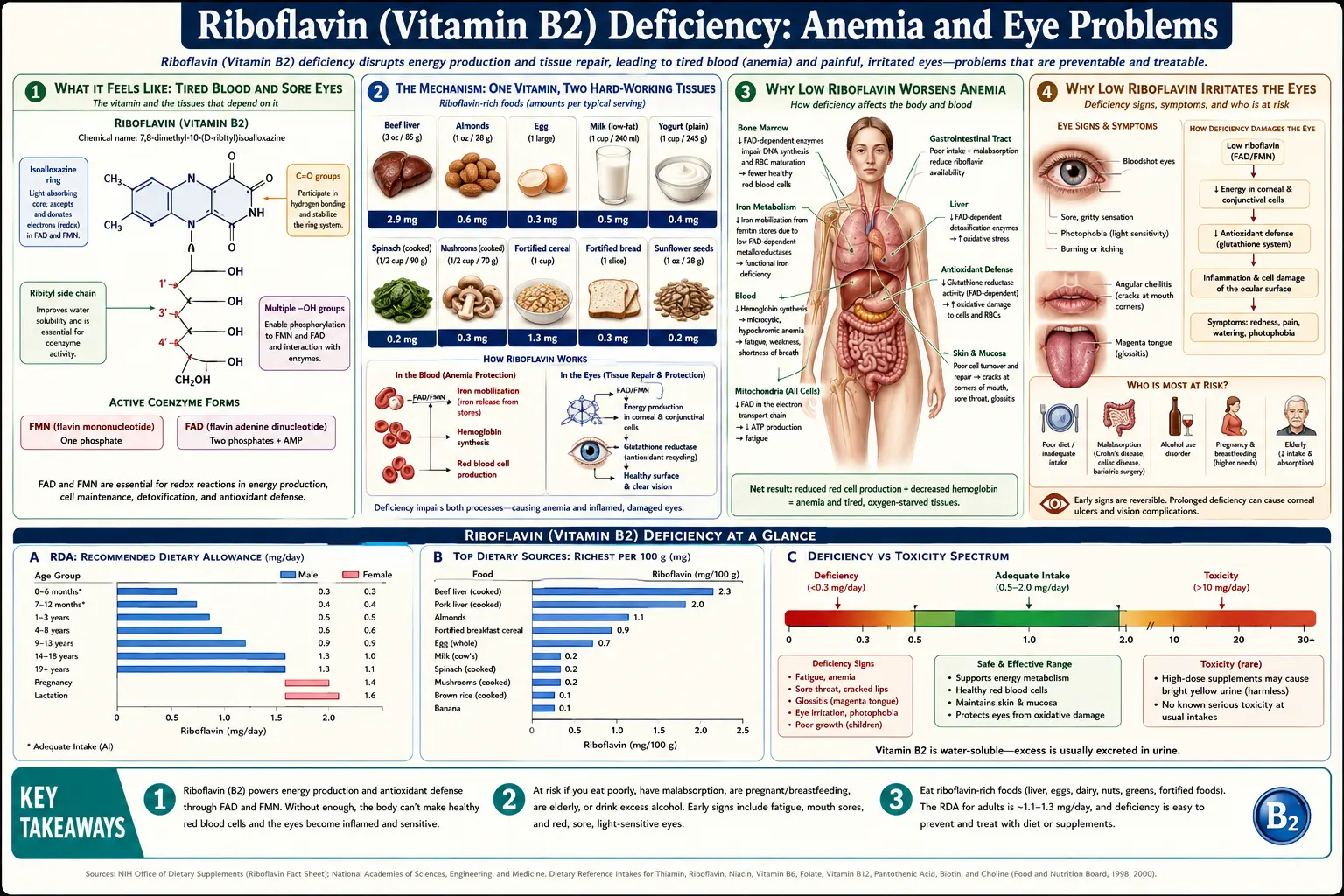
Two of the quieter signs that your body is running short of riboflavin show up in places you might never connect: your blood and your eyes. A long-standing shortfall can leave you mildly anemic — tired, pale, and short of breath — not because riboflavin is part of red blood cells, but because it quietly props up the iron that is. And the same shortage can make your eyes feel gritty, burning, and painfully sensitive to bright light, because the cells lining the front of the eye are exactly the kind of fast-renewing tissue that suffers first when this vitamin is scarce. This page explains why one missing B vitamin can ripple into both the blood and the eyes, how to tell when riboflavin is the real culprit (it usually is not the only one), and how the problem is confirmed and corrected.
Table of Contents
- What It Feels Like: Tired Blood and Sore Eyes
- The Mechanism: One Vitamin, Two Hard-Working Tissues
- Why Low Riboflavin Worsens Anemia
- Why Low Riboflavin Irritates the Eyes
- Honesty: Many Things Cause Anemia and Sore Eyes
- Clues That Point Toward Riboflavin
- What Causes Riboflavin to Run Low
- Getting Tested
- Correcting Low Riboflavin Safely
- When to Seek Care / Red Flags
- Key Research Papers
- Connections
- Featured Videos
What It Feels Like: Tired Blood and Sore Eyes
Riboflavin deficiency rarely announces itself with one dramatic symptom. It tends to settle in slowly as a cluster of small complaints, and two of them — the blood and the eyes — are easy to miss or to blame on something else.
The blood side (anemia) feels like ordinary run-down tiredness. Because the anemia that accompanies riboflavin deficiency is usually normochromic and normocytic — meaning the red cells are a normal color and a normal size, just too few of them — there is nothing distinctive about how it feels. People describe:
- Fatigue and low stamina — getting winded on stairs you used to climb easily, needing to rest partway through chores.
- Pallor — a washed-out look to the face, the inside of the lower eyelids, and the nail beds.
- Breathlessness on exertion and a faster heartbeat — the heart works harder to move oxygen when there are fewer red cells to carry it.
- Lightheadedness, cold hands and feet, and difficulty concentrating — the generic, non-specific signs shared by every kind of anemia.
The eye side is more particular and is often what finally makes someone wonder if something nutritional is going on. The classic riboflavin-deficiency eye complaints are:
- Photophobia — an uncomfortable, even painful sensitivity to bright light, so that sunshine or overhead lighting makes you squint and want to look away.
- Burning, itching, and grittiness — the sensation that there is sand or an eyelash in the eye that you can't blink away.
- Watery, easily-tired eyes — eyes that water in light yet still feel dry and strained, and that tire quickly during reading or screen work.
- Bloodshot eyes — visible redness from small blood vessels at the margin of the cornea, which in prolonged, severe deficiency can creep inward across the normally clear cornea (corneal vascularization).
Crucially, these two problem areas usually travel with the more familiar signs of riboflavin deficiency — cracks at the corners of the mouth and chapped lips, a sore throat and a smooth, magenta-colored tongue, and a greasy, scaly rash around the nose and folds of the face. It is the combination, far more than the anemia or the eye symptoms alone, that points a clinician toward riboflavin.
The Mechanism: One Vitamin, Two Hard-Working Tissues
To understand why a single missing vitamin can affect both the blood and the eyes, it helps to know what riboflavin actually does. Riboflavin (vitamin B2) is not used by the body in its raw form. It is converted into two coenzymes — flavin mononucleotide (FMN) and flavin adenine dinucleotide (FAD) — and it is these flavin coenzymes, working as the business end of enzymes called flavoproteins, that do the real work.
Their job is to shuttle electrons during chemical reactions, especially the reactions that release energy from food inside the mitochondria and the reactions that keep the body's antioxidant defenses charged up. (The deeper energy-production story is covered on the riboflavin and mitochondrial energy and glutathione reductase pages.) Because these flavin coenzymes sit at the center of energy metabolism, the tissues that feel a shortage first are the ones that divide fastest and burn the most fuel: the lining of the mouth and gut, the skin, the blood-forming marrow, and the surface of the eye.
An analogy. Think of riboflavin as the rechargeable batteries that power a whole shelf of small but essential tools. The batteries themselves do nothing on the shelf — but slot them in and they run the iron-handling tool, the antioxidant-recharging tool, the folate-activating tool, and the energy-release tool. When the batteries run low, every tool keeps running for a while on reserves, but the tools that are used hardest, all day, every day — the ones in fast-renewing tissue — are the first to stutter. The blood and the front of the eye are two such heavily-used tools, which is why they fail in parallel.
Why Low Riboflavin Worsens Anemia
Riboflavin is not a building block of red blood cells the way iron, vitamin B12, and folate are. Instead, it works behind the scenes to keep the iron supply line running, and that is why a shortage shows up as anemia. There are several linked reasons:
- It helps the body mobilize and recycle iron. Flavin coenzymes are needed to release iron from ferritin, the body's iron storage protein, so the iron can be sent to the marrow to build new red cells. When riboflavin is low, iron gets “stuck” in storage — present in the body but not available for the assembly line — so red-cell production falls even when iron stores look adequate. Animal studies established this iron-handling role decades ago, showing that riboflavin-deficient animals handle and absorb iron less efficiently.
- It supports the gut lining that absorbs iron. The cells lining the intestine turn over rapidly and depend on riboflavin. When the lining is impaired by deficiency, dietary iron is absorbed less well, compounding the problem.
- It protects red cells from oxidative stress. Riboflavin keeps the enzyme glutathione reductase charged, and glutathione is the antioxidant that shields red blood cells from damage. Poorly defended red cells are more fragile and shorter-lived.
- It works alongside folate and B12. Riboflavin (as FAD) is the cofactor for the enzyme MTHFR, a key step in folate metabolism. A riboflavin shortfall can therefore drag down folate activation, and folate and B12 are themselves central to making red cells. This overlap is one reason riboflavin deficiency rarely travels alone.
Because the bottleneck is iron handling rather than a missing red-cell ingredient, the resulting anemia is typically normocytic and normochromic — normal-sized, normal-colored red cells, simply too few of them — or it can blur into the small, pale cells of iron deficiency when iron is short as well. A practical and well-documented consequence is that iron-deficiency anemia which won't fully respond to iron supplements alone may improve once riboflavin is also corrected, because the iron can finally be put to use. Population studies have repeatedly linked low riboflavin intake and status to a higher risk of anemia, and reviews of riboflavin and anemia conclude that riboflavin status influences how well the body utilizes iron.
Why Low Riboflavin Irritates the Eyes
The front surface of the eye is covered by the cornea and the thin conjunctiva, and like the lining of the mouth these are rapidly-renewing, metabolically busy tissues that lean heavily on riboflavin's flavin coenzymes for energy and antioxidant protection. The cornea also has a special vulnerability: it is normally clear and completely free of blood vessels, getting its oxygen directly from the air and its nutrients from tears and the fluid behind it. That avascular clarity is what lets you see through it.
When riboflavin runs low, two things happen at the eye's surface. First, the surface cells become inflamed and poorly maintained, producing the burning, itching, gritty, light-sensitive, easily-tired eyes that patients describe — a picture sometimes grouped with the other deficiency signs under the old term ariboflavinosis. Second, in prolonged and severe deficiency, tiny blood vessels begin to grow inward from the edge of the cornea across its normally clear surface — corneal vascularization. This was demonstrated experimentally in classic studies of riboflavin-deficient animals, in which a previously clear cornea developed an invading network of new vessels that regressed when riboflavin was restored.
An analogy. Picture the cornea as a clean pane of glass kept clear by constant maintenance. Riboflavin helps power that maintenance crew. Starve the crew of fuel and the glass first gets smudged and irritated (the burning, gritty, light-sensitive stage); leave it long enough and the surrounding plumbing starts running pipes across the pane to try to nourish the struggling tissue (corneal vascularization). The good news is that, caught in time, restoring riboflavin lets the crew get back to work and the smudging — and even early vessel growth — can clear.
It is worth being clear about severity: the burning, itching, light-sensitive eyes are relatively common when riboflavin status is poor, whereas dense corneal vascularization is a sign of severe, long-standing deficiency and is uncommon where diets contain dairy, eggs, or meat. Photophobia and surface irritation are the everyday face of this problem; the dramatic corneal changes are the rare, advanced end.
Honesty: Many Things Cause Anemia and Sore Eyes
This is the most important section on the page, because it is easy to read a list of symptoms and leap to a single cause. Neither anemia nor sore, light-sensitive eyes is unique to riboflavin deficiency — in fact, for both, riboflavin is far from the most common explanation.
Anemia has many causes, and riboflavin is rarely the main one. By far the most common cause worldwide is iron deficiency — from blood loss (heavy periods, gastrointestinal bleeding), inadequate intake, or poor absorption. Vitamin B12 and folate deficiencies produce a large-cell (macrocytic) anemia. Chronic kidney disease, chronic inflammation, thyroid disease, inherited disorders such as thalassemia and sickle cell disease, and many medications all cause anemia. Riboflavin deficiency is best understood as a contributor that worsens or perpetuates anemia — especially iron-related anemia — rather than as a common stand-alone cause. The broader picture is on the Anemia page.
Burning, gritty, light-sensitive eyes have an even longer list of causes. The everyday culprits are dry eye disease, too much screen time, allergies, contact-lens overwear, eye strain, and ordinary conjunctivitis. Photophobia can accompany migraine, eye infections, inflammation inside the eye (uveitis), corneal abrasions, and certain medications. A clinician will think of these common, treatable explanations long before reaching for a riboflavin test — and rightly so.
The honest bottom line: if you have anemia or sore eyes in isolation, riboflavin deficiency is an unlikely sole explanation and the common causes above should be investigated first. Riboflavin moves up the list mainly when these symptoms appear together, alongside the mouth, tongue, and skin signs, and in someone whose diet or circumstances make a shortfall plausible.
Clues That Point Toward Riboflavin
Given how non-specific anemia and sore eyes are on their own, what raises the suspicion that riboflavin is genuinely involved? A few patterns:
- The full cluster appears together. Anemia and irritated eyes plus cracked lips and angular cheilitis, a sore throat and magenta tongue, and seborrheic skin changes is a far more convincing riboflavin picture than any one sign alone.
- The diet or situation fits. Riboflavin comes heavily from dairy, eggs, and meat. People who consume little or none of these — some vegans, people with very limited diets, those in food insecurity — are more plausibly short of it.
- Iron-deficiency anemia that stalls on iron alone. When anemia doesn't fully correct despite adequate iron therapy, an unaddressed riboflavin (or B12/folate) shortfall is one of the things worth considering.
- Other B vitamins are likely low too. Because the B vitamins share food sources, a deficiency rarely occurs in isolation. Finding signs of more than one B-vitamin shortfall makes the whole pattern more credible.
- Symptoms ease quickly after riboflavin is restored. The surface eye irritation and the general picture often improve within days to a couple of weeks of correcting intake — a response that supports the diagnosis in hindsight.
None of these clues is proof. They simply move riboflavin up or down the list of explanations a clinician weighs against the far more common causes of anemia and eye irritation.
What Causes Riboflavin to Run Low
Frank, severe riboflavin deficiency is uncommon in countries where dairy, eggs, and meat are part of the diet, because those foods are rich and reliable sources. Marginal (mild, subclinical) riboflavin status, however, is more widespread than many people realize — documented even in parts of wealthy countries — and the situations that drive a true deficiency include:
- A diet low in dairy, eggs, and meat. This is the central dietary risk. Milk and yogurt are especially important contributors; people who avoid them without deliberate replacement can drift low. (Note that riboflavin is destroyed by light, which is one reason milk is sold in opaque containers.)
- Pregnancy and breastfeeding. Requirements rise, and marginal status is well documented in pregnancy — a time when anemia is also common, so the two can compound.
- Older age and limited or monotonous diets. Reduced intake and variety lower riboflavin along with other nutrients.
- Heavy alcohol use. Alcohol reduces both the intake and the absorption of riboflavin and many other B vitamins.
- Malabsorption. Conditions such as celiac disease, inflammatory bowel disease, and short-bowel states, as well as some gut surgeries, impair absorption.
- Increased needs or losses. Some chronic illnesses, certain medications, and very high physical demands raise requirements or losses.
An interesting genetic angle ties riboflavin to anemia and beyond: people who carry two copies of the common MTHFR 677C→T gene variant rely especially heavily on riboflavin to keep their folate metabolism running, and riboflavin status influences outcomes such as blood pressure in this group. It is a reminder that “how much riboflavin is enough” is partly individual.
Getting Tested
There is no single “riboflavin level” on a routine blood panel, and because the anemia and eye symptoms are non-specific, testing usually proceeds in two directions at once: confirm and characterize the anemia, and look for the deficiency pattern.
- Complete Blood Count (CBC). A Complete Blood Count confirms anemia and, importantly, describes the red cells. Normal-sized, normal-colored cells (normocytic, normochromic) fit riboflavin's contribution; small pale cells point to iron; large cells point to B12 or folate. The red-cell indices are a major clue to which deficiency is at work.
- Iron studies. Because riboflavin and iron are so intertwined, an Iron Panel (ferritin, serum iron, transferrin saturation) is usually checked to see whether iron is also short or simply not being mobilized.
- The riboflavin-specific test. The standard functional measure of riboflavin status is the erythrocyte glutathione reductase activation coefficient (EGRAC) — a clever test that measures how much a riboflavin-dependent enzyme in red cells “perks up” when extra FAD is added in the lab. A big jump means the cells were starved of riboflavin. Plasma or urinary riboflavin can also be measured. These tests are used mainly in research and specialist settings rather than ordered routinely.
- B12 and folate. Given the overlap, B12 and folate are commonly checked alongside, since they cause anemia and frequently run low together with riboflavin.
- An eye exam. If eye symptoms are prominent, an ophthalmologist or optometrist examines the cornea and conjunctiva directly, both to look for changes consistent with deficiency and — more often — to find the common eye conditions that better explain the symptoms.
In everyday practice, because frank riboflavin deficiency is uncommon and the symptoms overlap with common conditions, the diagnosis is frequently a clinical one: the recognizable cluster of signs in a plausible person, often confirmed in hindsight by a prompt response to better riboflavin intake.
Correcting Low Riboflavin Safely
The reassuring news is that riboflavin is inexpensive, widely available, and remarkably safe, and the deficiency responds quickly once intake improves. The approach is food first, supplements when needed, and — always — treating the other deficiencies that usually accompany it.
- Food first. The richest everyday sources are milk and yogurt, eggs, and meat — especially organ meat such as beef liver. Plant contributors include almonds, spinach and other green vegetables, mushrooms, and fortified grains and cereals. The full food list and recommended intakes are on the Vitamin B2 food sources page. For most people, simply adding dairy, eggs, or fortified foods restores riboflavin reliably.
- Recommended intake. The adult Recommended Dietary Allowance (RDA) for riboflavin is about 1.3 mg/day for men and 1.1 mg/day for women, with higher needs in pregnancy (1.4 mg) and breastfeeding (1.6 mg). These are small amounts that a balanced diet easily meets.
- Supplements. When diet can't close the gap — or to treat a documented deficiency — riboflavin supplements (often as part of a B-complex or multivitamin) work quickly. Because riboflavin is water-soluble, the body excretes the surplus; the only common “side effect” is harmless bright-yellow urine. There is no established upper limit and no recognized toxicity from oral riboflavin (the honest detail is on the Vitamin B2 toxicity page).
- Treat the iron, B12, and folate too. Because the anemia is so often a team effort, correcting riboflavin in isolation may not fully fix the blood count. If iron, B12, or folate is also low, those must be replaced as well — and, as noted, an iron-deficiency anemia that stalled on iron alone may finally improve once riboflavin is restored.
- Eye comfort while you heal. Lubricating (artificial-tear) drops, sunglasses for light sensitivity, and reduced screen strain can ease surface eye symptoms while nutrition is corrected. If a separate eye condition such as dry eye disease is also present, it is treated on its own merits.
When to Seek Care / Red Flags
Mild riboflavin shortfall is corrected calmly with diet and, if needed, a supplement. But anemia and eye symptoms can also signal problems that need prompt medical attention, so certain features mean see a clinician without delay:
- Marked breathlessness, chest pain, a racing or pounding heartbeat, or fainting — anemia severe enough to strain the heart is urgent, regardless of the cause.
- Signs of internal bleeding — black or tarry stools, blood in the stool or vomit, or very heavy menstrual bleeding. Anemia from blood loss needs the source found and treated; it is not a vitamin problem.
- Anemia that does not improve despite treatment, or that keeps coming back — this needs a proper diagnostic work-up, not repeated guessing.
- Eye pain, sudden light sensitivity, redness with discharge, or any change in vision — these can mean infection, inflammation inside the eye, or a corneal problem that requires same-day eye care. Do not assume sore eyes are “just a vitamin.”
- Symptoms in pregnancy — anemia and fatigue in pregnancy should always be assessed by your maternity care provider rather than self-treated.
The guiding principle is that riboflavin deficiency is a diagnosis of pattern and plausibility, never a reason to skip evaluating dangerous causes of anemia or eye disease. When the picture is severe, sudden, or not adding up, the common and serious explanations come first.
Key Research Papers
- Powers HJ (2003). Riboflavin (vitamin B-2) and health. The American Journal of Clinical Nutrition;77(6):1352-1360. — DOI: 10.1093/ajcn/77.6.1352
- Suwannasom N, Kao I, Pruss A, Georgieva R, Baumler H (2020). Riboflavin: The Health Benefits of a Forgotten Natural Vitamin. International Journal of Molecular Sciences;21(3):950. — DOI: 10.3390/ijms21030950
- Aljaadi AM, Devlin AM, Green TJ (2023). Riboflavin intake and status and relationship to anemia. Nutrition Reviews;81(1):114-132. — DOI: 10.1093/nutrit/nuac043
- Shi Z, Zhen S, Wittert GA, Yuan B, Zuo H, Taylor AW (2014). Inadequate Riboflavin Intake and Anemia Risk in a Chinese Population: Five-Year Follow Up of the Jiangsu Nutrition Study. PLoS ONE;9(2):e88862. — DOI: 10.1371/journal.pone.0088862
- Powers HJ (1985). An Experiment to Determine the Effect of Riboflavin Deficiency at Weaning on Iron Economy and Heme Synthesis. Annals of Nutrition and Metabolism;29(5):261-266. — DOI: 10.1159/000176980
- Guo M, Li M, Liu X, et al. (2016). Plasma riboflavin is a useful marker for studying riboflavin requirement in Chinese male adults. Nutrition Research;36(6):534-540. — DOI: 10.1016/j.nutres.2016.02.003
- Sydenstricker VP, Sebrell WH, Cleckley HM, Kruse HD (1939). Vascularization of the cornea of the rat in riboflavin deficiency, with a note on corneal vascularization in vitamin A deficiency. The Journal of Experimental Medicine;69(1):1-10. — DOI: 10.1084/jem.69.1.1
- McNulty H, Strain JJ, Hughes CF, Ward M (2017). Riboflavin, MTHFR genotype and blood pressure: A personalized approach to prevention and treatment of hypertension. Molecular Aspects of Medicine;53:2-9. — DOI: 10.1016/j.mam.2016.10.002
- Horigan G, McNulty H, Ward M, Strain JJ, Purvis J, Scott JM (2010). Riboflavin lowers blood pressure in cardiovascular disease patients homozygous for the 677C→T polymorphism in MTHFR. Journal of Hypertension;28(3):478-486. — DOI: 10.1097/HJH.0b013e328334c126
PubMed Topic Searches
- PubMed — Riboflavin deficiency, anemia, and iron
- PubMed — Riboflavin and iron absorption / utilization
- PubMed — Riboflavin deficiency and corneal vascularization
- PubMed — Ariboflavinosis and ocular symptoms (photophobia)
- PubMed — Riboflavin status, EGRAC, and marginal deficiency
Connections
- All Vitamins
- Vitamin B2 Deficiency Hub
- Cracked Lips and Mouth Sores
- Sore Throat and Swollen Tongue
- Skin Rashes
- Vitamin B2 Toxicity
- Vitamin B2 Overview
- Riboflavin and Mitochondrial Energy
- Riboflavin and Glutathione Reductase
- Vitamin B2 Food Sources
- Anemia
- Iron
- Vitamin B12
- Folate (Vitamin B9)
- Dry Eye Disease
- Complete Blood Count
- Iron Panel
- Milk
- Eggs
- Beef Liver