Riboflavin (Vitamin B2) Deficiency: Cracked Lips and Mouth Sores
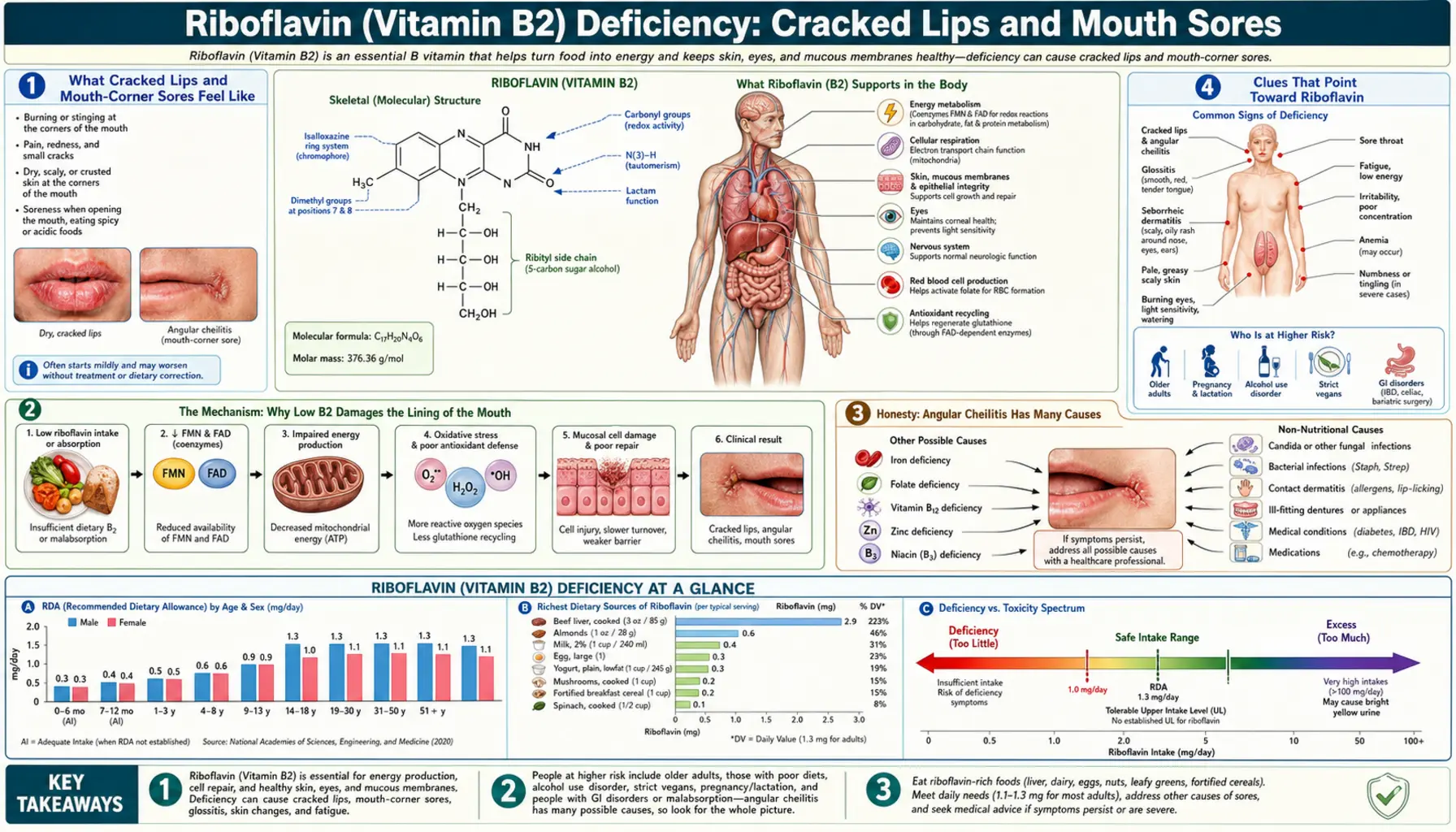
If the corners of your mouth keep splitting, stinging, and crusting over — and your lips feel chronically dry, scaly, or cracked — that combination has a name doctors have used for almost a century. The cracks at the mouth corners are angular cheilitis (also called angular stomatitis or perlèche); the dry, fissured, peeling lips are cheilosis. Both were among the very first signs described when scientists deliberately depleted volunteers of riboflavin (vitamin B2) in the 1930s and 1940s. But here is the honest part you need up front: angular cheilitis has many causes — saliva pooling in the mouth folds, ill-fitting dentures, a Candida yeast or staph infection, iron or B12 deficiency, and more — and riboflavin shortage is only one of them. This page explains why low B2 produces these mouth changes, names the far more common everyday causes you should rule out first, and shows when the cracks really do point to a vitamin problem.
Table of Contents
- What Cracked Lips and Mouth-Corner Sores Feel Like
- The Mechanism: Why Low B2 Damages the Lining of the Mouth
- Honesty: Angular Cheilitis Has Many Causes
- Clues That Point Toward Riboflavin
- What Lowers Riboflavin in the First Place
- Getting Tested
- Healing the Corners and Restoring B2
- When to Seek Care / Red Flags
- Key Research Papers
- Connections
- Featured Videos
What Cracked Lips and Mouth-Corner Sores Feel Like
The picture is distinctive once you know what to look for, and it tends to involve two related areas: the corners of the mouth and the lips themselves.
- Splits at the corners of the mouth (angular cheilitis). The skin where the upper and lower lips meet becomes red, raw, and cracked. The fissures sting or burn — especially when you open wide to yawn, laugh, eat, or smile — and they may bleed a little, then crust over and re-crack. Many people describe a maddening cycle: it almost heals, then splits open again the moment they open their mouth.
- Dry, scaly, fissured lips (cheilosis). The lips lose their smooth surface and become chapped, peeling, and vertically cracked, sometimes with a reddened border. Lip balm helps the surface feel better but does not make the underlying problem go away.
- A sore, burning quality rather than itch. The discomfort is usually described as raw, stinging, or burning rather than itchy, and it is worse with movement and with acidic or salty food.
- Company it keeps. When riboflavin is genuinely the cause, these mouth changes rarely travel alone. They tend to come bundled with a sore throat and a swollen, magenta-colored tongue, sometimes with a greasy, scaly rash around the nose and folds of the face (see skin rashes), and occasionally with tired, gritty, light-sensitive eyes.
This cluster — cracked corners, sore lips, sore tongue, facial rash — is the classic syndrome that early researchers called ariboflavinosis (literally, “without riboflavin”). The corner cracks were one of the most reliable early signs they could produce and reverse on demand by removing and then restoring B2.
The Mechanism: Why Low B2 Damages the Lining of the Mouth
Riboflavin’s job in the body is to become two business-end molecules — flavin mononucleotide (FMN) and flavin adenine dinucleotide (FAD). These two “flavin” cofactors clip into dozens of enzymes (collectively called flavoproteins) that run the cell’s energy assembly line, helping turn food into usable energy and shuttling electrons through metabolism. Riboflavin is also part of the system that keeps the body’s master antioxidant, glutathione, recharged, so flavins help protect cells from oxidative wear and tear.
Now think about which tissues feel a shortage first. The skin and the moist lining (mucosa) of the lips and mouth are among the body’s fastest-renewing tissues — the cells turn over constantly, like a conveyor belt that never stops. Fast-renewing tissue has a high energy demand and a constant need to build new cells, which makes it especially dependent on the flavin-driven enzymes. When riboflavin runs short, those tissues are among the first to show it: the lining thins, becomes inflamed, and loses its normal resilience.
An analogy. Picture the corner of your mouth as a hinge that flexes hundreds of times a day every time you talk, eat, or smile. Healthy skin at that hinge is like supple, well-oiled leather — it bends without splitting. Riboflavin is part of what keeps that leather supple by powering the rapid repair of the skin there. Starve the hinge of B2 and the leather dries, thins, and cracks at exactly the fold that takes the most flexing — the corner of the mouth. Restore the riboflavin and the repair line catches back up, the leather softens, and the cracks knit closed.
There is a second, vicious-circle layer. A cracked, moist corner is a perfect home for microbes — especially the yeast Candida albicans and the bacterium Staphylococcus aureus. Once a riboflavin-weakened corner splits and stays damp, these organisms move in and keep the inflammation going even after the original trigger fades. That is why the cracks can become so stubborn, and why simply restoring B2 sometimes is not enough on its own — the secondary infection may need treating too (covered below). It is also why doctors think about more than one cause at a time.
Honesty: Angular Cheilitis Has Many Causes
This is the section to read carefully, because it is where well-meaning advice most often goes wrong. Angular cheilitis is common, and riboflavin deficiency is far from its most common cause. In well-nourished countries, the great majority of mouth-corner cracks are local and mechanical — they have nothing to do with a vitamin level at all. Before you reach for a B2 supplement, weigh these much more frequent explanations:
- Saliva pooling and skin maceration. This is the single biggest cause. When the corners of the mouth stay constantly wet — from drooling at night, lip-licking, a deep mouth fold, or sagging at the corners with age — the skin softens, breaks down, and cracks. Anything that deepens the fold (lost teeth, dentures, or simply aging that shortens the lower face) makes a moist trough where saliva collects.
- Dentures and bite changes. Ill-fitting or old dentures, or a collapsed bite, change the shape of the mouth corners and trap moisture. Angular cheilitis is genuinely common in denture wearers, and it is often paired with denture-related yeast overgrowth on the palate.
- Candida (yeast) and bacterial infection. Candida albicans and Staphylococcus aureus are recovered from a large share of angular cheilitis lesions. In one denture study, cultures from the cracked corners were dominated by Candida species. Infection can be the primary driver, not just a passenger.
- Other nutritional shortfalls. Riboflavin is only one B-vitamin implicated. Vitamin B12, folate, vitamin B6, and especially iron deficiency can all produce angular cheilitis — iron-deficiency is a classic cause, often alongside a sore tongue and the pallor of anemia.
- Skin and allergy. Eczema, contact allergy (to toothpaste flavorings, lip products, nickel, or even mango/citrus), and habitual lip-licking dermatitis all crack the lips and corners.
- Dry mouth and medications. Drugs and conditions that dry the mouth, oral retinoid acne medicines that chap the lips, and dehydration can all leave the lips fissured.
- Diabetes and immune suppression. Poorly controlled diabetes and any cause of weakened immunity raise the risk of the yeast-driven version.
So a single split at one corner of the mouth, in an otherwise healthy person who licks their lips in winter, is overwhelmingly likely to be local irritation — not vitamin B2 deficiency. The vitamin angle becomes worth taking seriously only when the pattern and the company it keeps point that way, which is the next section.
Clues That Point Toward Riboflavin
How do you tell apart a run-of-the-mill cracked corner from one that signals a genuine B2 problem? No single feature is proof, but the following pattern shifts the odds toward riboflavin (and toward checking for deficiency rather than just treating the skin):
- It is not just the corners. Isolated angular cheilitis is usually local. Riboflavin deficiency tends to hit the whole oral “system” at once — cracked corners plus a sore, swollen, smooth or magenta-purple tongue, sore lips, and often a greasy scaly rash on the face. When several of these show up together, think nutrition.
- Other B2 signs are present. Gritty, watery, light-sensitive eyes; a scaly rash around the nose, ears, or genitals (seborrheic-type dermatitis); and unusual fatigue can accompany the mouth changes. See the sibling pages on anemia and eye problems and skin rashes.
- The diet plausibly lacks B2. Riboflavin comes heavily from milk and dairy, eggs, organ meats like liver, and fortified grains. People who consume little or none of these — some vegans, people who avoid dairy, those with very limited diets, heavy alcohol use, or food insecurity — are genuinely at risk.
- It coexists with other deficiencies. Riboflavin shortage rarely travels alone; it usually rides along with other B-vitamin and iron gaps, because the same poor diet or malabsorption depletes several at once. Multiple deficiencies showing up together is itself a clue.
- It improves only when B2 is restored. If the corners stubbornly resist barrier creams and antifungal treatment but heal once riboflavin (often as part of a B-complex) is added, that response after the fact supports the nutritional explanation.
The practical takeaway: treat the local causes first (keep the corners dry, fix the denture, treat any yeast), and if the problem is widespread, recurrent, or comes packaged with the other oral and skin signs above, get tested for the deficiencies rather than guessing.
What Lowers Riboflavin in the First Place
Frank riboflavin deficiency is uncommon in places with fortified grains and a normal dairy intake, because the requirement is modest and many everyday foods supply it. When it does occur, a recognizable set of situations is usually behind it — and they often overlap:
- A diet low in dairy, eggs, and meat. These are the richest everyday sources. Diets that exclude them without deliberate substitution — some vegan patterns, dairy avoidance, or simply a narrow, processed diet — are the leading dietary cause.
- Poverty and food insecurity. When fresh dairy, eggs, and meat are unaffordable or unavailable, intake can fall short. Riboflavin deficiency remains common in parts of the world where these foods are scarce.
- Pregnancy and breastfeeding. The need for riboflavin rises during pregnancy and lactation, so a marginal diet that was “just enough” before can tip into shortfall.
- Heavy alcohol use. Alcohol reduces both the intake and the absorption of riboflavin and other B vitamins, which is why mouth and tongue changes are common in people who drink heavily.
- Malabsorption. Conditions that impair absorption in the small intestine — celiac disease, Crohn’s disease, and other gut disorders — can limit how much riboflavin the body takes up from food.
- Light exposure of food, and certain medicines. Riboflavin is destroyed by light, so milk stored in clear containers in sunlight loses some of its B2. A few medications can also interfere with how the body handles riboflavin.
- Rare inherited problems. Uncommon genetic defects in riboflavin transport exist and cause severe, early-onset disease; these are diagnosed and managed by specialists and are very different from the everyday dietary shortfall described here.
Because the same circumstances — a poor diet, alcohol, or malabsorption — deplete several nutrients at once, riboflavin deficiency is best thought of as a marker that the whole diet may be inadequate, prompting a look at iron, folate, B6, and B12 as well.
Getting Tested
Most angular cheilitis never needs a blood test — a clinician or dentist will first look for the obvious local cause (saliva pooling, a denture problem, a yeast infection) and treat it. Testing for deficiency comes in when the picture is widespread, recurrent, resistant to local treatment, or accompanied by the other oral, skin, and eye signs of a vitamin problem.
Riboflavin status is not a routine number on a standard panel, and it is somewhat awkward to measure. The most reliable laboratory method is the erythrocyte glutathione reductase activation coefficient (EGRAC) — a red-blood-cell test that measures how much a riboflavin-dependent enzyme “perks up” when extra flavin is added in the lab; a large jump means the body was running short. This test is used mainly in research and specialized settings. Urinary riboflavin excretion is another marker. In ordinary practice, a clinician faced with classic mouth changes will often look at the whole nutritional picture rather than order an isolated B2 assay.
Because the look-alike causes matter, the more useful first tests are usually aimed at the company riboflavin keeps. A Complete Blood Count can reveal the anemia of iron, folate, or B12 deficiency; iron studies, a folate level, and a B12 level pin down the most common nutritional causes of angular cheilitis; and a swab of the corner can confirm Candida or Staphylococcus when infection is suspected. A Comprehensive Metabolic Panel and blood glucose help screen for diabetes and general health. The strategy is to confirm or exclude the common causes first, and consider a dedicated riboflavin assessment when those come back clean but the syndrome still fits B2.
Healing the Corners and Restoring B2
Effective treatment usually does two things at once: it calms the local crack, and — if a deficiency is found — it refills the missing nutrient. Skipping either step is why angular cheilitis so often recurs.
- Keep the corners dry and protected. Because pooled saliva is the engine of so many cases, a barrier ointment (such as plain petrolatum or a zinc-oxide paste) at the corners protects the skin while it heals. Breaking the lip-licking habit and treating any underlying drooling or fold problem is central.
- Treat the infection if present. When Candida is involved, a topical antifungal cream clears the yeast; when Staphylococcus is the culprit, a topical antibacterial is used. Combination antifungal/anti-inflammatory creams are commonly prescribed. For denture wearers, cleaning and refitting the denture — and treating any yeast on the palate — is often what finally stops the cycle.
- Food first for riboflavin. If B2 is low, the foundation is riboflavin-rich food: milk and dairy (the classic source), eggs, organ meats like beef liver, lean meats and fish, almonds, leafy greens, and fortified cereals and grains. See the Vitamin B2 food sources page for a fuller list. The adult Recommended Dietary Allowance is roughly 1.1 mg/day for women and 1.3 mg/day for men, a little higher in pregnancy and lactation — amounts a normal mixed diet easily supplies.
- Supplements when needed. When the diet cannot be fixed quickly, when malabsorption is at work, or when several B vitamins are low together, a riboflavin or B-complex supplement corrects the shortfall — usually rapidly. Riboflavin is water-soluble and very well tolerated; the body simply excretes what it does not use (which is why high doses turn urine bright yellow, a harmless effect). Riboflavin deficiency rarely occurs in isolation, so a B-complex is often the practical choice.
- Fix the other deficiencies and the diet. If iron, folate, or B12 are also low, treating them is essential — both for the mouth and for the rest of the body. The most durable result comes from correcting the underlying diet or absorption problem, not from creams alone.
When riboflavin truly is the cause, the response can be striking: the corner cracks, sore lips, and sore tongue often begin to settle within days of restoring B2 — one of the clearest demonstrations early researchers had that the vitamin was responsible. The piece people miss is the local care; a deep mouth fold or an old denture will keep the corners moist and cracking no matter how much B2 you take.
When to Seek Care / Red Flags
Cracked lips and mouth-corner sores are usually a nuisance, not a danger, and most clear with simple care. But see a clinician or dentist — and do not just keep treating it yourself — if any of the following apply:
- It will not heal despite weeks of barrier cream, keeping the area dry, and (if tried) over-the-counter antifungal cream — especially if it keeps coming back.
- A single sore or ulcer that does not heal within about two weeks, or a lump, white or red patch, thickening, or bleeding that does not resolve — any non-healing lesion in or around the mouth should be examined to rule out other conditions, including oral cancer.
- It is spreading, becoming increasingly painful, swollen, warm, or oozing pus — signs of a worsening infection.
- It comes with the wider pattern of deficiency — a sore swollen tongue, a facial rash, fatigue, or signs of anemia — which warrants checking nutrient levels rather than treating the skin in isolation.
- You have diabetes, a weakened immune system, or wear dentures and the corners are recurrently infected — these need targeted treatment and a check for yeast.
- You suspect a deficiency from a very restricted diet, alcohol use, or a gut condition — talk to a clinician about testing and correcting the underlying problem, ideally before starting your own high-dose supplements.
The reassuring bottom line: angular cheilitis itself is rarely serious, and riboflavin deficiency, when it is the cause, is one of the most easily and safely corrected nutritional problems there is. The reason to get it looked at is to be sure you are treating the right cause — and to catch the uncommon non-healing lesion that needs more than a vitamin.
Key Research Papers
- McNulty H, Ward M, Hoey L, et al. (2023). Causes and Clinical Sequelae of Riboflavin Deficiency. Annual Review of Nutrition;43(1):101-122. — DOI: 10.1146/annurev-nutr-061121-084407
- Powers HJ (2003). Riboflavin (vitamin B-2) and health. The American Journal of Clinical Nutrition;77(6):1352-1360. — DOI: 10.1093/ajcn/77.6.1352
- McCormick DB (1989). Two interconnected B vitamins: riboflavin and pyridoxine. Physiological Reviews;69(4):1170-1198. — DOI: 10.1152/physrev.1989.69.4.1170
- Sebrell WH, Butler RE (1939). Riboflavin Deficiency in Man (Ariboflavinosis). Public Health Reports;54(48):2121-2131. — DOI: 10.2307/4583104
- Williams RD, Mason HL, Cusick PL, Wilder RM (1943). Observations on Induced Riboflavin Deficiency and the Riboflavin Requirement of Man. The Journal of Nutrition;25(4):361-377. — DOI: 10.1093/jn/25.4.361
- Wellwood Ferguson J (1944). Ocular Signs of Riboflavin Deficiency. The Lancet;243(6292):431-433. — DOI: 10.1016/s0140-6736(00)58567-5
- Jafari AA, Lotfi-Kamran MH, Falah-Tafti A, Shirzadi S (2013). Distribution Profile of Candida Species Involved in Angular Cheilitis Lesions Before and After Denture Replacement. Jundishapur Journal of Microbiology;6(6):e10884. — DOI: 10.5812/jjm.10884
- Kim J, Kim M, Kho HS (2016). Oral manifestations in vitamin B12 deficiency patients with or without history of gastrectomy. BMC Oral Health;16(1):60. — DOI: 10.1186/s12903-016-0215-y
- National Institutes of Health, Office of Dietary Supplements (2022). Riboflavin — Health Professional Fact Sheet. — ods.od.nih.gov
PubMed Topic Searches
- PubMed — Angular cheilitis: aetiology and management
- PubMed — Riboflavin deficiency, cheilosis, and ariboflavinosis
- PubMed — Angular cheilitis, Candida, Staphylococcus, and dentures
- PubMed — Iron deficiency, angular cheilitis, and glossitis
- PubMed — Nutritional deficiency and oral manifestations
Connections
- All Vitamins
- Riboflavin Deficiency Hub
- B2 Deficiency: Sore Throat & Swollen Tongue
- B2 Deficiency: Skin Rashes
- B2 Deficiency: Anemia & Eye Problems
- Riboflavin Toxicity / Safety
- Vitamin B2 Overview
- Vitamin B2 Food Sources
- Vitamin B12
- Folate (Vitamin B9)
- Vitamin B6
- Iron Deficiency
- Iron Deficiency: Pallor of Anemia
- Complete Blood Count
- Comprehensive Metabolic Panel
- Milk
- Eggs
- Beef Liver
- Diabetes