Addiction and Substance Use Disorders
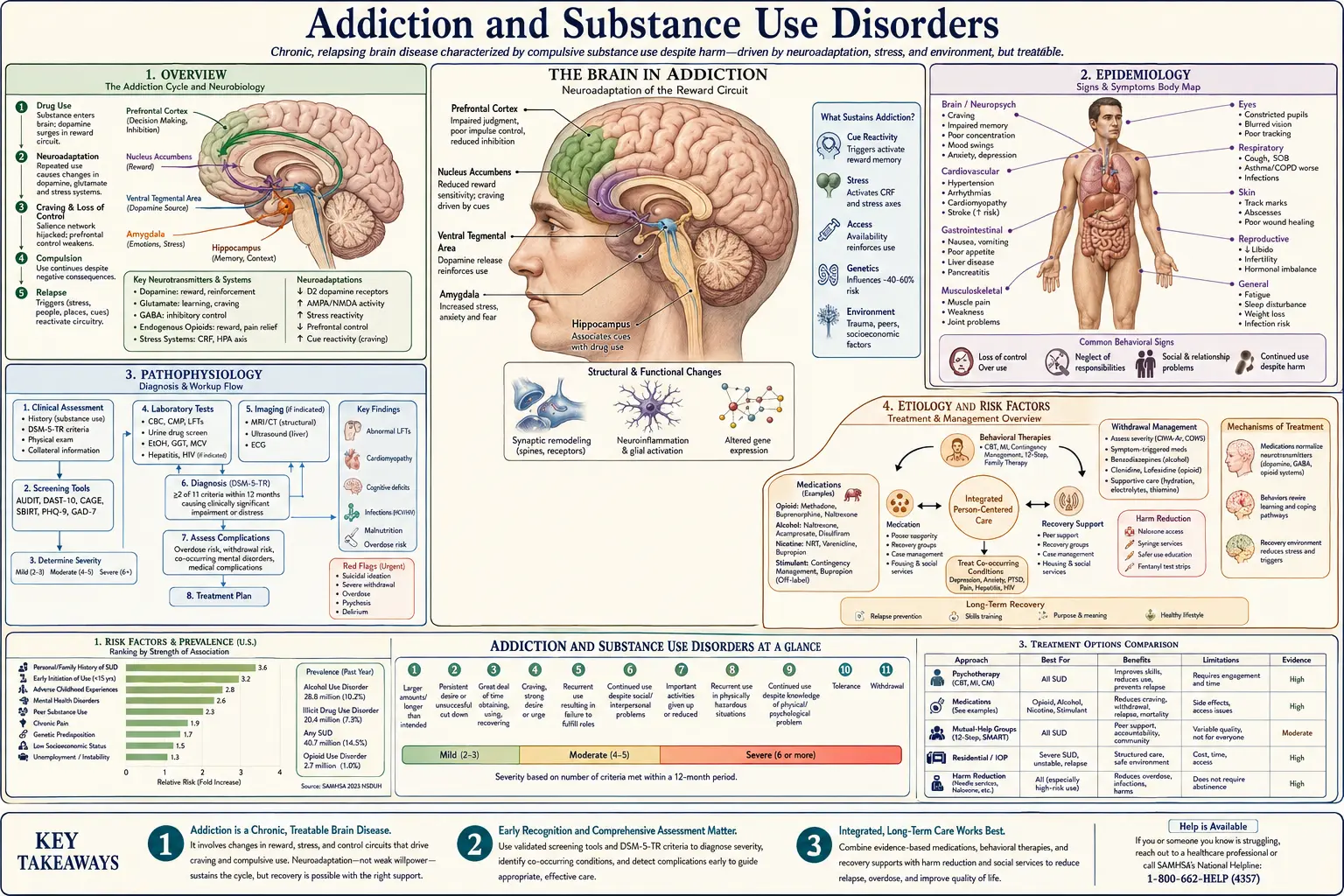
If you or someone you love is struggling with alcohol or other drugs, you are not weak, and you are not alone. Addiction is a treatable medical condition — not a moral failing, not a character flaw, and not a punishment you deserve. Most people who develop a substance use disorder eventually recover. This page explains what addiction actually is in the brain, what treatments genuinely work, and exactly where to find help today. Free, confidential help is available 24/7: call the SAMHSA National Helpline at 1-800-662-4357, or dial 988 (the Suicide & Crisis Lifeline) if you or someone you love is in crisis.
Interactive Visualization Dopamine, Reward & How Habits Hijack You Dopamine is not the pleasure chemical. Watch the spike migrate from the reward to the cue — then withhold the reward and see it dip below zero. That dip is craving. Launch → Interactive Visualization Tolerance & Dependence — why a drug does less, then withdrawal Watch a neuron pull receptors off the surface so a drug does less and less — tolerance — then stop suddenly and see everything rebound the opposite way into withdrawal, and taper slowly to recover safely. Launch →Table of Contents
- Overview
- Epidemiology
- Pathophysiology
- Etiology and Risk Factors
- Clinical Presentation
- Diagnosis
- Treatment
- Complications
- Prognosis
- Prevention
- Recent Research and Advances
- Research Papers
- Connections
- Featured Videos
1. Overview
Addiction — clinically called a substance use disorder (SUD) — is a chronic, treatable brain condition in which a person keeps using a substance despite real harm to their health, relationships, work, or freedom. The key word is despite. Nobody chooses to keep using when it is destroying their life. By the time a use disorder is established, the brain's own decision-making and reward systems have been changed by the drug, and willpower alone is no longer enough — any more than willpower alone fixes diabetes or high blood pressure.
For decades, society treated addiction as a moral problem to be punished. Modern neuroscience tells a different story. Addiction is now understood as a disorder of brain circuits that govern reward, motivation, memory, and self-control. This is the heart of what researchers call the brain disease model: repeated drug use hijacks the same circuitry the brain evolved to make us seek food, safety, and connection (Volkow et al., 2016). Understanding this is not about excusing harmful behavior — it is about pointing people toward treatments that actually work instead of shame that does not.
"Substance" here covers a wide range: alcohol (the most common), opioids (the deadliest right now), nicotine (the biggest overall killer), stimulants (cocaine, methamphetamine, misused prescription stimulants), benzodiazepines and other sedatives, and cannabis. Each behaves differently, but all can produce the same core pattern of loss of control, craving, and continued use despite harm.
2. Epidemiology
Substance use disorders are common — far more common than most people realize, in part because shame keeps them hidden. In the United States, national survey data estimate that roughly 48 million Americans aged 12 and older meet criteria for a substance use disorder in a given year. That is nearly one in six people. If you are struggling, you are part of a very large group, most of whom never tell anyone.
By substance:
- Alcohol use disorder is the most prevalent, affecting roughly 29 million Americans. Excessive alcohol use contributes to more than 140,000 U.S. deaths each year.
- Nicotine remains the leading cause of preventable death — cigarette smoking is linked to about 480,000 U.S. deaths annually, more than alcohol and all illicit drugs combined.
- Opioid use disorder drives the overdose crisis. U.S. drug overdose deaths exceeded 100,000 per year at their recent peak, the majority involving illicitly manufactured fentanyl.
- Stimulants (methamphetamine and cocaine) are involved in a rising share of overdose deaths, increasingly mixed with fentanyl.
- Cannabis use disorder affects a meaningful minority of users — roughly 1 in 10 adults who use cannabis, and a higher fraction of those who start in adolescence.
A critical and hopeful number sits alongside these: research finds that the large majority of people who ever had a substance problem are in recovery or have resolved it — more on that under Prognosis.
3. Pathophysiology
To understand addiction, it helps to understand the brain's reward system. Deep in the brain, a chemical messenger called dopamine signals "this is important, do it again." Naturally rewarding things — a good meal, a hug, an accomplishment — release modest amounts of dopamine. Addictive drugs release far more, and faster. The brain reads that surge as a survival-level signal and rewires itself to chase it.
Three changes turn ordinary use into a disorder:
- Tolerance. The brain adapts to repeated flooding by turning down its own dopamine response. Over time it takes more of the drug to feel the same effect — and normal pleasures feel flat. This is a physical adaptation, not greed.
- Withdrawal. Once the brain has recalibrated around the drug, removing it leaves the person feeling physically and emotionally terrible — sick, anxious, in pain. Use then continues partly just to feel normal, not high.
- Loss of prefrontal control. The prefrontal cortex is the brain's brake pedal — it weighs consequences and says "not now." Chronic drug use weakens this region while strengthening automatic, cue-driven craving. Behavior shifts from a deliberate choice to a near-automatic habit and then a compulsion (Everitt & Robbins, 2016).
This is why "just stop" rarely works on its own: the part of the brain that would carry out that decision is exactly the part the disorder has impaired, while the craving machinery is running on overdrive. Treatment works by stabilizing this biology long enough for the brain to heal.
4. Etiology and Risk Factors
No single thing causes addiction. It emerges from a mix of genes, environment, age, and mental health — which is why it can affect anyone, in any family, at any income level.
- Genetics. Heritability of substance use disorders is high — roughly 40–60% of risk is genetic. Having a parent or sibling with addiction raises risk, though it never makes addiction certain.
- Age of first use. The earlier someone starts, the higher the lifetime risk. The adolescent brain — whose prefrontal "brake" is not fully developed until the mid-twenties — is especially vulnerable to rewiring (Squeglia, 2020).
- Adverse childhood experiences (ACEs). Childhood abuse, neglect, and household dysfunction strongly predict later substance use. The landmark ACE study found a graded, dose-response relationship between early adversity and adult addiction (Felitti et al., 1998).
- Co-occurring mental illness. Depression, anxiety, PTSD, bipolar disorder, and ADHD all raise risk. Many people are unknowingly self-medicating — using a substance to quiet symptoms that have a real, treatable cause.
- Exposure and access. Prescribed opioids after surgery or injury, a high-stress job, a drinking-heavy social world, or simply living where a drug is cheap and available all increase risk.
None of these is a verdict. They are risk factors, not destiny — and several of them (especially treating the underlying mental health condition) are directly addressable.
5. Clinical Presentation
Addiction looks different across substances, but the underlying pattern — using more than intended, wanting to cut down but not being able to, and continuing despite harm — is consistent. Common signs include preoccupation with getting and using the substance, neglecting responsibilities, withdrawal from family and hobbies, mood swings, secrecy, financial trouble, and physical withdrawal symptoms when use stops.
By substance:
- Alcohol: drinking more or longer than intended, morning drinking, blackouts, shakiness or sweating when not drinking. Heavy long-term drinking depletes thiamine (vitamin B1), and abrupt withdrawal can be medically dangerous (see Complications).
- Opioids: drowsiness ("nodding"), pinpoint pupils, constipation, and a brutal flu-like withdrawal (sweats, cramps, restlessness, diarrhea) that drives continued use. Fentanyl's potency makes overdose frighteningly easy.
- Nicotine: strong cravings within an hour of the last cigarette/vape, irritability and difficulty concentrating when trying to quit.
- Stimulants: bursts of energy and euphoria followed by a "crash" of exhaustion, depression, and intense craving; sleeplessness, paranoia, weight loss.
- Benzodiazepines/sedatives: sedation and unsteadiness; dependence develops quietly. Never stop these suddenly — abrupt withdrawal can cause seizures.
- Cannabis: using more frequently and in larger amounts, irritability, sleep problems, and reduced appetite during attempts to quit (Volkow et al., 2014).
Roughly half of people with a substance use disorder also have a co-occurring mental health condition. Treating only the substance, while ignoring the depression, anxiety, or trauma underneath, is a common reason relapse happens — the unmet need is still there.
6. Diagnosis
Clinicians diagnose substance use disorders using the DSM-5, which lists 11 criteria. You do not need a lab test — the diagnosis is based on patterns of behavior and experience over the past year. In plain language, the 11 criteria ask whether a person:
- uses more, or longer, than intended;
- wants or tries to cut down but cannot;
- spends a lot of time getting, using, or recovering from the substance;
- has strong cravings;
- fails to keep up with work, school, or home;
- keeps using despite relationship problems it causes;
- gives up important activities to use;
- uses in physically risky situations;
- keeps using despite knowing it is causing a physical or mental health problem;
- needs more to get the same effect (tolerance);
- has withdrawal symptoms when stopping.
Meeting 2–3 criteria is a mild disorder, 4–5 moderate, and 6 or more severe. Framing it on a spectrum, rather than "addict vs. not," better reflects reality and reduces stigma (Hasin et al., 2013).
Simple, validated screening tools help catch problems early. The AUDIT (Alcohol Use Disorders Identification Test) is a 10-question screen for risky drinking; a primary-care visit is a good place to ask for it. There is no shame in screening — it is as routine as a blood-pressure check.
7. Treatment
Here is the most important message on this page: addiction is treatable, and the treatments are effective. The best outcomes usually combine three things — medication (when one exists for that substance), behavioral therapy, and social/mutual support — matched to the right level of care.
Medications that save lives
- Opioids: buprenorphine and methadone are first-line, evidence-based treatments. They are not "swapping one addiction for another" — they stabilize brain chemistry, stop withdrawal and craving, and let people rebuild their lives. A large systematic review found that being on opioid agonist treatment roughly halves the risk of death compared with being off it (Sordo et al., 2017; Mattick et al., 2014). Naloxone (Narcan) reverses overdoses and should be in every home touched by opioids; fentanyl test strips let people check their supply.
- Alcohol: naltrexone and acamprosate both reduce drinking and relapse, and are recommended first-line — yet they remain badly underprescribed (Jonas et al., 2014; Anton et al., 2006). If you have an alcohol use disorder, it is worth specifically asking a clinician about them.
- Nicotine: varenicline and nicotine replacement therapy (patch, gum, lozenge) meaningfully raise quit rates, especially when combined with counseling (Cahill et al., 2016).
- Stimulants & cannabis: no FDA-approved medication yet, so behavioral treatment leads — with contingency management (below) the strongest evidence for stimulants.
Behavioral therapies that work
- Cognitive behavioral therapy (CBT) teaches people to recognize triggers, manage cravings, and change the thinking patterns that drive use.
- Contingency management — tangible rewards for verified abstinence — has some of the strongest evidence of any psychosocial treatment, particularly for stimulant use disorders (Prendergast et al., 2006).
- Motivational interviewing meets people where they are rather than confronting them, and helps build their own reasons to change.
Mutual-aid and levels of care
Mutual-help groups such as Alcoholics Anonymous (AA) are free, widely available, and — contrary to old skepticism — genuinely effective. A 2020 Cochrane review of 27 studies concluded that AA and clinically delivered 12-step facilitation produce higher rates of continuous abstinence than other established treatments, often at lower cost (Kelly et al., 2020). SMART Recovery is a secular alternative for those who prefer it.
Care is offered at different intensities — from a primary-care office or telehealth visit, to intensive outpatient programs, to residential and medically supervised detox. More intensive is not always better; the right level is the least intensive setting that keeps the person safe and engaged.
Where to start today: the SAMHSA National Helpline (1-800-662-4357) is free, confidential, 24/7, and will connect you to local treatment and support — in English or Spanish.
8. Complications
Untreated substance use disorders carry serious medical risks, which is exactly why getting help matters:
- Overdose — the most acute danger, especially with opioids in the fentanyl era. Keep naloxone on hand.
- Alcohol-related withdrawal can progress to delirium tremens and seizures — this can be fatal and may require medical detox.
- Wernicke encephalopathy — a brain emergency caused by thiamine (B1) deficiency in heavy drinkers; it can cause confusion, loss of coordination, and permanent memory damage if thiamine is not given promptly (Galvin et al., 2010). This is why thiamine is a cornerstone of alcohol recovery.
- Liver disease — cirrhosis and other liver damage from chronic alcohol use.
- Pancreatitis — alcohol is a leading cause of acute and chronic pancreatitis.
- Peripheral neuropathy — nerve damage from alcohol and B-vitamin deficiency.
- Infections — injection drug use raises the risk of hepatitis C, HIV, and heart-valve infections.
- Benzodiazepine withdrawal seizures — why these drugs must be tapered, never stopped cold-turkey.
Benzodiazepine safety: if you have been taking a benzodiazepine regularly, do not stop abruptly. Work with a prescriber on a gradual taper to avoid dangerous withdrawal.
9. Prognosis
This is the section to read on a hard day. Most people with a substance use disorder recover. A national study found that the large majority of U.S. adults who once had a significant alcohol or drug problem now consider themselves in recovery or to have resolved the problem — an estimated tens of millions of Americans (Kelly et al., 2017). Recovery is the rule, not the exception.
It is also worth reframing relapse. Addiction is a chronic illness, and like other chronic illnesses it can flare. Relapse rates for substance use disorders (around 40–60%) are comparable to or lower than relapse rates for type 1 diabetes, hypertension, and asthma when patients stop their treatment (McLellan et al., 2000). When someone with diabetes has a blood-sugar spike, we adjust treatment — we do not call them a failure. Relapse in addiction deserves the same response: it is a signal to adjust care, not proof that treatment "didn't work" or that the person is hopeless.
Sustained recovery typically takes time and more than one attempt. That is normal. Each treatment episode builds skills and insight, and people who stay engaged with care — medication, therapy, support — do well over the long run.
10. Prevention
Prevention works best when it targets the windows of greatest vulnerability:
- Protecting the adolescent brain. Because the prefrontal cortex matures into the mid-twenties, delaying first use of alcohol, nicotine, and cannabis substantially lowers lifetime addiction risk. Honest, non-scare-tactic education and limiting youth access are the evidence-based levers.
- Addressing childhood adversity. Reducing and buffering ACEs — through stable caregiving, mental-health support, and trauma-informed schools — is one of the most powerful upstream prevention strategies (Felitti et al., 1998).
- Treating mental illness early. Catching and treating depression, anxiety, ADHD, and trauma reduces the pull toward self-medication.
- Careful prescribing. Thoughtful use of opioids and benzodiazepines, with clear stop plans, prevents iatrogenic dependence.
- Harm reduction. Naloxone distribution, fentanyl test strips, and safe-supply measures keep people alive long enough to reach recovery — you cannot recover if you do not survive.
Nutrition in recovery
Recovery is also a physical rebuild. In alcohol recovery, repleting thiamine (B1) and other B-vitamins is standard medical practice to prevent and treat nerve and brain damage. Beyond that, the amino acid N-acetylcysteine (NAC) — a form of cysteine — has been studied as an add-on for reducing craving; a controlled trial found it improved abstinence outcomes in cannabis use disorder in adolescents (Gray et al., 2012). NAC is promising but not a stand-alone cure — it is an adjunct to, never a replacement for, evidence-based treatment.
11. Recent Research and Advances
The science of addiction is moving quickly, and the direction is hopeful:
- Expanded access to buprenorphine. The U.S. removed the federal "X-waiver," so any clinician with a standard DEA registration can now prescribe buprenorphine — a major step toward closing the enormous treatment gap.
- Over-the-counter naloxone. Naloxone nasal spray is now available without a prescription, putting overdose reversal within reach of families and bystanders.
- Contingency management at scale. With no medication for stimulant use disorder, health systems are deploying contingency-management programs — the best-evidenced behavioral treatment — more widely.
- Family-focused approaches. Research consistently shows that CRAFT (Community Reinforcement and Family Training) — which coaches loved ones to use positive communication and reinforcement — gets reluctant people into treatment far more often than confrontational "interventions," and improves the family's own wellbeing too (Miller, Meyers & Tonigan, 1999).
- Refined screening. Wider primary-care screening with tools like the AUDIT catches problems earlier, when they are easiest to treat.
A note for families: if you love someone who is struggling, the dramatic surprise "intervention" you have seen on television is not the best-supported approach. CRAFT — learning to reinforce healthy behavior and protect your own boundaries — works better and is kinder to everyone. The SAMHSA helpline can point you to family resources.
12. References & Research
Historical Background
For most of the 19th and early 20th centuries, addiction was framed through a moral lens — a vice to be cured by willpower and temperance, culminating in Prohibition. A more compassionate, self-help approach emerged with the founding of Alcoholics Anonymous in 1935. The first genuinely effective medication arrived in the 1960s, when Vincent Dole and Marie Nyswander demonstrated methadone maintenance for heroin addiction. In 1997, NIDA director Alan Leshner crystallized a paradigm shift with his argument that "addiction is a brain disease," reframing it as a treatable medical condition rather than a moral failure. That reframing ushered in the modern era of medication-assisted treatment (MAT) — buprenorphine, naltrexone, acamprosate, and varenicline — combined with behavioral therapy and peer support that defines best practice today.
Key Research Papers
- Volkow ND, Koob GF, McLellan AT. Neurobiologic Advances from the Brain Disease Model of Addiction. New England Journal of Medicine. 2016;374(4):363–371.
- Everitt BJ, Robbins TW. Drug Addiction: Updating Actions to Habits to Compulsions Ten Years On. Annual Review of Psychology. 2016;67(1):23–50.
- Hasin DS, O'Brien CP, Auriacombe M, et al. DSM-5 Criteria for Substance Use Disorders: Recommendations and Rationale. American Journal of Psychiatry. 2013;170(8):834–851.
- McLellan AT, Lewis DC, O'Brien CP, Kleber HD. Drug Dependence, a Chronic Medical Illness: Implications for Treatment, Insurance, and Outcomes Evaluation. JAMA. 2000;284(13):1689–1695.
- Schuckit MA. Treatment of Opioid-Use Disorders. New England Journal of Medicine. 2016;375(4):357–368.
- Sordo L, Barrio G, Bravo MJ, et al. Mortality risk during and after opioid substitution treatment: systematic review and meta-analysis of cohort studies. BMJ. 2017;357:j1550.
- Mattick RP, Breen C, Kimber J, Davoli M. Buprenorphine maintenance versus placebo or methadone maintenance for opioid dependence. Cochrane Database of Systematic Reviews. 2014;2014(2):CD002207.
- Jonas DE, Amick HR, Feltner C, et al. Pharmacotherapy for Adults With Alcohol Use Disorders in Outpatient Settings: A Systematic Review and Meta-analysis. JAMA. 2014;311(18):1889–1900.
- Anton RF, O'Malley SS, Ciraulo DA, et al. Combined Pharmacotherapies and Behavioral Interventions for Alcohol Dependence: The COMBINE Study. JAMA. 2006;295(17):2003–2017.
- Cahill K, Lindson-Hawley N, Thomas KH, Fanshawe TR, Lancaster T. Nicotine receptor partial agonists for smoking cessation. Cochrane Database of Systematic Reviews. 2016;2016(5):CD006103.
- Prendergast M, Podus D, Finney J, Greenwell L, Roll J. Contingency management for treatment of substance use disorders: a meta-analysis. Addiction. 2006;101(11):1546–1560.
- Kelly JF, Humphreys K, Ferri M. Alcoholics Anonymous and other 12-step programs for alcohol use disorder. Cochrane Database of Systematic Reviews. 2020;(3):CD012880.
- Lee JD, Nunes EV, Novo P, et al. Comparative effectiveness of extended-release naltrexone versus buprenorphine-naloxone for opioid relapse prevention (X:BOT): a multicentre, open-label, randomised controlled trial. The Lancet. 2018;391(10118):309–318.
- Gray KM, Carpenter MJ, Baker NL, et al. A Double-Blind Randomized Controlled Trial of N-Acetylcysteine in Cannabis-Dependent Adolescents. American Journal of Psychiatry. 2012;169(8):805–812.
- Galvin R, Bráthen G, Ivashynka A, et al. EFNS guidelines for diagnosis, therapy and prevention of Wernicke encephalopathy. European Journal of Neurology. 2010;17(12):1408–1418.
- Volkow ND, Baler RD, Compton WM, Weiss SRB. Adverse Health Effects of Marijuana Use. New England Journal of Medicine. 2014;370(23):2219–2227.
- Miller WR, Meyers RJ, Tonigan JS. Engaging the unmotivated in treatment for alcohol problems: A comparison of three strategies for intervention through family members. Journal of Consulting and Clinical Psychology. 1999;67(5):688–697.
- Kelly JF, Bergman B, Hoeppner BB, Vilsaint C, White WL. Prevalence and pathways of recovery from drug and alcohol problems in the United States population. Drug and Alcohol Dependence. 2017;181:162–169.
- Squeglia LM. Alcohol and the developing adolescent brain. World Psychiatry. 2020;19(3):393–394.
- Felitti VJ, Anda RF, Nordenberg D, et al. Relationship of Childhood Abuse and Household Dysfunction to Many of the Leading Causes of Death in Adults: The Adverse Childhood Experiences (ACE) Study. American Journal of Preventive Medicine. 1998;14(4):245–258.
Research Papers
Explore the latest peer-reviewed literature on addiction and substance use disorders through these live PubMed searches. Each link opens current research in a new tab.
- Substance use disorder treatment
- Alcohol use disorder pharmacotherapy
- Opioid agonist treatment
- Fentanyl overdose and naloxone
- Addiction reward circuitry
- Contingency management for stimulants
- Co-occurring mental illness and SUD
- N-acetylcysteine and craving
- Thiamine and Wernicke encephalopathy
- Recovery prevalence and pathways
- CRAFT family approach
- Adverse childhood experiences and addiction
Connections
- Psychiatry
- How Drug Tolerance & Dependence Develop — interactive animation
- Dopamine, Reward & How Habits Hijack You — interactive animation
- Depression
- Anxiety
- PTSD
- Bipolar Disorder
- Insomnia
- ADHD
- Chronic Pain
- Cirrhosis
- Liver Disease
- Pancreatitis
- Peripheral Neuropathy
- Hepatitis C
- Vitamin B1 (Thiamine)
- Cysteine (NAC)