The Gerson Coffee Enema: Step-by-Step Protocol
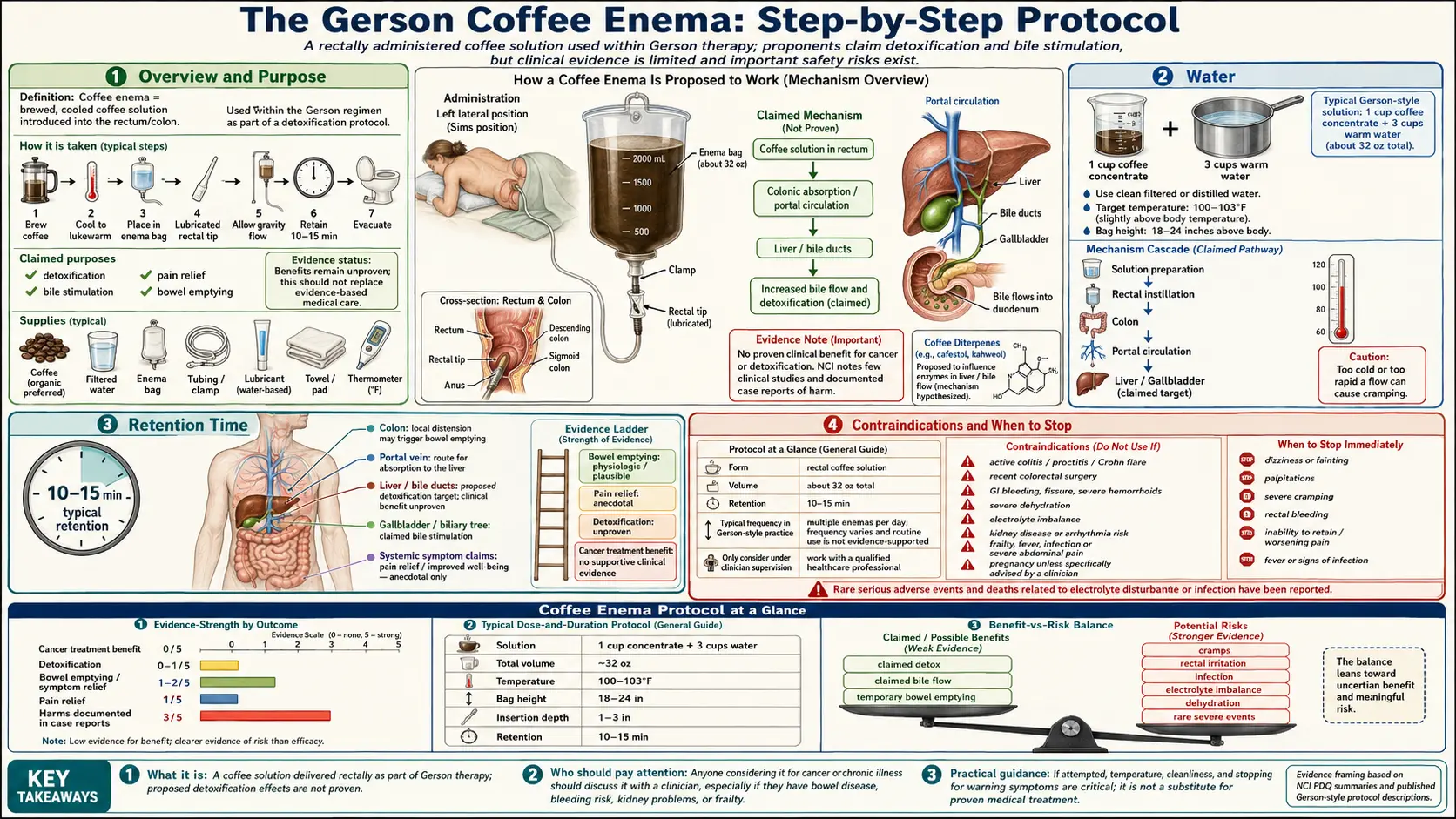
Important. This page describes the protocol exactly as the Gerson Institute publishes it. Coffee enemas carry documented risks including electrolyte disturbance, rectal injury, and infection; deaths have been reported in the medical literature. Read Coffee Enemas: Tradition and Medical Perspective for the full risk discussion before deciding whether to use this practice. Discuss with a qualified physician.
Table of Contents
- Overview and Purpose
- Equipment
- Coffee Bean Selection
- Water
- Brewing the Enema Coffee
- Temperature and Volume
- Body Position and Administration
- Retention Time
- Frequency: Cancer Protocol vs. Wellness Use
- Troubleshooting
- Contraindications and When to Stop
- Key Research and Sources
- Featured Videos
Overview and Purpose
In the Gerson Therapy, the coffee enema is described as a hepatobiliary stimulant rather than a bowel cleanser. The proposed mechanism (see Detoxification) is that compounds in the coffee — theophylline, theobromine, palmitates, kahweol, cafestol, and caffeine — are absorbed through the rectal mucosa, enter the portal venous system, reach the liver in concentrated form, and stimulate bile flow and Phase II glutathione-S-transferase activity. Whether this mechanism produces clinically meaningful detoxification effects has not been demonstrated in randomized trials.
Equipment
- Stainless-steel or glass enema bucket, 1.5 to 2 quart capacity. Plastic buckets are tolerated for travel but glass is preferred for daily home use because of phthalate concerns with hot liquid.
- Silicone or medical-grade rubber tubing, 4 to 6 feet, with a flow-control clamp.
- Smooth-tip enema nozzle, 4 to 6 inches. A short, soft nozzle is preferred over a colon tube for routine use.
- Stainless-steel or enameled cooking pot for brewing (no aluminum).
- Fine-mesh stainless or unbleached muslin filter to remove all grounds before pouring.
- A way to hang the bucket at hip height when the patient is on the floor — usually a hook on a bathroom door, a shower-curtain rod, or a dedicated stand.
- Thick towel or yoga mat for floor comfort.
- Lubricant: a small amount of organic cold-pressed coconut oil or a water-based personal lubricant. Petroleum-based lubricants are avoided.
- A timer.
Coffee Bean Selection
Use organic, light-roast or medium-roast, regular (not decaffeinated) coffee. The Gerson Institute specifies:
- Organic certification (because of pesticide residue).
- Light to medium roast. Dark roasts have lower concentrations of palmitates, cafestol, and kahweol — the compounds Gerson considered most important.
- Whole bean, ground fresh. Pre-ground coffee oxidizes within days.
- Mold-free. Some patients use third-party mycotoxin-tested brands.
- Several Gerson-specific brands exist (S.A. Wilson’s Therapy Blend, Café Mam, others). Any high-quality organic light-roast is acceptable.
Water
Distilled water is used throughout the Gerson Therapy, including for enemas. Tap water with chlorine, fluoride, and unknown trace contaminants is not used. Some patients use spring water with low total dissolved solids; reverse-osmosis filtered water is acceptable. The water for an enema should never be straight tap water in any case.
Brewing the Enema Coffee
Standard daily-batch recipe:
- Bring 1 quart (4 cups, ~950 mL) of distilled water to a vigorous boil in a stainless-steel pot.
- Add 3 tablespoons of organic light-roast ground coffee (about 18–20 g).
- Reduce to a low simmer for exactly 15 minutes. The lid stays off — volatile aromatics are not the target compound.
- Remove from heat. Pour through a fine-mesh stainless or unbleached muslin filter into a clean glass measuring container. Discard grounds.
- Top up with cool distilled water to bring the total volume to 1 quart and the temperature to body temperature (about 100°F / 37–38°C). Test on the inside of the wrist; the liquid should feel neutral, neither warm nor cool.
For two enemas per day, double the batch and brew once; refrigerate the second portion in a closed glass jar and warm by water-bath before use. Brewed coffee for enemas is not stored more than 24 hours.
Temperature and Volume
Temperature is critical. Hot coffee (above 105°F / 41°C) causes rectal mucosal burns — one of the documented serious injuries in the published case literature. Cold coffee causes cramping and is poorly retained. Body temperature is the target. Always test before infusion.
Volume for adults is 1 quart (32 oz, about 950 mL). For first-time users or for patients with rectal irritation, start with half a quart (16 oz) and increase as tolerated. Children under 12 should not perform enemas without explicit medical supervision; the protocol for the children’s version is reduced and individualized.
Body Position and Administration
- Lie on the bathroom floor on a towel or mat, on the right side, with knees drawn toward the chest. The right-side position is intended to use gravity to encourage flow toward the cecum and the hepatic flexure.
- Hang the filled enema bucket about 18–24 inches above the body (hip height when reclined).
- Lubricate the nozzle. Insert gently, 3 to 5 inches.
- Open the clamp slowly. The full quart should infuse over 5 to 10 minutes. If cramping occurs, close the clamp, breathe slowly, and resume when the cramp passes.
- If you cannot retain the full volume, infuse what you can comfortably hold, close the clamp, and stop.
- Withdraw the nozzle, close the clamp, and remain on the right side for the retention period.
Retention Time
The traditional retention is 12 to 15 minutes. Less than 10 minutes is considered insufficient for the bile-stimulation effect; more than 20 minutes does not appear to add benefit and increases cramping. After the retention period, sit on the toilet and release. Stay near a toilet for the next 15 to 30 minutes; some patients pass additional liquid in stages.
If the urge to evacuate is overwhelming before 10 minutes, evacuate. Forcing retention against an urgent rectal stretch reflex risks injury and is not the goal. With practice, retention generally becomes easier; new users who can hold only 5 minutes typically work up to 12–15 minutes within a few weeks.
Frequency: Cancer Protocol vs. Wellness Use
Full cancer protocol: 4 to 5 enemas per day, spaced approximately every 4 hours during waking hours. This is the highest frequency reported in published Gerson literature and corresponds to the highest documented harm risk — severe electrolyte disturbance has been reported almost exclusively in patients on multiple-times-per-day schedules. Patients on this frequency must monitor serum electrolytes (sodium, potassium, magnesium) regularly under physician supervision.
Modified protocol: 1 to 2 enemas per day for several weeks, then tapering to 2 to 3 per week.
Wellness / occasional use: 1 enema 1 to 3 times per week. This is the frequency most commonly used by people who are not pursuing the cancer protocol.
Caution. The body adapts. Daily enemas can lead to a dependence pattern in which normal bowel function declines because the rectum and colon habituate to external stimulation. The Gerson Institute’s response is that the protocol is finite (typically 18–24 months) and dependence resolves on tapering. Long-term, indefinite daily use is not the published recommendation.
Troubleshooting
- Cramping during infusion. Slow the flow, breathe deeply, take a brief break. If cramps persist, the coffee may be too cold, too concentrated, or the volume may be too large.
- Inability to retain. Reduce volume, ensure body-temperature accuracy, and try lying flat or in left-side then right-side rotation.
- Caffeine jitteriness, racing heart, insomnia. The coffee is delivering systemic caffeine. Try a half-batch (1.5 tablespoons of coffee in 1 quart). If symptoms persist, the protocol is not tolerated and should be reconsidered.
- Hemorrhoidal flare or bleeding. Stop until the tissue heals. Consider a softer nozzle and more lubricant. If bleeding recurs, see a clinician.
- Lightheadedness, weakness, palpitations the day after. Suspect electrolyte disturbance, particularly hypokalemia. Stop the protocol, replace electrolytes, and have serum levels checked.
Contraindications and When to Stop
Absolute contraindications — do not perform the protocol if you have any of the following:
- Active gastrointestinal bleeding
- Inflammatory bowel disease (ulcerative colitis, Crohn’s) in active flare
- Recent colonic, rectal, or pelvic surgery
- Diverticulitis or diverticular bleeding
- Pregnancy
- Severe arrhythmia or known electrolyte instability
- Renal failure on dialysis (volume and electrolyte risks)
- Known caffeine sensitivity sufficient to cause arrhythmia or seizures
Stop immediately and seek medical care for: rectal bleeding, severe abdominal pain, fever, palpitations, fainting, profound weakness, dark urine, or any neurological symptom.
Key Research and Sources
- Gerson C, Walker S (2001). The Gerson Therapy. — the most accessible step-by-step protocol description.
- Gerson Institute. “Coffee Enema FAQ” and patient training materials. gerson.org/coffee-enema-8-things-you-need-to-know
- Eisele JW, Reay DT (1980). “Deaths related to coffee enemas.” JAMA. — Search PubMed
- Margolin K, Green M (1984). “Polymicrobial enteric septicemia from coffee enemas.” Western Journal of Medicine. — Search PubMed
- Memorial Sloan Kettering Cancer Center. “Coffee enemas.” mskcc.org
- PubMed search: “coffee enema complications”
- PubMed search: “rectal absorption caffeine”