Gerson Therapy Supplements and Medications
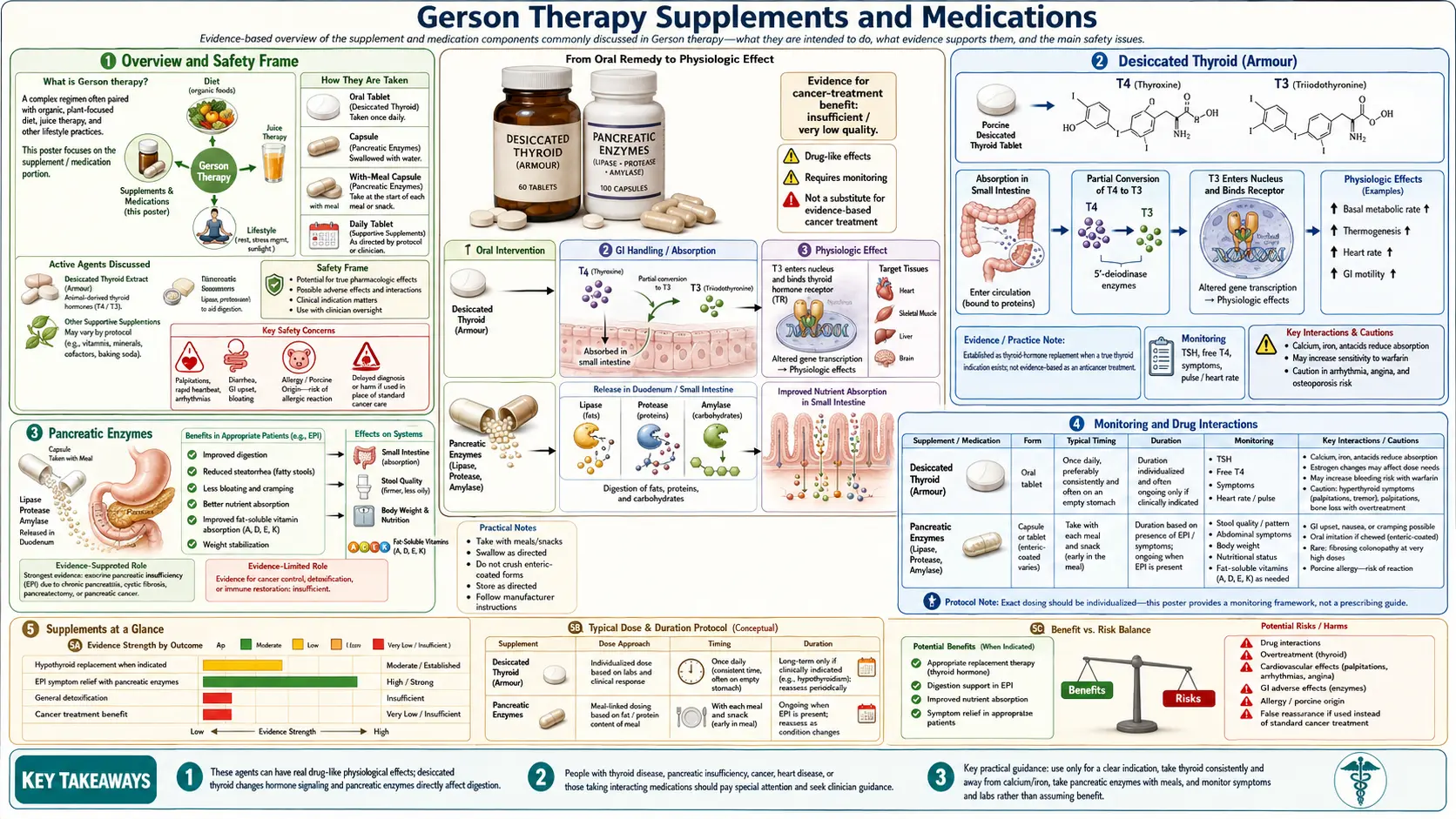
Table of Contents
- Overview and Safety Frame
- Potassium Compound
- Lugol’s Iodine
- Desiccated Thyroid (Armour)
- Niacin (Vitamin B3)
- Vitamin B12 and Crude Liver (Historical)
- Pancreatic Enzymes
- Coenzyme Q10
- Discontinued Components: Crude Liver Injection and Raw Calf-Liver Juice
- Monitoring and Drug Interactions
- Key Research and Sources
- Featured Videos
Overview and Safety Frame
The Gerson supplement schedule is more aggressive than most modern naturopathic protocols. Several of its components — thyroid extract, Lugol’s iodine at multi-drop doses, high-dose niacin, intramuscular B12 with liver crude — are prescription-class interventions in most jurisdictions. They are not supplements in the casual sense; they are pharmacologic doses of bioactive substances. Patients should not assemble the schedule from the internet alone. The Gerson Institute trains practitioners and clinic staff in the dosing, contraindications, and laboratory monitoring; in the United States, the supplement protocol legally requires physician oversight.
Potassium Compound
Potassium repletion is the largest single supplement input in the Gerson protocol. It directly serves the sodium–potassium theory of cellular metabolism. The compound consists of three potassium salts in equal parts:
- Potassium gluconate
- Potassium acetate
- Potassium monophosphate
The three are dissolved together in distilled water at a concentrated stock (typically 100 grams of mixed salts in 1 liter of water). The patient adds 4 teaspoons (about 20 mL of stock) to ten of the daily juices, totaling roughly 8 grams of mixed potassium salts per day — far above ordinary supplement doses.
Safety. Potassium at this scale is dangerous in patients with reduced kidney function, on potassium-sparing diuretics (spironolactone, eplerenone), on ACE inhibitors or ARBs, or with addisonian adrenal insufficiency. Serum potassium must be checked regularly. Symptoms of hyperkalemia include weakness, tingling, palpitations — stop and seek care immediately if any occur.
Lugol’s Iodine
Lugol’s solution is a 5% elemental iodine and 10% potassium iodide solution in water (the “5/10” or “Strong Lugol’s”), containing about 6.25 mg of iodine per drop. The Gerson protocol uses 3 drops with each of 5 to 6 juices per day — on the order of 90–120 mg of elemental iodine daily. For comparison, the U.S. RDA for iodine is 150 micrograms (0.15 mg). The Gerson dose is 600 to 800 times the RDA.
Gerson’s rationale was that all body cells (not only the thyroid) require iodine, that environmental iodine intake had fallen below historical levels, and that high doses both supported thyroid function and acted as a generalized antioxidant. The high-dose iodine concept was revived in the 2000s by physicians such as Guy Abraham and Jorge Flechas under the “Iodine Project” banner; the underlying claim remains controversial in mainstream endocrinology.
Safety. High-dose iodine can precipitate thyroiditis, hyperthyroidism, hypothyroidism, or the Wolff–Chaikoff effect, and is contraindicated in patients with autoimmune thyroid disease until evaluated. Thyroid function (TSH, free T4, anti-TPO antibodies) should be measured before starting and at regular intervals.
Desiccated Thyroid (Armour)
Patients on the cancer protocol typically receive 1 to 5 grains per day of desiccated porcine thyroid (Armour Thyroid or equivalent), each grain containing approximately 38 mcg of T4 and 9 mcg of T3. The dose is titrated up gradually with monitoring. Gerson believed that most chronic-disease patients had subclinical hypothyroidism and that thyroid replacement was central to restoring metabolic vigor.
Safety. Desiccated thyroid is a prescription medication. Overshoot causes iatrogenic thyrotoxicosis: tachycardia, weight loss, tremor, heat intolerance, and in older or cardiac-compromised patients, atrial fibrillation. Thyroid replacement is not a do-it-yourself supplement and the Gerson protocol obtains it through clinic prescription.
Niacin (Vitamin B3)
Niacin (nicotinic acid, not the no-flush forms) is given at 50 mg with each of 5 to 6 juices per day. The flushing reaction — the prostaglandin-mediated cutaneous vasodilation that causes warmth, redness, and a pins-and-needles sensation — is welcomed in the Gerson framing as evidence of peripheral circulation. Gerson regarded niacin as supportive of fatty-acid metabolism and as a co-factor for several Phase I oxidative reactions.
Safety. High-dose niacin can cause hepatotoxicity, particularly the slow-release forms (which are not used in Gerson). Liver function should be monitored. Active liver disease, gout, and active peptic ulcer are contraindications.
See the dedicated deep-dive: Niacin (Vitamin B3) in the Gerson Therapy — full coverage of the GPR109A flush mechanism, NAD+/sirtuin/PARP biology, the cancer-chemoprevention literature, lipid effects, drug interactions, and a PubMed-linked bibliography.
Vitamin B12 and Crude Liver (Historical)
The original protocol called for daily intramuscular injection of 0.1 cc of vitamin B12 mixed with 3 cc of crude liver extract. Crude liver was used for its broad-spectrum content of iron, B vitamins, and trace nutrients in a form Gerson considered superior to synthetic vitamins. After a salmonella outbreak traced to a contaminated crude liver lot in the early 1980s, crude liver injection was discontinued at Institute-affiliated clinics. The current protocol typically uses methylcobalamin or hydroxocobalamin B12 alone, given as injection or sublingual.
Pancreatic Enzymes
Pancreatic enzymes — a mix of trypsin, chymotrypsin, lipase, and amylase — are given between juices on an empty stomach. The Gerson rationale draws on the early-twentieth-century work of John Beard, who argued that pancreatic proteolytic enzymes had systemic anti-tumor effects. The dose is typically 3 to 4 tablets four times a day, totaling roughly 10 to 25 grams of pancreatic enzyme concentrate per day.
Modern pancreatic-enzyme cancer therapy of the Gonzalez/Kelley type uses similar doses on a similar Beard-derived rationale. The Chabot trial (2010) of the Gonzalez protocol in pancreatic cancer reported no survival advantage over gemcitabine and was widely interpreted as evidence against the systemic-enzyme cancer hypothesis. The Gerson Institute’s response is that pancreatic enzymes are one of many components and were not isolated as the variable in the Chabot trial.
Coenzyme Q10
CoQ10 was added to the Gerson protocol in the 1990s, after the work of Karl Folkers and others suggested benefits in cardiovascular disease and possibly in breast cancer. The protocol calls for 50–100 mg per day, taken with food (CoQ10 is fat-soluble; the small flax-oil intake aids absorption).
Discontinued Components: Crude Liver Injection and Raw Calf-Liver Juice
Two components of the original protocol have been formally discontinued at Gerson Institute–affiliated clinics:
- Crude liver injection — discontinued in the 1980s after a documented salmonella outbreak.
- Raw calf-liver juice — discontinued in the 1990s after concerns about microbial and prion contamination, and after the protocol’s cancer indication broadened to a population in which raw animal products posed an unacceptable infection risk.
Some independent practitioners outside the Gerson Institute network continue to promote raw liver products. The Institute does not.
Monitoring and Drug Interactions
The Gerson supplement schedule is intense enough that patients on the full cancer protocol should have, at minimum:
- Comprehensive metabolic panel (sodium, potassium, BUN, creatinine, glucose, liver enzymes) every 2 to 4 weeks initially.
- Thyroid panel (TSH, free T4) at start, at 6 weeks, and every 3 months thereafter.
- CBC at baseline and every 4 to 6 weeks.
- EKG at baseline if older than 50 or with known cardiac disease.
The protocol interacts with many prescription medications. Most common concerns: thyroid replacement plus prescription levothyroxine = double-dosing; potassium plus ACE inhibitors / ARBs / spironolactone = hyperkalemia; high-dose iodine plus amiodarone or pre-existing thyroid disease = thyroid storm or myxedema; pancreatic enzymes plus warfarin = increased bleeding risk; flax oil plus warfarin = increased bleeding risk; grapefruit juice (if used) plus statins or calcium-channel blockers or chemotherapy = elevated drug levels.
Key Research and Sources
- Gerson C, Bishop B (2007). Healing the Gerson Way. — current Institute supplement schedule.
- Chabot JA et al. (2010). “Pancreatic proteolytic enzyme therapy compared with gemcitabine-based chemotherapy for the treatment of pancreatic cancer.” Journal of Clinical Oncology. PMID: 19687327
- Wolff J, Chaikoff IL (1948). “Plasma inorganic iodide as a homeostatic regulator of thyroid function.” Journal of Biological Chemistry. — the foundational Wolff–Chaikoff effect paper relevant to high-dose iodine safety.
- Abraham GE (2004). “The historical background of the iodine project.” The Original Internist. — the modern revival of the high-dose iodine framework Gerson used.
- Folkers K et al. (1993). “Activities of vitamin Q10 in animal models and a serious deficiency in patients with cancer.” Biochemical and Biophysical Research Communications. Search PubMed
- NIH Office of Dietary Supplements. Iodine, potassium, niacin, B12 fact sheets. ods.od.nih.gov
- PubMed search: “high dose iodine safety”
- PubMed search: “pancreatic enzymes cancer therapy”