Glyphosate, Copper Chelation & the Iron-Overload Cascade
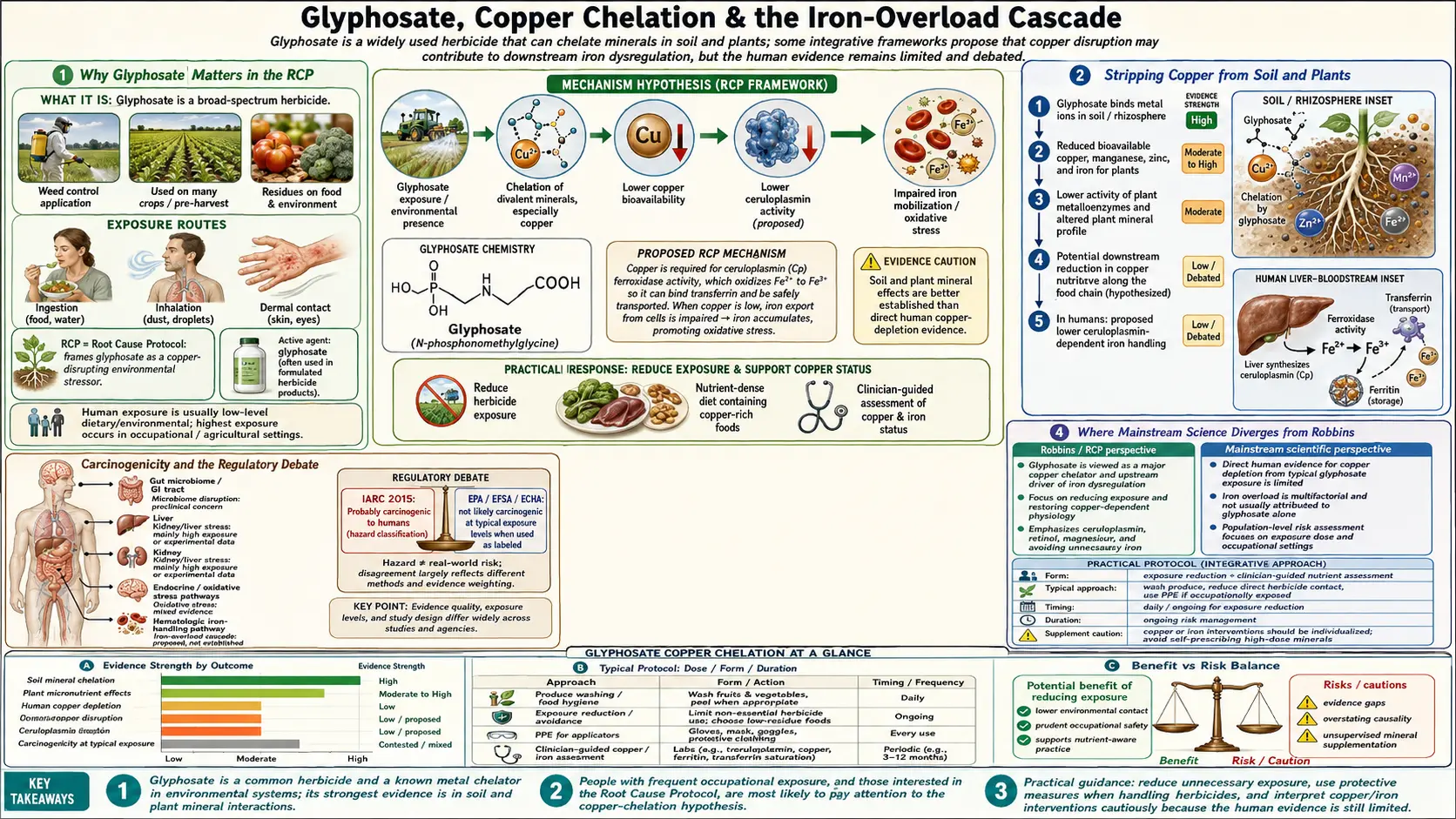
Of all the “why is everyone copper-deficient now?” questions Morley Robbins poses, none has a more concrete biochemical answer than glyphosate. The active ingredient in Roundup — the most-used herbicide in the history of agriculture — was originally patented in 1964 not as a weed-killer but as a metal chelator. Its industrial-cleaning patent specifically claims chelation of calcium, magnesium, manganese, iron, and copper. The same chemistry that descales boiler pipes also strips divalent cations out of soil, out of the plants we and our livestock eat, and — the Robbins thesis goes — out of human bodies that consume residue-laden food. The downstream consequence in the RCP framework is straightforward: less bioavailable copper means less ceruloplasmin, less ferroxidase activity, and more unbound iron generating Fenton-reaction free radicals. The food supply is, on this view, simultaneously copper-deficient and iron-overloaded, and a single class of compound is sitting at the center of both problems.
This article walks through the chemistry, the agronomic practices that drive exposure (especially the under-discussed pre-harvest desiccation of grains and pulses), the documented mineral declines in the food supply, the livestock and pollinator effects, the cascade into iron dysregulation, the residue burden in human bodies, the regulatory debate, and the practical mitigations the RCP teaches. Where mainstream toxicology agrees with the Robbins framing, we say so; where it diverges, we say that too.
Table of Contents
- Why Glyphosate Matters in the RCP
- Glyphosate’s Mineral-Chelation Chemistry
- The 1964 Chelator Patent (Before It Was an Herbicide)
- Roundup Ready Crops and Pre-Harvest Desiccation
- Stripping Copper from Soil and Plants
- Declining Copper in the Modern Food Supply
- Effects on Livestock, Wildlife & Pollinators
- The Glyphosate → Copper → Iron Cascade
- Glyphosate in Human Bodies (Urine, Blood, Breast Milk)
- Carcinogenicity and the Regulatory Debate
- Practical Mitigation: How to Reduce Exposure
- Lab Testing for Glyphosate Burden
- Where Mainstream Science Agrees with Robbins
- Where Mainstream Science Diverges from Robbins
- Key Research Papers
- Connections
- Featured Videos
1. Why Glyphosate Matters in the RCP
Robbins names glyphosate as one of the “Big Five” environmental drivers of mineral dysregulation, alongside synthetic vitamin D3, ascorbic acid, fluoride, and electromagnetic field (EMF) exposure. He places glyphosate at or near the top of the list because it is unavoidable for most non-organic eaters and because it directly attacks the proteins and enzymes the RCP is trying to restore. Specifically:
- It chelates copper. The Cu²⁺ stability constant for glyphosate is in the same range as EDTA for some metals. Copper that would otherwise reach the liver to be loaded into ceruloplasmin can be tied up by residual glyphosate before it ever crosses the gut wall.
- It chelates manganese. Manganese is the cofactor for SOD2 (mitochondrial superoxide dismutase). Without it, mitochondrial reactive oxygen species (ROS) rise, putting more oxidative stress on already iron-loaded cells.
- It chelates magnesium. Magnesium is required for the two hydroxylations that activate vitamin D, for >600 enzymatic reactions, and for the SOD enzymes themselves. Glyphosate attacks the same mineral the RCP is trying to replenish.
- It disrupts the gut microbiome. Glyphosate inhibits the shikimate pathway, which is absent in mammals but present in many gut bacteria. The downstream consequence is a microbial-population shift that itself impairs micronutrient absorption.
- It loads ambient iron. Glyphosate’s decades-long use has paralleled the rise of iron-fortified flour, iron-fortified breakfast cereals, and iron-rich infant formula. The body simultaneously gets more ambient iron and less functional copper to handle it — the RCP’s central pathology.
If the Root Cause Protocol has a single environmental antagonist, it is glyphosate.
2. Glyphosate’s Mineral-Chelation Chemistry
Glyphosate is N-(phosphonomethyl)glycine. Structurally it carries three functional groups that can each coordinate a metal ion: a carboxylate (−COO−), an amine (−NH), and a phosphonate (−PO&sub3;H&sub2;). Together these groups can form a tridentate or even tetradentate chelating cage around a divalent or trivalent cation. The result is a strong metal complex that is far less bioavailable than the free ion would have been.
Published stability constants (log K, the higher the stronger the bind) for glyphosate–metal complexes:
- Cu²⁺: log K ≈ 11.9 — one of the strongest binds
- Fe³⁺: log K ≈ 10.1
- Zn²⁺: log K ≈ 8.7
- Mn²⁺: log K ≈ 5.5
- Ca²⁺: log K ≈ 3.3
- Mg²⁺: log K ≈ 3.3
For comparison, EDTA — the chelator pharmacists use to treat heavy-metal poisoning — has log K values for Cu²⁺ of about 18.8. So glyphosate is a milder chelator than EDTA, but milder is still strong enough to matter biologically when the dose reaches grams-per-acre and the residue persists in soil and food. Glyphosate also chelates calcium and zinc less strongly, but the population-level mineral imbalance it produces is real and reproducible in agronomic field studies (Eker et al. 2006; Cakmak et al. 2009).
The herbicidal mechanism is not pure chelation — glyphosate’s primary kill mode in plants is inhibition of the enzyme 5-enolpyruvylshikimate-3-phosphate synthase (EPSPS), which plants use to make aromatic amino acids. EPSPS sits at the start of the shikimate pathway. Mammals have no shikimate pathway, which is why glyphosate’s manufacturer has long argued the chemical is non-toxic to humans. But mammals do harbor gut bacteria that do have the shikimate pathway, and human cells need the same minerals glyphosate sequesters. The chelation is a side effect from a marketing standpoint and a primary effect from a nutritional one.
3. The 1964 Chelator Patent (Before It Was an Herbicide)
Glyphosate was first synthesized in 1950 by Swiss chemist Henri Martin while working for the pharmaceutical company Cilag. The compound sat unused for years. Then in 1964 the Stauffer Chemical Company filed U.S. Patent 3,160,632 for glyphosate as a chelating agent, claiming use in industrial cleaning, descaling of pipes and boilers, and removal of mineral deposits. The patent specifically lists calcium, magnesium, manganese, iron, and copper as the metals the molecule binds.
The herbicidal property was discovered separately at Monsanto by John E. Franz in 1970, and the first U.S. patent on glyphosate as a herbicide (3,799,758) was granted in 1974. Roundup was launched commercially that same year. Decades later, the existence of the original chelation patent is uncontroversial — it is part of the public record — but the implication that the same compound that descales pipes can also strip minerals from food is one mainstream toxicology generally addresses by pointing to the differential dose between industrial and agricultural application. Robbins and other independent researchers (Don Huber, Stephanie Seneff) push back that chronic low-dose exposure adds up over decades of three-meal-a-day consumption.
A second relevant patent: in 2010 Monsanto received U.S. Patent 7,771,736 for glyphosate as an antibiotic (specifically for use against the parasite Cryptosporidium). The patent is the company’s own admission that the compound has antimicrobial activity in mammals — a fact relevant to the gut-microbiome-disruption argument.
4. Roundup Ready Crops and Pre-Harvest Desiccation
Two agricultural practices have driven the explosive growth in glyphosate use:
Roundup Ready (genetically modified) crops
Starting in 1996 with Roundup Ready soybeans, Monsanto engineered crop varieties carrying a glyphosate-resistant EPSPS gene from Agrobacterium. Farmers can spray the entire field with glyphosate; the weeds die, the crop survives. By 2018 roughly 90–95% of U.S. corn, soybean, and cotton acreage was glyphosate-tolerant, plus large fractions of canola, sugar beet, and alfalfa. Direct in-season application drives glyphosate residues into the harvested grain, oil, and processed-food products that follow.
Pre-harvest desiccation (the “burndown”)
Less well known but arguably more consequential for human food: glyphosate is sprayed on non-GMO crops 7–10 days before harvest to kill and dry the crop uniformly so combine harvesting is faster and grain moisture is consistent. Crops commonly desiccated this way:
- Wheat (especially in cooler climates — common in U.S. Northern Plains, Canadian Prairies)
- Oats (a particularly heavy use; Environmental Working Group testing has found glyphosate in nearly all conventional and many organic oat products)
- Barley
- Lentils, chickpeas, dried peas, dry beans
- Flax, canola, sunflower
- Sugarcane (in some regions)
Because the spray happens days before harvest, there is no time for the chemical to break down. Residues end up directly in the grain that becomes bread, cereal, oatmeal, hummus, and pulses. This is the route by which conventional U.S. wheat carries detectable glyphosate even though wheat itself is not a Roundup Ready crop. Pre-harvest desiccation is also why oat-based products — widely sold as “heart-healthy whole grain” — have been singled out in EWG and Friends of the Earth residue testing.
5. Stripping Copper from Soil and Plants
Once glyphosate enters soil, three things happen, each relevant to mineral availability:
- It binds soil minerals. Eker et al. (Journal of Agricultural and Food Chemistry, 2006) showed glyphosate application reduced uptake of iron, manganese, zinc, and copper in non-target plants. Cakmak et al. (European Journal of Agronomy, 2009) extended this to soybeans and showed reduced shoot manganese, iron, and zinc concentrations.
- It suppresses beneficial soil microbes. Mycorrhizal fungi, which extend plant root reach for phosphorus and trace minerals, are sensitive to glyphosate. Zaller et al. (Scientific Reports, 2014) showed reduced mycorrhizal colonization and altered nutrient transfer in glyphosate-treated soils.
- It persists. Soil half-life ranges from a few days to over 200 days depending on soil composition, microbial activity, and pH. Long-tilled, glyphosate-treated soils show progressive accumulation in some long-term studies.
The composite agronomic effect is a soil ecosystem with reduced mineral mobilization and reduced microbial-mediated mineral cycling, growing crops that themselves carry glyphosate residue. Don Huber, professor emeritus of plant pathology at Purdue, has been the most vocal academic voice on this point, with multiple presentations connecting widespread glyphosate use to declining trace-mineral levels in U.S. crops.
6. Declining Copper in the Modern Food Supply
Mainstream nutrition data (USDA tables compared across decades) document declines in trace-mineral content of common produce:
- Davis, Epp & Riordan (2004) compared USDA nutrient data for 43 garden crops from 1950 to 1999 and found statistically significant declines in protein, calcium, phosphorus, iron, riboflavin, vitamin C, and (in many crops) copper. The authors attributed the declines to a combination of cultivar shifts toward higher-yielding but less nutrient-dense varieties, and to soil and agricultural practice changes.
- Mayer (1997) found similar declines in U.K. produce data over comparable decades.
- Animal-source foods. Beef and dairy from CAFO operations fed glyphosate-treated grains and silage carry less copper than pasture-raised counterparts. Direct copper measurement in beef liver from grain-finished vs. pasture-raised cattle shows differences of 20–40% in some samples.
The Davis 2004 paper does not prove glyphosate is the cause of the decline — cultivar selection and soil practice changes are confounders — but the timeline overlaps with glyphosate’s ascendency from a niche industrial chemical to the world’s most-used herbicide. Robbins reads the decline as one piece of evidence among many that the modern food supply is functionally copper-poor.
7. Effects on Livestock, Wildlife & Pollinators
The clearest demonstrations of glyphosate’s mineral-deranging effects come from animal studies and animal-husbandry observation:
- Cattle. Krüger et al. (2013) measured glyphosate in urine of dairy cows with chronic botulism and found significantly higher residues than in healthy controls. The authors connected the residue burden to disrupted gut microbiomes that allowed Clostridium botulinum overgrowth.
- Pigs. Carman et al. (2013) reported that pigs fed Roundup Ready corn and soy showed increased rates of severe stomach inflammation compared to controls fed equivalent non-GMO feed.
- Honey bees. Motta, Raymann & Moran (PNAS, 2018) showed that glyphosate exposure at field-realistic doses altered the gut microbiome of honey bees, with downstream effects on susceptibility to bacterial infection. The shikimate pathway is present in bee gut bacteria, validating the same mechanism Robbins points to in humans.
- Aquatic life. Glyphosate’s adjuvant surfactants (POEA in older Roundup formulations) are more toxic to amphibians than the active ingredient itself. Relyea (2005) documented near-100% mortality of tadpoles in glyphosate-formulation-exposed water.
Veterinary practitioners working with grass-fed and organic-fed herds anecdotally report fewer mineral-deficiency signs (white-muscle disease, copper-deficiency depigmentation, retained placentas) than herds fed glyphosate-treated silage and grain. These are observational, not randomized, but the pattern is consistent.
8. The Glyphosate → Copper → Iron Cascade
The Robbins synthesis — the cascade that ties this whole article to the rest of the RCP — runs as follows:
- Glyphosate-treated and Roundup-Ready food is the dominant component of the modern American diet (corn syrup, soybean oil, wheat-flour products, oats, beans, lentils).
- Glyphosate residue chelates dietary copper in the gut and reduces absorption. Some chelated copper is excreted; some that does cross is bound up before reaching the liver.
- Liver hepatocytes synthesize apoceruloplasmin (the protein backbone) at normal rates, but cannot load enough copper to produce functional holoceruloplasmin. The empty apoprotein is rapidly degraded.
- Plasma ceruloplasmin levels fall — or, more insidiously, total ceruloplasmin looks normal on a lab panel but its ferroxidase activity is reduced because magnesium and retinol cofactors are also depleted.
- Without adequate ferroxidase, ferrous iron (Fe²⁺) cannot be efficiently oxidized to ferric iron (Fe³⁺) for transferrin loading. Iron destined for the bone marrow is stalled in the body’s iron-handling pathway.
- Unbound Fe²⁺ participates in the Fenton reaction (Fe²⁺ + H&sub2;O&sub2; → Fe³⁺ + OH• + OH−), generating hydroxyl radicals that damage lipids, proteins, and DNA.
- Tissue iron accumulates — in the liver, brain, heart, joints — while red-cell hemoglobin synthesis falls. The patient looks “iron-deficient” on a CBC, gets prescribed iron supplements, and the cycle worsens (more unbound Fe²⁺, more Fenton oxidation).
- Simultaneously, glyphosate’s magnesium-chelation accelerates the magnesium burn rate that high-dose D3 supplementation also drives, weakening SOD-1 (Cu/Zn) and SOD-2 (Mn) antioxidant defense, allowing more Fenton damage to express as oxidative stress.
The full cascade is the RCP’s most-developed environmental story. It connects an agricultural compound to a hepatic protein to a hematology lab pattern to a clinical syndrome of fatigue and inflammation. Mainstream toxicology accepts each individual link in isolation; what is contested is the population-level magnitude.
9. Glyphosate in Human Bodies (Urine, Blood, Breast Milk)
Multiple independent studies have measured glyphosate in human samples:
- Urine. Mills et al. (JAMA, 2017) measured urinary glyphosate in a cohort of southern California residents from 1993 to 2016 and found a 1208% increase in mean concentration over the period — an increase that closely paralleled the rise in agricultural glyphosate use after 1996.
- Blood. Multiple smaller studies have found glyphosate detectable in human blood. The Detox Project’s own residue-testing program has reported detectable levels in 70–90% of U.S. samples.
- Breast milk. Honeycutt & Rowlands (2014, Moms Across America survey) reported detection of glyphosate in 3 of 10 American breast milk samples at 76–166 µg/L — orders of magnitude above the EU drinking-water limit of 0.1 µg/L. The methodology has been criticized; subsequent more rigorous studies (Steinborn et al. 2016) using LC-MS/MS in 114 German samples did not detect glyphosate above their limit of quantification (75 ng/mL). The state of the breast-milk evidence is unsettled, but at minimum the worst-case scenario is plausible enough to warrant precaution.
- Children. CDC NHANES sampling has found detectable urinary glyphosate in roughly 80% of U.S. children tested (samples from 2013–2014), making this one of the most ubiquitous chemical exposures of the modern American childhood.
The presence of glyphosate in human samples does not by itself prove harm — many compounds are detectable below the threshold of biological effect — but it does refute the older industry framing that the molecule is metabolized and excreted before it reaches systemic circulation.
10. Carcinogenicity and the Regulatory Debate
The most contentious question about glyphosate is whether it causes cancer. The major regulatory positions:
- IARC (International Agency for Research on Cancer, WHO), 2015: Classified glyphosate as “probably carcinogenic to humans” — Group 2A — based on limited evidence in humans (non-Hodgkin lymphoma case-control studies) and sufficient evidence in experimental animals. The IARC review (Monograph 112) was written by an independent working group drawing from the published peer-reviewed literature.
- EPA (U.S.): Maintains glyphosate is “not likely to be carcinogenic to humans” at typical exposure levels. The EPA review weights industry-submitted studies more heavily and has been criticized for its handling of the question.
- EFSA (European Food Safety Authority): Has classified glyphosate as “unlikely to pose a carcinogenic hazard.” EU re-authorization in 2023 extended approval to 2033 over the objections of multiple member states.
- Litigation outcome: Bayer (which acquired Monsanto in 2018) has paid more than $11 billion to settle approximately 100,000 U.S. lawsuits, primarily filed by people with non-Hodgkin lymphoma who attributed their disease to Roundup exposure (Johnson v. Monsanto, Hardeman v. Monsanto, Pilliod v. Monsanto). Several juries returned verdicts in plaintiffs’ favor with multi-million-dollar damages.
From the RCP’s standpoint, the cancer question is downstream of the mineral-dysregulation question. The argument is that glyphosate doesn’t need to be a direct mutagen to be harmful — chronic copper deficiency, chronic iron oxidation, chronic mitochondrial superoxide stress (from Mn-SOD impairment), and chronic gut-microbiome disruption are themselves risk factors for the diseases that glyphosate-cancer litigation focuses on.
11. Practical Mitigation: How to Reduce Exposure
Robbins teaches a practical avoidance hierarchy. In rough order of impact:
- Eat USDA Organic. By federal regulation, USDA Organic certification prohibits glyphosate use in the production of the food. Organic is not glyphosate-free in absolute terms (drift from neighboring conventional fields, contaminated water, processing equipment) but residue testing consistently shows organic produce 10–100× lower in glyphosate than conventional.
- Avoid pre-harvest-desiccated grains. The biggest single dietary glyphosate sources for most Americans are conventional oats, wheat, lentils, chickpeas, dried beans, and the products made from them (oatmeal, breakfast cereal, bread, hummus, lentil soup). Switch to organic versions specifically. Look for “Glyphosate Residue Free” certification (the Detox Project standard).
- Avoid Roundup Ready commodity oils. Soybean, corn, canola, and cottonseed oils are derived from glyphosate-tolerant crops and concentrate residues into the oil during processing. Replace with grass-fed butter, ghee, beef tallow, coconut oil, extra-virgin olive oil from a verified source.
- Choose grass-fed and pasture-raised animal products. Animals fed Roundup Ready corn and soy concentrate residues into fat, organ meats, milk, and eggs. Pasture-raised eliminates that pathway. Beef liver from pasture-raised is the RCP’s top-tier copper food precisely because it is not tainted by the feed pathway.
- Filter drinking water. Glyphosate has been detected in U.S. groundwater and tap water at low levels in many regions. A reverse-osmosis or activated-carbon filter substantially reduces the residue.
- Wash produce. Surface residue can be reduced by washing with a baking-soda solution (1 tsp per 2 cups water for 12–15 minutes per Yang et al. 2017). Internal residues in glyphosate-tolerant crops are not washable.
- Restore minerals. Even with avoidance, the existing depletion needs reversal: beef liver, oysters, cacao, bee pollen, magnesium, real cod liver oil — the standard RCP “Starts.”
Robbins is realistic about the limits of avoidance. Glyphosate is in the rain, in the air around farm operations, in dust drifting from treated fields. Total elimination is impossible. The goal is dose reduction plus mineral restoration, not zero exposure.
12. Lab Testing for Glyphosate Burden
Several commercial labs offer glyphosate testing for individuals:
- HRI Labs / Detox Project — urine glyphosate test, $99–$149 USD, ELISA-based, results compared to a population-reference distribution.
- Great Plains Laboratory (now Mosaic) — urine GPL-TOX panel includes glyphosate among other environmental toxins.
- Doctor’s Data — comprehensive urine environmental-toxin panel.
- Real-Time Laboratories — mycotoxin panel that some practitioners pair with glyphosate testing.
A first-morning-void urine sample is the standard collection. Results are typically reported as ng/mL or µg/g creatinine. There is no formal “normal” reference range for glyphosate — the labs report relative to their tested population, where the median U.S. adult shows detectable residue. The clinically useful question is whether your level is in the upper or lower portion of the population distribution and whether it falls after 60–90 days of organic eating, which it generally does.
13. Where Mainstream Science Agrees with Robbins
- Glyphosate is a metal chelator. The 1964 Stauffer patent and the published log K stability constants are uncontested. Industrial chemistry textbooks list glyphosate among the aminocarboxylate-phosphonate chelators.
- Glyphosate disrupts plant micronutrient uptake. Eker 2006 and Cakmak 2009 are mainstream peer-reviewed agronomy.
- Glyphosate disrupts the shikimate pathway in bacteria. Motta 2018 in PNAS demonstrated the gut-microbiome effect in honey bees. Industry concedes the mechanism.
- Glyphosate residues are detectable in human bodies. The Mills 2017 JAMA paper is mainstream literature.
- Pre-harvest desiccation is a documented practice. Wheat, oat, and pulse industry publications openly describe the technique.
- Mineral content of crops has declined. Davis 2004 and Mayer 1997 are widely cited.
14. Where Mainstream Science Diverges from Robbins
- Population-level magnitude. Whether the chronic, low-dose, dietary glyphosate exposure typical of a non-organic eater is sufficient to meaningfully impair human copper uptake or ceruloplasmin activity is contested. Industry-funded studies argue the doses are well below biological-effect thresholds; independent researchers argue the cumulative chronic exposure is the relevant variable.
- Carcinogenicity. EPA and EFSA disagree with IARC. The litigation outcomes have not resolved the scientific question.
- Cause of mineral decline in food. Cultivar selection, soil-management practices, and changes in fertilization all confound the “glyphosate caused the decline” framing. Davis 2004 is careful not to attribute decline to a single cause.
- Breast-milk residue. The methodology of the Moms Across America positive results has been questioned; the more rigorous Steinborn 2016 study did not detect glyphosate.
- Whether glyphosate’s antimicrobial action meaningfully affects the human gut microbiome. The mechanism is conceded; the population-level impact in humans is still being characterized.
A balanced reading: the chemistry and the agronomy support Robbins. The clinical magnitude in humans is still under active investigation. Even partial credibility of the cascade is sufficient justification, in the RCP framing, to reduce exposure aggressively while restoring minerals.
15. Key Research Papers
Selected PubMed topic searches and individually cited references. All open in a new tab.
- PubMed: Glyphosate metal chelation
- PubMed: Glyphosate–copper complex chemistry
- PubMed: Glyphosate, manganese, and SOD
- PubMed: Glyphosate and plant micronutrient uptake
- PubMed: Eker et al. — glyphosate and iron uptake
- PubMed: Cakmak et al. — glyphosate and soybean micronutrients
- PubMed: Glyphosate and the gut microbiome
- Motta, Raymann & Moran 2018 — Glyphosate and honey-bee gut bacteria (PNAS)
- PubMed: Glyphosate in human urine
- Mills 2017 — Excretion of glyphosate over 23 years (JAMA)
- PubMed: Glyphosate in breast milk
- PubMed: Steinborn 2016 — LC-MS/MS breast milk negative
- PubMed: Krüger 2013 — glyphosate and bovine botulism
- PubMed: IARC glyphosate carcinogenicity
- PubMed: Glyphosate and non-Hodgkin lymphoma
- PubMed: Davis 2004 — mineral decline in produce 1950–1999
- PubMed: Glyphosate and mycorrhizal fungi
- PubMed: Glyphosate EPSPS inhibition
- PubMed: Ceruloplasmin ferroxidase activity
- PubMed: Glyphosate and oxidative stress
Connections
- Morley Robbins
- Root Cause Protocol
- Copper-Iron Dysregulation
- Ceruloplasmin and Bioavailable Copper
- Magnesium Replenishment
- Iron Overload and Hidden Toxicity
- Vitamin D Controversy
- Whole Food Copper Sources
- Adrenal Cortisol and Mineral Connection
- Cure Your Fatigue
- Glyphosate
- Pesticides
- Copper
- Iron
- Magnesium
- Manganese
- Vitamin A
- Gut Healing