EMF Exposure: Electromagnetic Fields and Human Health
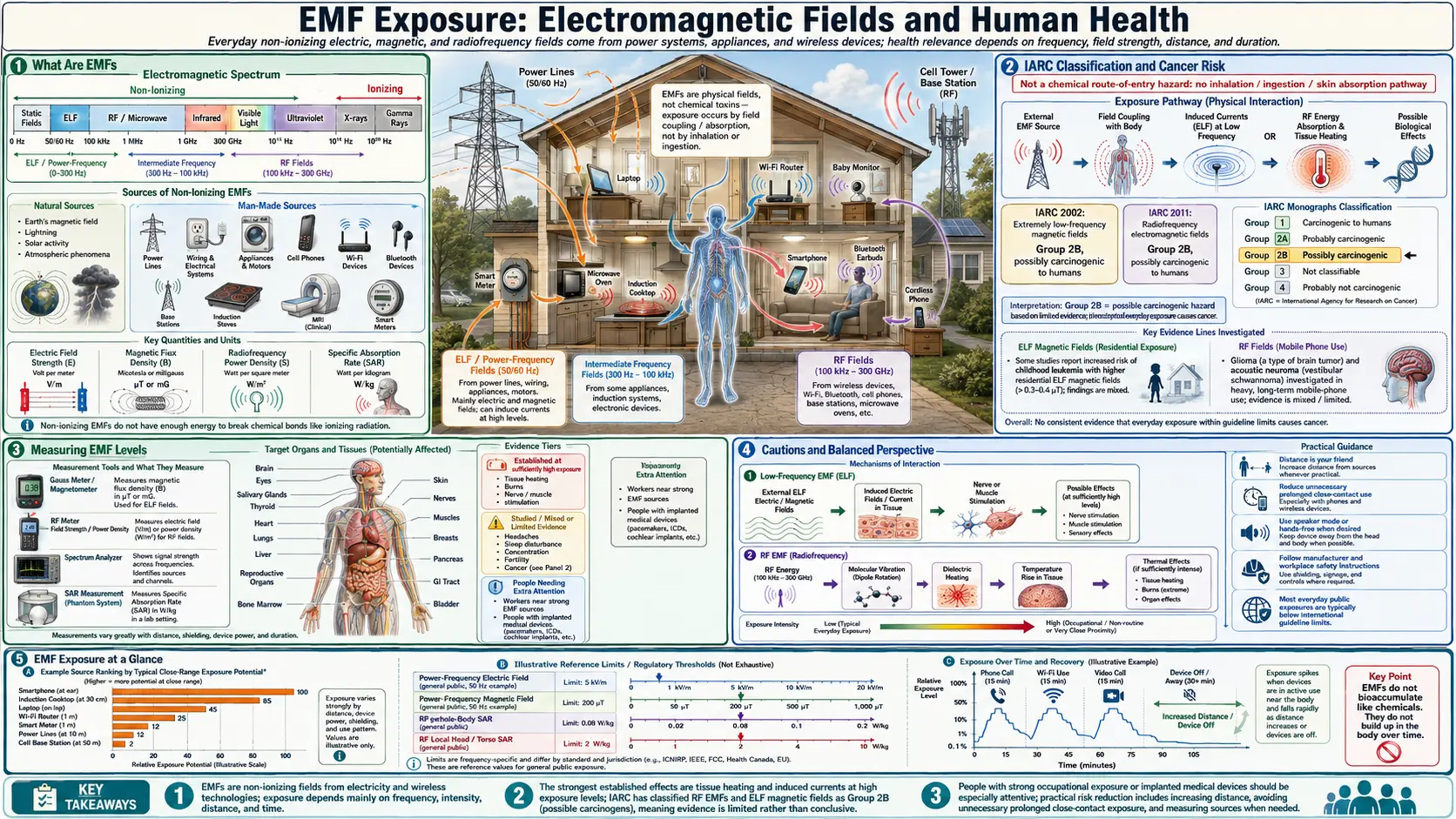



Table of Contents
- What Are EMFs
- The Electromagnetic Spectrum
- Sources of EMF in Daily Life
- How EMFs Affect Biology
- IARC Classification and Cancer Risk
- Health Concerns and Research Findings
- Electrohypersensitivity (EHS)
- Measuring EMF Levels
- Reducing EMF Exposure
- Dirty Electricity
- Grounding and Earthing
- Cautions and Balanced Perspective
- Connections
- Featured Videos
What Are EMFs
Electromagnetic fields (EMFs) are invisible areas of energy produced wherever electricity flows or electromagnetic radiation is emitted. Every electrical device, power line, and wireless transmitter generates EMFs of varying strength and frequency. These fields consist of two interrelated components: an electric field, produced by voltage differences, and a magnetic field, produced by the flow of electric current. Together, they propagate through space as electromagnetic radiation.
EMFs are broadly divided into three categories relevant to human exposure. Extremely low frequency (ELF) fields are generated by power lines, household wiring, and electrical appliances operating at 50 or 60 Hz. Radiofrequency (RF) fields are emitted by wireless communication devices including cell phones, Wi-Fi routers, Bluetooth devices, and cell towers, operating in the range of approximately 3 kHz to 300 GHz. Static fields, produced by direct current and the earth's natural magnetic field, represent a third category with distinct characteristics. From a naturopathic perspective, understanding these distinctions is essential because the biological effects and mitigation strategies differ for each type of EMF.
The Electromagnetic Spectrum
The electromagnetic spectrum encompasses all forms of electromagnetic radiation, organized by frequency and wavelength. Understanding where common EMF exposures fall on this spectrum provides critical context for evaluating health risks.
- Extremely Low Frequency (ELF): Ranges from 3 to 300 Hz. This includes the 50/60 Hz fields generated by electrical power systems, household wiring, and appliances. ELF fields are non-ionizing and have very long wavelengths measured in thousands of kilometers
- Radiofrequency (RF): Spans from 3 kHz to 300 MHz. AM and FM radio broadcasts, some older wireless technologies, and certain industrial equipment operate in this range
- Microwave: Ranges from 300 MHz to 300 GHz. This includes cell phones (typically 700 MHz to 2.5 GHz), Wi-Fi (2.4 GHz and 5 GHz), Bluetooth (2.4 GHz), microwave ovens (2.45 GHz), smart meters, and 5G millimeter wave transmissions (24 to 100 GHz)
- Infrared: Frequencies just below visible light, experienced as heat radiation from objects, heaters, and remote controls
- Visible light: The narrow band of electromagnetic radiation detectable by the human eye, from red (lower frequency) through violet (higher frequency)
- Ultraviolet (UV): Higher energy radiation from sunlight that can cause sunburn, skin aging, and skin cancer. UV marks the transition zone where radiation begins to have enough energy to damage DNA directly
- Ionizing radiation: Includes X-rays and gamma rays. These carry enough energy to strip electrons from atoms and directly break chemical bonds in DNA, posing well-established cancer risks. The key distinction in the EMF debate is that non-ionizing radiation (ELF, RF, microwave) does not carry enough energy per photon to directly ionize atoms, yet research suggests it may still cause biological harm through other mechanisms
Sources of EMF in Daily Life
Modern life involves continuous exposure to an unprecedented number of EMF-emitting devices and infrastructure. The following sources represent the most significant contributors to daily EMF exposure.
- Cell phones: One of the strongest RF sources for most people because the device is held directly against the head or carried on the body. Cell phones transmit RF energy to communicate with cell towers, with power output varying based on signal strength and distance from the nearest tower
- Wi-Fi routers: Emit continuous RF radiation at 2.4 GHz and 5 GHz frequencies, broadcasting signals throughout the home or office 24 hours a day. Routers are often placed in living areas and bedrooms where people spend extended periods
- Smart meters: Utility meters that communicate usage data wirelessly via RF pulses. These are typically mounted on the exterior wall of the home, sometimes directly adjacent to bedrooms or living spaces
- Bluetooth devices: Wireless earbuds, headphones, speakers, fitness trackers, and smartwatches all emit RF radiation at 2.4 GHz. Bluetooth earbuds are of particular concern because they transmit RF energy directly inside or adjacent to the ear canal
- Power lines: High-voltage transmission lines and local distribution lines generate strong ELF magnetic fields. Field strength diminishes with distance but can be significant for homes located within 200 meters of high-voltage lines
- Household appliances: Microwave ovens, hair dryers, electric blankets, dimmer switches, refrigerators, and induction cooktops all generate ELF magnetic fields during operation, with intensity varying by device and distance
- Cell towers: Base station antennas transmit RF energy continuously to serve wireless communication networks. Exposure levels are highest for those living or working in direct line of sight and close proximity to tower-mounted antennas
- 5G infrastructure: Fifth-generation wireless technology uses higher frequencies (including millimeter waves from 24 to 100 GHz) and requires a denser network of small cell antennas placed closer to ground level on utility poles, buildings, and other structures, potentially increasing the proximity of RF sources to people
- Cordless phones: DECT cordless phone base stations emit RF radiation continuously, even when the phone is not in use, making them a persistent source of household exposure
- Baby monitors: Wireless baby monitors transmit RF signals continuously and are often placed very close to sleeping infants
How EMFs Affect Biology
The conventional position has long held that non-ionizing radiation cannot harm biological systems because it lacks the energy to break chemical bonds. However, a growing body of research has identified several mechanisms through which non-ionizing EMFs can produce measurable biological effects.
- Voltage-gated calcium channels (VGCCs): Research by Dr. Martin Pall at Washington State University has identified the activation of voltage-gated calcium channels in cell membranes as a primary mechanism of EMF biological effects. EMFs exert forces on the voltage sensor of these channels, causing them to open and allowing an excessive influx of calcium ions into the cell. This calcium overload triggers a cascade of downstream effects including the production of nitric oxide and superoxide, which combine to form peroxynitrite, a potent oxidant that damages DNA, proteins, and lipids
- Oxidative stress: Numerous studies have demonstrated that EMF exposure increases the production of reactive oxygen species (ROS) in cells, overwhelming the body's antioxidant defense systems. This oxidative stress has been documented in cell culture studies, animal models, and human biomarker studies, and is a well-established pathway to cellular damage and disease
- DNA damage: Multiple independent studies have reported single-strand and double-strand DNA breaks in cells exposed to RF and ELF electromagnetic fields at levels below current safety standards. The REFLEX study, funded by the European Union, found that RF radiation at mobile phone frequencies caused DNA strand breaks in human cell cultures
- Blood-brain barrier permeability: Research by Dr. Leif Salford and colleagues at Lund University in Sweden demonstrated that RF exposure at cell phone frequencies increased the permeability of the blood-brain barrier in animal models, allowing albumin and potentially neurotoxic molecules to enter brain tissue
- Melatonin suppression: ELF magnetic fields have been shown to suppress the production of melatonin by the pineal gland in some studies. Melatonin is not only the primary sleep hormone but also a powerful antioxidant, so its suppression may contribute to both sleep disruption and increased oxidative damage
- Heat shock protein activation: Cells exposed to EMFs have been shown to activate heat shock proteins, a stress response normally triggered by thermal stress, toxins, or infection, indicating that cells recognize EMF exposure as a stressor even at non-thermal levels
IARC Classification and Cancer Risk
In 2011, the International Agency for Research on Cancer (IARC), a specialized agency of the World Health Organization, classified radiofrequency electromagnetic fields as Group 2B, meaning "possibly carcinogenic to humans." This classification was based on an increased risk of glioma, a malignant type of brain cancer, associated with wireless phone use.
- Group 2B context: The Group 2B classification places RF EMFs in the same category as lead, DDT, and gasoline engine exhaust. While "possibly carcinogenic" is not the highest level of concern (Group 1 is "carcinogenic" and Group 2A is "probably carcinogenic"), it represents a significant acknowledgment by the world's leading cancer research authority that RF radiation may contribute to cancer development
- Basis for classification: The IARC decision was influenced primarily by the Interphone study, which found a statistically significant increased risk of glioma among the heaviest cell phone users, and by studies showing increased brain tumor incidence on the side of the head where the phone was predominantly held
- Calls for reclassification: Following the release of the National Toxicology Program (NTP) study results in 2018, which found "clear evidence" of heart tumors in male rats exposed to cell phone radiation, several scientists who participated in the original IARC evaluation have called for RF radiation to be reclassified as Group 2A (probably carcinogenic) or Group 1 (carcinogenic to humans)
- ELF classification: ELF magnetic fields were separately classified by IARC as Group 2B (possibly carcinogenic) in 2002, based on epidemiological evidence linking childhood leukemia to residential proximity to power lines
Health Concerns and Research Findings
A substantial body of research has associated EMF exposure with a range of health effects. While the degree of evidence varies for each condition, the cumulative picture warrants a precautionary approach, particularly for vulnerable populations such as children and pregnant women.
- Sleep disruption: Multiple studies have reported that exposure to RF radiation from cell phones and Wi-Fi affects sleep quality, including delayed sleep onset, reduced deep sleep stages, and changes in sleep EEG patterns. The potential suppression of melatonin production provides a plausible biological mechanism
- Headaches and fatigue: Headaches, fatigue, difficulty concentrating, and cognitive fog are among the most commonly reported symptoms associated with EMF exposure in epidemiological surveys and case reports
- Fertility effects: A significant body of research has demonstrated negative effects of RF radiation on male reproductive health. Studies have found that cell phone radiation decreases sperm motility, reduces sperm count, increases sperm DNA fragmentation, and alters sperm morphology. Keeping a cell phone in a front trouser pocket has been specifically associated with reduced sperm quality in multiple studies. Female fertility effects are less studied but animal research suggests potential impacts on ovarian function
- Blood-brain barrier permeability: As noted in the biological mechanisms section, EMF exposure has been shown to increase the permeability of the blood-brain barrier, potentially allowing toxins, pathogens, and inflammatory molecules to enter brain tissue and contribute to neurological conditions
- Childhood leukemia near power lines: Epidemiological studies spanning several decades have consistently found a roughly twofold increase in the risk of childhood leukemia for children living in close proximity to high-voltage power lines, where ELF magnetic field levels exceed approximately 3 to 4 milligauss. This association led to the IARC Group 2B classification of ELF magnetic fields in 2002
- Brain tumors and heavy cell phone use: The Interphone study, a large multinational case-control study coordinated by IARC, found a statistically significant 40% increased risk of glioma among the heaviest cell phone users (those in the top 10% of cumulative call time). Swedish researcher Dr. Lennart Hardell found even stronger associations in his studies, particularly for those who began using cell phones before age 20
- National Toxicology Program (NTP) study: This $30 million US government study, one of the largest and most rigorous animal studies ever conducted on cell phone radiation, found "clear evidence" of malignant schwannomas (tumors of the nerve sheath) in the hearts of male rats and "some evidence" of malignant gliomas in the brains of male rats exposed to GSM and CDMA cell phone radiation
- Ramazzini Institute study: The Ramazzini Institute in Italy independently replicated key findings of the NTP study, finding increased incidence of heart schwannomas and brain gliomas in rats exposed to RF radiation at levels mimicking cell tower emissions, which are far lower than cell phone emissions. The concordance between these two independent studies significantly strengthens the evidence
- Cardiac effects: Some research has suggested that EMF exposure may affect heart rate variability and autonomic nervous system function, potentially contributing to cardiac arrhythmias in susceptible individuals
Electrohypersensitivity (EHS)
Electrohypersensitivity, also known as electromagnetic hypersensitivity or EHS, is a condition in which individuals experience a range of symptoms that they attribute to exposure to electromagnetic fields. While the condition is not recognized as a medical diagnosis in most countries, it represents a significant concern for a growing number of people.
- Symptoms: Commonly reported symptoms include headaches, fatigue, difficulty concentrating, sleep disturbances, skin tingling or burning sensations, heart palpitations, dizziness, nausea, and digestive problems. Symptoms are reported to worsen with proximity to EMF sources and improve when exposure is reduced
- Prevalence: Estimates of self-reported EHS prevalence vary widely by country, from approximately 1.5% to 13% of the population. Sweden was one of the first countries to recognize EHS as a functional impairment, and the condition is acknowledged by the WHO as a real and sometimes disabling condition, regardless of its cause
- Provocation studies: Double-blind provocation studies, in which subjects are exposed to real and sham EMF and asked to identify which is which, have generally not found that EHS individuals can reliably detect EMF exposure. However, critics of these studies argue that the study designs often involve short exposure durations, single frequencies, and laboratory conditions that do not reflect real-world cumulative exposure patterns
- Naturopathic perspective: From a naturopathic standpoint, EHS may represent a state of reduced tolerance resulting from cumulative toxic burden, chronic inflammation, mast cell activation, or impaired detoxification capacity. Addressing these underlying factors through nutrition, detoxification support, and lifestyle modifications may improve tolerance to EMF while simultaneously reducing overall exposure
Measuring EMF Levels
Understanding and measuring the EMF levels in your environment is an important first step in any exposure reduction strategy. Different instruments are required to measure different types of EMF.
- RF meter: Measures radiofrequency radiation from cell phones, Wi-Fi routers, cell towers, smart meters, Bluetooth devices, and other wireless sources. Common consumer-grade options include the Acoustimeter, the Safe and Sound Pro II, and the Cornet ED88TPlus. RF meters measure field strength in milliwatts per square meter or microwatts per square meter
- Gaussmeter: Measures AC magnetic fields from power lines, wiring, and electrical appliances in the ELF range. Units are measured in milligauss (mG) or microtesla. Many building biologists recommend keeping sleeping area exposure below 1 milligauss
- Electric field meter: Measures AC electric fields emanating from wiring in walls, extension cords, and ungrounded electronics. These fields are measured in volts per meter (V/m)
- Dirty electricity meter: Specialized meters such as the Stetzerizer Microsurge Meter or the GreenWave Broadband EMI Meter measure high-frequency voltage transients on home wiring. These instruments plug into standard electrical outlets to measure microsurge levels in GS units or millivolts
- Professional assessment: A certified building biologist or EMF consultant can conduct a comprehensive assessment of your home or workplace using professional-grade equipment and provide specific recommendations for remediation
Reducing EMF Exposure
The most effective strategy for reducing EMF exposure follows the principle that field strength decreases rapidly with distance. Even small increases in distance from a source can produce dramatic reductions in exposure.
- Distance is key: EMF field strength decreases with the square of the distance from the source. Moving a cell phone from direct contact with your head to even a few inches away significantly reduces RF exposure to the brain. Moving a Wi-Fi router from the bedroom to another room can reduce nighttime exposure by orders of magnitude
- Airplane mode at night: Putting your cell phone in airplane mode while sleeping eliminates its RF emissions entirely. If you use your phone as an alarm clock, airplane mode still allows the alarm function while stopping RF transmission
- Wired internet over Wi-Fi: Using ethernet cables for computers and other devices instead of Wi-Fi eliminates RF exposure from the router and the device's wireless adapter. If Wi-Fi cannot be eliminated entirely, turning the router off at night reduces exposure during sleep
- Speaker mode or air tube headphones: Using speakerphone or air tube headphones (which transmit sound through a hollow tube rather than a wire near the head) keeps the cell phone's RF-emitting antenna away from the brain. Standard wired earbuds may conduct some RF energy along the wire, while Bluetooth earbuds introduce a new RF source directly inside the ear
- Keep devices away from the body: Avoid carrying a cell phone in a pocket against the body, especially a front trouser pocket near reproductive organs. Use a bag, purse, or holster to maintain distance. Avoid placing a laptop directly on the lap
- EMF-blocking cases and products: Shielding phone cases that incorporate RF-blocking material can reduce exposure from the side of the case facing the body. However, it is important to understand their limitations: these cases block RF in one direction only, and the phone may increase its transmission power to compensate for the signal attenuation caused by the case, potentially increasing exposure from the unshielded side
- Bedroom optimization: The bedroom is the highest priority for EMF reduction because 7 to 9 hours of sleep represent the longest continuous exposure period. Move electronic devices away from the bed, unplug unnecessary electronics, consider turning off the circuit breaker for the bedroom at night, and avoid electric blankets and heated mattress pads
- Smart meter opt-out: Many utilities offer the option to opt out of wireless smart meters in favor of traditional analog meters or non-transmitting digital meters, sometimes for an additional fee
- Router placement: If Wi-Fi must be used, position the router as far from bedrooms and frequently occupied areas as possible. Some routers offer the ability to reduce transmission power or schedule automatic shutdown during nighttime hours
Dirty Electricity
Dirty electricity, also known as electrical pollution or microsurge electrical pollution, refers to high-frequency voltage transients and harmonics that ride on standard 50/60 Hz electrical wiring. These transients are generated when modern electronic devices and energy-efficient technologies convert or manipulate standard AC power.
- Sources: Common sources of dirty electricity include compact fluorescent light bulbs (CFLs), LED dimmer switches, solar panel inverters, variable speed motors in appliances and HVAC systems, smart meters with switching mode power supplies, and battery chargers for laptops and devices
- Health concerns: Dr. Samuel Milham, an epidemiologist and author of "Dirty Electricity," has linked elevated microsurge levels in homes and schools to increased cancer incidence and other health effects. Teacher cancer clusters at La Quinta Middle School in California were associated with elevated dirty electricity levels measured in the classrooms
- Measurement and filtration: Dirty electricity can be measured using plug-in meters and reduced using capacitive filters that plug into standard outlets to absorb high-frequency transients. Graham-Stetzer filters and GreenWave filters are the most widely available options
- Wiring considerations: Wiring errors such as neutral-to-ground connections, shared neutrals between circuits, and improperly grounded systems can significantly increase dirty electricity levels and stray magnetic fields in the home
Grounding and Earthing
Grounding, also known as earthing, is the practice of maintaining direct physical contact with the earth's surface, typically through bare feet on soil, grass, or sand, or through conductive grounding devices connected to the earth via a ground rod or grounded outlet.
- Electrical basis: The earth's surface carries a mild negative electrical charge. When the body is in direct contact with the earth, free electrons flow from the ground into the body, potentially neutralizing positively charged free radicals and reducing the body's overall electrical charge and accumulated static voltage
- Research findings: Published studies on grounding have reported reductions in blood viscosity, improvements in heart rate variability, decreased inflammation markers, reduced cortisol levels, improved sleep, and reduced pain. Research by Clint Ober, Dr. Stephen Sinatra, and Dr. James Oschman has documented these effects
- EMF context: Proponents of grounding suggest that maintaining electrical contact with the earth may help discharge accumulated electrical charge from environmental EMF exposure and support the body's bioelectrical systems. Walking barefoot on natural ground surfaces, gardening with bare hands, or swimming in natural bodies of water are simple ways to incorporate grounding into daily life
- Grounding products: Grounding mats, sheets, and patches connected to the earth terminal of a grounded electrical outlet or to an external ground rod are available for indoor use. However, if home wiring has errors or high dirty electricity levels, grounding through the electrical system may introduce unwanted currents onto the grounding device, so testing with a body voltage meter before and after use is advisable
Cautions and Balanced Perspective
It is important to approach the topic of EMF exposure with a balanced perspective that acknowledges both the legitimate concerns raised by independent research and the limitations of the current evidence base.
- Ongoing research: The science on EMF health effects is actively evolving. While significant evidence has accumulated suggesting biological effects at non-thermal exposure levels, the research is not yet at the stage of established scientific consensus. Major health organizations including the WHO continue to state that current evidence does not confirm that low-level EMF exposure causes adverse health effects, though they acknowledge the need for further research
- Precautionary principle: Given the ubiquitous and involuntary nature of EMF exposure, many scientists and health practitioners advocate applying the precautionary principle: taking reasonable steps to reduce exposure without waiting for absolute proof of harm, particularly for children and other vulnerable populations
- Safety standards debate: Current FCC and ICNIRP safety standards for RF exposure are based solely on thermal effects, the ability of RF radiation to heat tissue. These standards were established in the 1990s and do not account for non-thermal biological effects demonstrated in subsequent research. Many independent scientists argue that these standards are inadequate to protect public health
- Industry influence: As with tobacco, asbestos, and other industries that faced health-related regulation, the telecommunications industry has a significant financial interest in the continued expansion of wireless technology. Awareness of potential conflicts of interest in industry-funded research and regulatory proceedings is warranted
- Avoid fear-based responses: While taking practical steps to reduce unnecessary exposure is prudent, excessive anxiety about EMFs can itself be detrimental to health. Stress hormones and chronic worry produce their own biological harm. Focus on the practical steps within your control, prioritize the highest-impact changes (particularly in the bedroom), and maintain perspective
- Individual variability: As with chemical sensitivities, individuals appear to vary significantly in their susceptibility to EMF effects. Factors such as overall toxic burden, nutritional status, genetic polymorphisms affecting detoxification capacity, and pre-existing health conditions may all influence individual vulnerability
- Children's vulnerability: Children may be more susceptible to EMF effects due to thinner skulls, developing nervous systems, more rapidly dividing cells, and a longer lifetime of cumulative exposure ahead of them. Limiting children's direct use of cell phones and other wireless devices close to the body is a reasonable precautionary measure supported by multiple national health agencies
Connections
- All Toxins
- Cancer
- Leukemia
- Fatigue
- Heart Palpitations
- Dizziness
- Anxiety
- Insomnia
- Sleep Hygiene
- Oxidative Stress
- Calcium
- Lead
- Detoxification