Understanding Your eGFR and CKD Stage
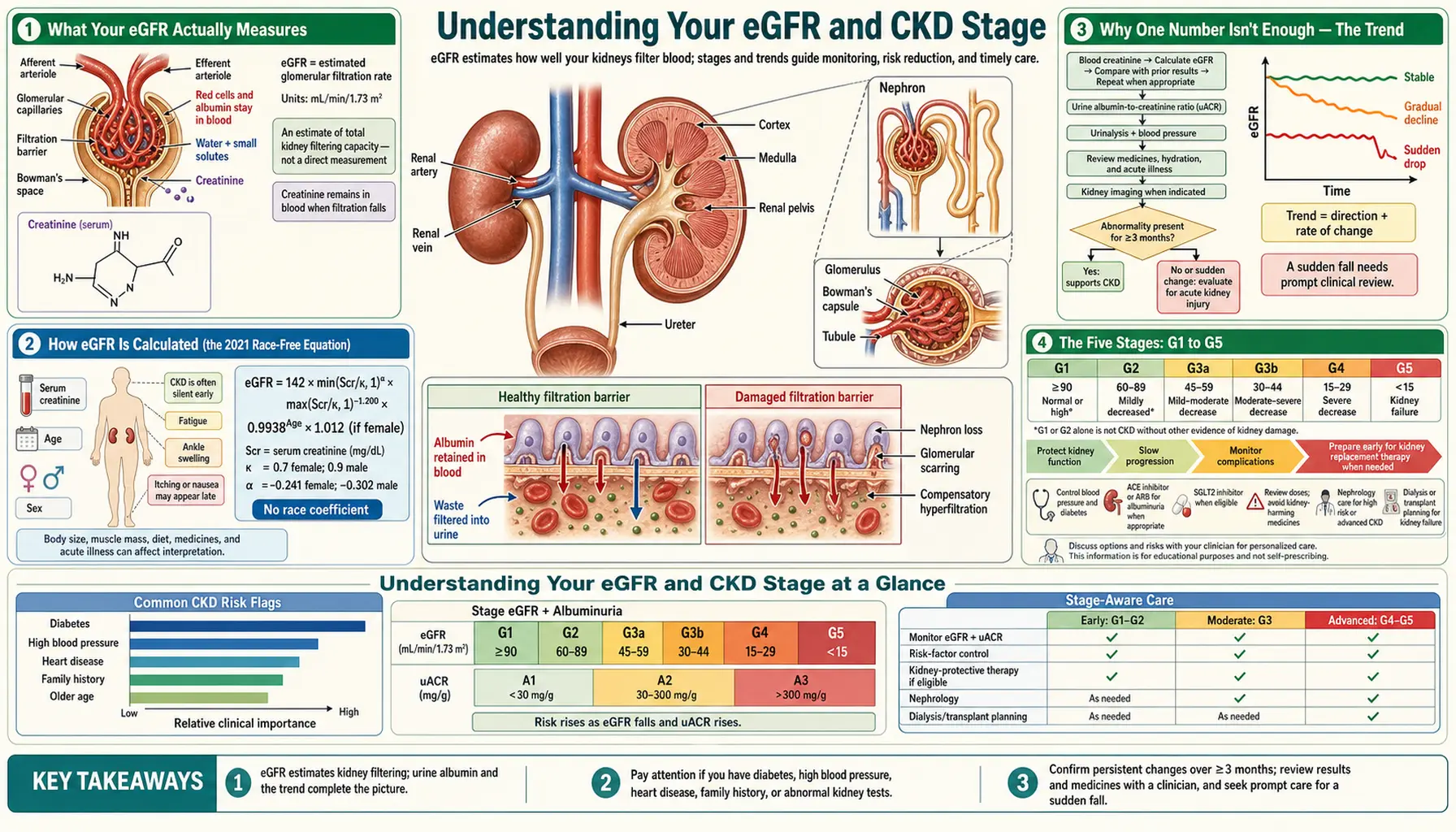
If a lab report or patient portal has just told you that your eGFR is 54 and that you are in "stage 3a CKD," it is completely normal to feel a jolt of fear — especially when no one has explained what those numbers mean or why nobody mentioned them before. Take a breath. An eGFR is not a countdown clock. It is a single snapshot of how fast your kidneys are cleaning your blood, and for most people the far more important questions are simple ones: Is it stable? Is there protein in my urine? And what can I do to keep it steady? This guide walks through exactly what eGFR measures, how it is calculated, why one reading is never the whole story, how the five stages and the albuminuria "second axis" fit together in the KDIGO risk map, when the standard test can mislead, and what to ask your doctor. We will keep the real numbers and name the equations and guidelines — but in plain language, for you, not for a nephrology exam.
Interactive Visualization Kidney Nephron — watch blood become urine Follow blood into the glomerulus and see filtration and reabsorption turn 180 litres of filtrate into urine — then toggle dehydration or diabetes. Launch →Table of Contents
- What Your eGFR Actually Measures
- How eGFR Is Calculated (the 2021 Race-Free Equation)
- Why One Number Isn't Enough — The Trend
- The Five Stages: G1 to G5
- The Second Axis: Albuminuria (A1–A3) and Your UACR
- Putting It Together: The KDIGO Risk Heat Map
- When Creatinine Lies — and Cystatin C Fixes It
- Normal Aging vs. Real Disease
- How Often to Test, and When to See a Nephrologist
- Questions to Ask Your Doctor
- Key Research Papers
- Connections
- Featured Videos
What Your eGFR Actually Measures
Each kidney holds roughly a million microscopic filters called nephrons — about two million between the pair. Together they strain about 180 liters of fluid out of your blood every single day, then reabsorb almost all of the water and useful chemicals, leaving only a liter or two of urine carrying the waste away. The speed of that straining is the glomerular filtration rate (GFR): the number of milliliters of blood the filters clean per minute.
Think of it like the pump on a swimming pool. A healthy pump might push 120 gallons a minute through the filter; a tired, half-clogged pump might only manage 50. GFR is that flow rate for your kidneys, and it is reported as mL/min/1.73 m² — milliliters per minute, adjusted to a standard adult body size (1.73 square meters of surface area) so that a small person and a large person can be compared on the same scale. A healthy young adult usually runs around 100–120.
Here is the part almost no one explains: the little "e" in front matters enormously. Nobody can measure your filtration rate directly during a routine blood draw. So the lab estimates it from a chemical in your blood, using a formula. That is why it is called an estimated GFR, or eGFR. It is a very good estimate for most people — but it is a calculation, not a direct reading, and that distinction explains most of the confusion that follows.
How eGFR Is Calculated (the 2021 Race-Free Equation)
When your blood is drawn, the lab measures serum creatinine — a waste product your muscles produce at a fairly steady rate as they use energy. Healthy kidneys clear creatinine efficiently, so when filtration slows, creatinine backs up in the blood. The lab then feeds three things into a formula: your creatinine level, your age, and your sex. That is it. Modern equations do not use your weight (the result is already size-adjusted) and, since 2021, do not use race.
The formula in use across the United States today is the 2021 CKD-EPI creatinine equation (Inker and colleagues, published in the New England Journal of Medicine). It was built by measuring the true, gold-standard filtration rate in thousands of people and then fitting a curve that best predicts that true rate from creatinine, age, and sex. Earlier versions — the CKD-EPI 2009 equation and, before it, the MDRD equation from 1999 — included a mathematical "race coefficient" that automatically raised a Black patient's estimated GFR by about 16%. That coefficient was based on average differences in creatinine across study groups, but using race — a social category, not a biological switch — to nudge a medical number drew serious criticism because it could make a Black patient's kidneys look healthier than they were and delay care.
A joint National Kidney Foundation and American Society of Nephrology (NKF-ASN) task force (Delgado and colleagues) reviewed the evidence and recommended a single, race-free equation for everyone, which is what the 2021 formula delivers. If your older records show a different eGFR than a recent one, part of the shift may simply be this equation change — worth asking about.
The true, directly measured GFR (mGFR) still exists: it involves injecting a harmless tracer such as iohexol and timing how fast the kidneys clear it. It is more accurate but slow, costly, and reserved for special situations — potential kidney donors, some cancer chemotherapy dosing, or cases where the estimate seems wrong. For everyday care, the estimate does the job.
Why One Number Isn't Enough — The Trend
A single eGFR is a photograph, not a movie — and photographs can be blurry. Your result can dip for reasons that have nothing to do with lasting kidney damage: dehydration on the morning of the draw, a large steak dinner the night before (extra creatinine from the meat), a recent infection, hard exercise, or ordinary lab-to-lab variation. That is exactly why the official definition of chronic kidney disease, set by the international KDIGO guidelines, requires the abnormality to persist for more than three months. One low reading is a reason to repeat the test, not to panic.
What matters far more than any single value is the trend over time. Consider two people who both have an eGFR of 55 today. The first has been steady at 55 for eight years; the second was 80 a year ago. Same number, completely different story — the second person is losing function fast and needs urgent attention, while the first may simply need routine monitoring. Ask to see your eGFR results graphed over years, not read one at a time.
Doctors watch the rate of decline. A gentle drift downward with age is expected (more on that below). KDIGO flags rapid progression when eGFR falls faster than about 5 mL/min/1.73 m² per year, or when it drops by 25% or more and crosses into a worse stage. Those are the patterns that change the plan — not an isolated blip.
The Five Stages: G1 to G5
CKD is divided into stages by eGFR (the "G" categories). The dividing line for the diagnosis is an eGFR below 60 sustained past three months — or, at higher eGFR, the presence of some other marker of kidney damage such as protein in the urine. Here is what each stage tends to mean for ordinary daily life. Stages 3 is split into 3a and 3b because they carry meaningfully different risk.
| Stage | eGFR (mL/min/1.73 m²) | What it means for daily life |
|---|---|---|
| G1 | ≥ 90 | Normal filtering speed. Counts as CKD only if another sign of damage is present (e.g. albumin in urine, cysts, a structural change). Usually no symptoms; the focus is on treating the underlying cause. |
| G2 | 60–89 | Mildly reduced — and common as a normal part of aging. Again, only labeled CKD if a damage marker is also present. Typically no symptoms you would notice. |
| G3a | 45–59 | Mild-to-moderate loss. Still often symptom-free. This is the sweet spot for action: control blood pressure and blood sugar, review medications, and protect what you have. |
| G3b | 30–44 | Moderate-to-severe loss. Complications such as anemia and bone-mineral changes may begin. Most people are referred to a nephrologist around here. |
| G4 | 15–29 | Severe loss. Symptoms (fatigue, swelling, poor appetite, itching) become more likely. Time to plan ahead — learn about dialysis and transplant, and create dialysis access early if needed. |
| G5 | < 15 | Kidney failure. Dialysis or a transplant is needed to stay well. "End-stage" is a billing and coding term — it is not a countdown, and many people live full lives for years with treatment. |
Notice that G1 and G2 are not automatically a disease. A perfectly healthy person can have an eGFR of 95 (G1) or 78 (G2). Those categories only become "CKD" when paired with evidence of actual kidney damage — which is why the urine test in the next section is so important.
The Second Axis: Albuminuria (A1–A3) and Your UACR
If eGFR tells you how fast the filters run, albuminuria tells you whether they are leaking. Healthy filters hold back albumin, a valuable blood protein, and keep it out of the urine. Damaged filters let it slip through. Detecting that leak is often the earliest warning sign of kidney disease — it can appear years before eGFR ever falls, which is why relying on eGFR alone misses many people who are only in the early, most treatable phase.
The test is easy and cheap: a single random ("spot") urine sample, from which the lab calculates the urine albumin-to-creatinine ratio (UACR), reported in milligrams of albumin per gram of creatinine (mg/g). Using the ratio corrects for how dilute or concentrated the sample happens to be, so you do not need a 24-hour urine collection. The three albuminuria categories are:
- A1 — Normal to mildly increased: UACR under 30 mg/g. The filters are holding the line.
- A2 — Moderately increased: UACR 30–300 mg/g. The older term for this was "microalbuminuria." A quiet but real signal, and often the first sign of diabetic or hypertensive kidney injury.
- A3 — Severely increased: UACR over 300 mg/g (once called "macroalbuminuria"). A strong signal of active damage and a much higher risk of progression.
If you have ever noticed persistently foamy or bubbly urine, that can be a visible clue of protein loss (though bubbles alone are not a diagnosis). Here is why albuminuria deserves equal billing with eGFR: large studies show it independently predicts kidney failure, heart attack, and death — and it does so even when eGFR still looks normal. Two people with the same eGFR can have very different futures depending on whether their UACR is 10 or 900. That is precisely the insight behind the risk map in the next section.
Putting It Together: The KDIGO Risk Heat Map
Because filtering speed (eGFR) and leakiness (albuminuria) each carry their own risk, modern guidelines describe you by both at once. The KDIGO system calls this "CGA" staging — Cause, GFR category, and Albuminuria category. Plotted on a grid, the two axes create the famous color-coded "heat map," where each square is shaded green, yellow, orange, or red for increasing risk of things going wrong (kidney failure, cardiovascular events, early death). The table below shows the risk level in each square; picture green at the top-left corner deepening to red at the bottom-right.
| GFR category (eGFR) | A1: UACR < 30 mg/g | A2: UACR 30–300 mg/g | A3: UACR > 300 mg/g |
|---|---|---|---|
| G1 (≥ 90) | Low (green)* | Moderate (yellow) | High (orange) |
| G2 (60–89) | Low (green)* | Moderate (yellow) | High (orange) |
| G3a (45–59) | Moderate (yellow) | High (orange) | Very high (red) |
| G3b (30–44) | High (orange) | Very high (red) | Very high (red) |
| G4 (15–29) | Very high (red) | Very high (red) | Very high (red) |
| G5 (< 15) | Very high (red) | Very high (red) | Very high (red) |
*The green squares (G1–G2 with A1) are only classified as CKD if some other marker of kidney damage is present; otherwise they represent normal kidney function.
The heat map explains a lot of real-world confusion. Someone at G3a with A1 (eGFR 52, no protein leak) sits in a yellow, moderate-risk square and may need little more than yearly monitoring. Someone at that same G3a but with A3 (heavy protein leak) sits in a red, very-high-risk square and needs aggressive treatment. The number "52" is identical; the risk is worlds apart. This is why a good clinician never stages you on eGFR alone — and why you should always know your UACR too.
When Creatinine Lies — and Cystatin C Fixes It
Remember that eGFR is estimated from creatinine, and creatinine comes from muscle. That single fact is the equation's Achilles' heel. If you have more muscle than the "average" person the formula assumes, your creatinine is naturally higher, and the equation will underestimate your true kidney function — making healthy kidneys look damaged. If you have less muscle than average, your creatinine is naturally low, and the equation will overestimate your function — making failing kidneys look better than they are, which is the more dangerous error.
People for whom creatinine-based eGFR can be misleading include:
- Bodybuilders and very muscular young men — high muscle mass inflates creatinine; their real eGFR is often better than the number suggests.
- Frail elderly adults and people with serious illness — low muscle mass drops creatinine; their real eGFR may be worse than it looks.
- Amputees and people with muscle-wasting conditions — less muscle, less creatinine, a falsely reassuring estimate.
- Vegetarians and vegans — less dietary creatine from meat can lower creatinine somewhat.
- People taking creatine supplements or certain drugs (such as trimethoprim or cimetidine) that shift creatinine without changing actual filtration.
The fix is a second marker: cystatin C. It is a small protein made at a steady rate by essentially every cell in the body, freely filtered by the kidneys, and — crucially — largely independent of muscle mass, diet, age, and sex. There is a validated 2021 CKD-EPI cystatin C equation, and even better, a combined creatinine–cystatin C equation that averages the two markers. Research (Inker 2012; Shlipak 2013) shows the combined estimate is the most accurate of all and that cystatin C-based estimates predict kidney failure and death more reliably. It is reasonable to ask your doctor for a cystatin C test when the creatinine result does not fit the clinical picture — for instance, before a nephrologist confirms a diagnosis, when dosing a risky medication, or when your body type sits far from average.
Normal Aging vs. Real Disease
Kidneys, like every organ, slow down gently with age. After roughly age 30–40, average GFR declines by about 0.8 to 1 mL/min/1.73 m² each year even in healthy people. Do the arithmetic and a fit, symptom-free 80-year-old can easily land around an eGFR of 60–70 — a number that would read as "stage 2" or borderline "stage 3a" on the chart, yet may reflect nothing more than a well-worn set of filters doing their job.
This creates a genuine, unsettled debate in kidney medicine. KDIGO uses the same eGFR thresholds for everyone regardless of age, which is simple and cautious but risks over-labeling healthy older adults with a scary-sounding "chronic disease." Other experts argue for age-adapted thresholds so that expected aging is not medicalized. Both camps agree on the tie-breaker: albuminuria and the trend. An 80-year-old with eGFR 58, no protein in the urine, and a stable line over five years is almost certainly experiencing normal aging. The same eGFR with a rising albumin leak, or a number that is dropping year over year, points to real disease that deserves treatment. Age tells you how to interpret the number; it does not let you ignore it.
How Often to Test, and When to See a Nephrologist
How often you should have your eGFR and UACR checked depends on where you land in the heat map — the riskier your square, the more often you monitor. As a practical guide that follows KDIGO:
- Low risk (green): at least once a year if you have any risk factors (diabetes, high blood pressure, family history, age over 60).
- Moderate risk (yellow): about once a year, sometimes more if your doctor sees a reason.
- High risk (orange): roughly twice a year.
- Very high risk (red): three to four times a year, or more, to catch problems early and manage complications.
Most CKD is managed perfectly well by a primary care doctor. But certain findings warrant a referral to a nephrologist (kidney specialist). KDIGO recommends referral when you have any of the following:
- eGFR below 30 (stage G4 or G5) — time to plan ahead with a specialist.
- Rapid decline — losing more than about 5 mL/min/1.73 m² per year, or a sustained drop crossing into a worse stage.
- Heavy albuminuria — UACR at or above 300 mg/g (category A3), especially if it is rising.
- Persistent blood in the urine not explained by a urinary or bladder cause.
- Hard-to-control blood pressure despite several medications.
- Recurring potassium problems (too high or too low).
- Recurrent kidney stones or a known/suspected hereditary kidney disease such as polycystic kidney disease.
- An uncertain cause of the kidney disease that needs specialist work-up.
Being referred is not a sign that things are dire — earlier specialist input is consistently linked to better outcomes, more time to plan, and fewer surprises.
Questions to Ask Your Doctor
You are allowed to be an active participant in your own kidney care. Bring this short list to your next appointment:
- "What is my eGFR, and can we look at how it has changed over the last few years?"
- "What is my UACR (urine albumin)? If it has not been checked, can we check it?"
- "Which stage and albuminuria category am I in — and where does that put me on the risk map?"
- "Is my number stable, or is it declining? How fast?"
- "Given my muscle mass and body type, would a cystatin C test give a more accurate picture?"
- "Are any of my current medications or supplements hard on the kidneys, and should any doses change for my eGFR?"
- "What is the likely cause in my case — diabetes, blood pressure, something else?"
- "What are my blood pressure and blood sugar targets, and would a medication like an ACE inhibitor, ARB, or SGLT2 inhibitor help protect my kidneys?"
- "How often should I be retested, and at what point would you refer me to a nephrologist?"
Key Research Papers
- Inker LA, Eneanya ND, Coresh J, et al. New Creatinine- and Cystatin C–Based Equations to Estimate GFR without Race. New England Journal of Medicine. 2021;385(19):1737-1749.
- Levey AS, Stevens LA, Schmid CH, et al. A New Equation to Estimate Glomerular Filtration Rate (CKD-EPI). Annals of Internal Medicine. 2009;150(9):604-612.
- Matsushita K, van der Velde M, Astor BC, et al (Chronic Kidney Disease Prognosis Consortium). Association of estimated glomerular filtration rate and albuminuria with all-cause and cardiovascular mortality in general population cohorts: a collaborative meta-analysis. The Lancet. 2010;375(9731):2073-2081.
- Astor BC, Matsushita K, Gansevoort RT, et al (Chronic Kidney Disease Prognosis Consortium). Lower estimated glomerular filtration rate and higher albuminuria are associated with mortality and end-stage renal disease: a collaborative meta-analysis of kidney disease population cohorts. Kidney International. 2011;79(12):1331-1340.
- Shlipak MG, Matsushita K, Ärnlöv J, et al. Cystatin C versus Creatinine in Determining Risk Based on Kidney Function. New England Journal of Medicine. 2013;369(10):932-943.
- Inker LA, Schmid CH, Tighiouart H, et al. Estimating Glomerular Filtration Rate from Serum Creatinine and Cystatin C. New England Journal of Medicine. 2012;367(1):20-29.
- Coresh J, Selvin E, Stevens LA, et al. Prevalence of Chronic Kidney Disease in the United States. JAMA. 2007;298(17):2038-2047.
- Delgado C, Baweja M, Crews DC, et al. A Unifying Approach for GFR Estimation: Recommendations of the NKF-ASN Task Force on Reassessing the Inclusion of Race in Diagnosing Kidney Disease. American Journal of Kidney Diseases. 2022;79(2):268-288.
- Stevens PE, Ahmed SB, Carrero JJ, et al (KDIGO CKD Work Group). KDIGO 2024 Clinical Practice Guideline for the Evaluation and Management of Chronic Kidney Disease. Kidney International. 2024;105(4S):S117-S314.
- Levey AS, Bosch JP, Lewis JB, et al. A More Accurate Method To Estimate Glomerular Filtration Rate from Serum Creatinine: A New Prediction Equation (MDRD Study). Annals of Internal Medicine. 1999;130(6):461-470.
- Stevens LA, Coresh J, Greene T, Levey AS. Assessing Kidney Function — Measured and Estimated Glomerular Filtration Rate. New England Journal of Medicine. 2006;354(23):2473-2483.
- Chen TK, Knicely DH, Grams ME. Chronic Kidney Disease Diagnosis and Management: A Review. JAMA. 2019;322(13):1294-1304.
Live PubMed Searches
- CKD-EPI equation and eGFR — PubMed search
- Cystatin C and GFR estimation — PubMed search
- Albuminuria (UACR) and prognosis — PubMed search
- eGFR decline and CKD progression — PubMed search
- KDIGO CKD classification and risk — PubMed search
- Race-free eGFR equations — PubMed search
- Nephrology referral thresholds in CKD — PubMed search
Connections
- Nephrology & Hepatology
- Kidney Nephron — interactive animation
- Kidney Disease (Hub)
- Kidney-Friendly Diet
- Slowing CKD Progression
- Diabetic Kidney Disease
- Dialysis & Transplant
- Kidney Function Tests
- eGFR (Lab Test)
- Creatinine
- Cystatin C
- Blood Urea Nitrogen (BUN)
- Comprehensive Metabolic Panel
- Diabetes
- Hypertension
- Glomerulonephritis
- Acute Kidney Injury
- Nephrotic Syndrome
- Polycystic Kidney Disease