The Synthetic-Venom-Peptide Hypothesis: Watch the Water, 3-Finger Toxins, and the Most Contested Chapter of COVID Lies
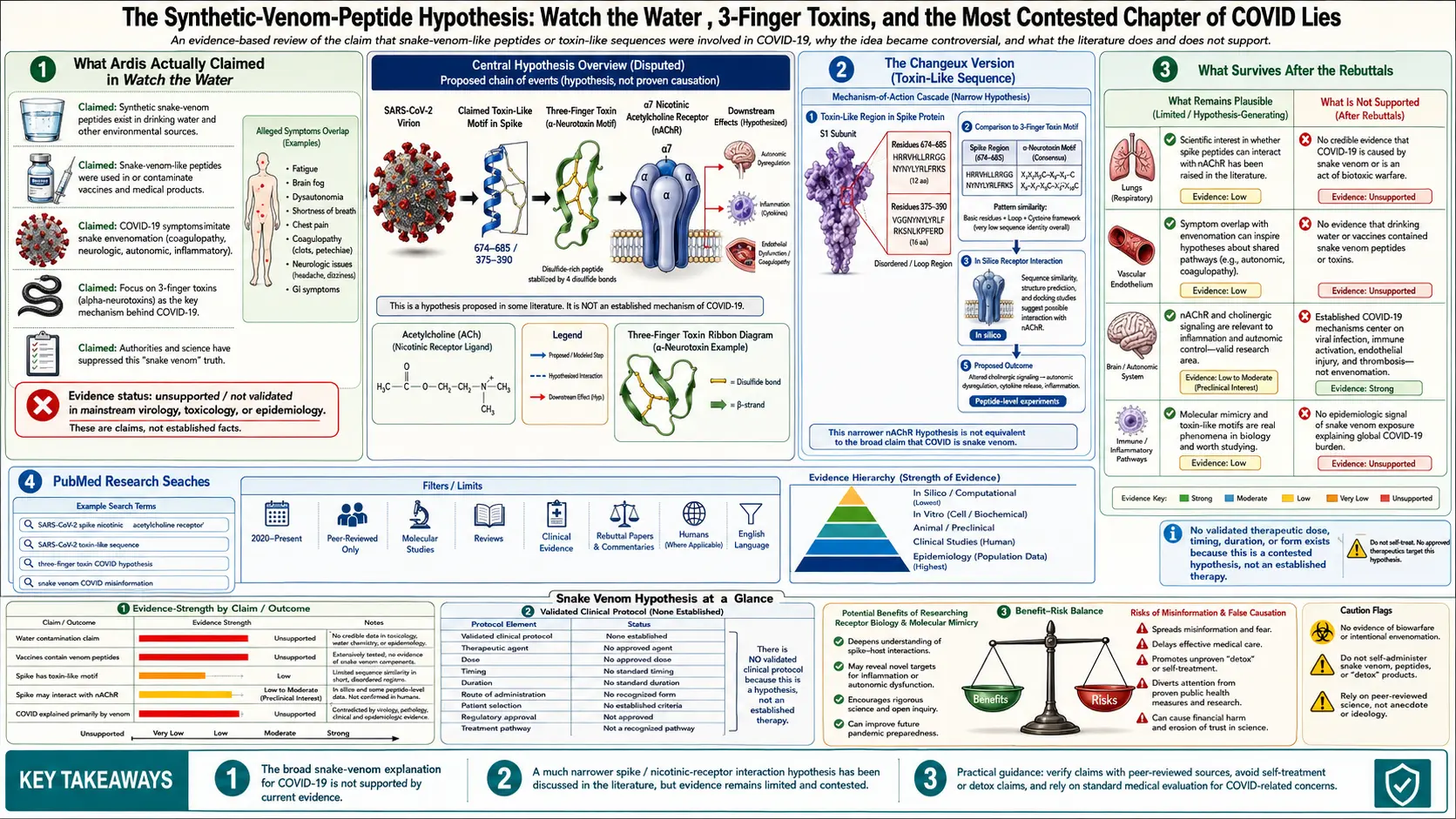
Table of Contents
- What Ardis Actually Claimed in Watch the Water
- Three-Finger Toxins: A 5-Minute Primer
- 3FTx Receptor Promiscuity Beyond nAChRs
- Where Spike and 3FTx Look Alike
- The Changeux Version (Toxin-Like Sequence)
- The Ardis Version (Synthetic Venom Peptide)
- The Water-Supply Speculation
- The Mainstream Rebuttals
- What Survives After the Rebuttals
- The Receptor Argument Still Stands
- How to Read This Chapter Critically
- Why It Matters — Even If Wrong
- Key Research Papers
- PubMed Research Searches
- Connections
- Featured Videos
1. What Ardis Actually Claimed in Watch the Water
The 2022 documentary Watch the Water, produced by Stew Peters and featuring Bryan Ardis as the principal interviewee, advanced four claims in escalating order of controversy:
- Structural homology. The receptor-binding domain of the SARS-CoV-2 spike protein contains amino-acid loop motifs that bear structural similarity to three-finger toxins (3FTx) found in elapid (cobra, krait, mamba) snake venoms.
- Functional convergence. Both 3FTx peptides and the spike RBD interact with nicotinic acetylcholine receptors and produce ion-channel and inflammatory effects through receptor-level mechanisms.
- Engineered origin. Ardis advanced the further claim that the spike protein was deliberately designed using 3FTx scaffolds — that the receptor-binding domain is, in his framing, a “synthetic venom peptide” manufactured under instruction by mRNA platforms or by gain-of-function research.
- Environmental delivery. The most speculative claim of the documentary: that snake-derived peptides may have entered the environmental supply chain through municipal water systems, and that king-cobra-related peptides may have been weaponized at scale.
The first two claims sit on solid peer-reviewed structural biology. The third is a strong, contestable inference. The fourth is speculative and was the focus of essentially all of the mainstream rebuttal coverage.
This page treats the four claims separately, because they have very different evidentiary statuses and very different therapeutic implications. The most important separation is between the receptor-pharmacology argument (the basis of the entire nicotine therapeutic case, which survives even if the venom-peptide framing is wrong) and the engineered-origin argument (much harder to evaluate, standing or falling on evidence about gain-of-function research).
2. Three-Finger Toxins: A 5-Minute Primer
Three-finger toxins (3FTx) are a family of small (60–75 amino-acid) snake-venom peptides defined by a characteristic fold: three β-stranded loops projecting from a disulfide-rich central core, looking under crystallography like three outstretched fingers from a tight central palm. The fold is exceptionally stable, evolutionarily ancient, and biochemically versatile.
The 3FTx family includes:
- α-Bungarotoxin (krait, Bungarus multicinctus): competitive antagonist of muscle α1- and neuronal α7-nAChRs; Kd ~10−9 M; used as a research probe for 50 years.
- α-Cobratoxin (Thai cobra, Naja kaouthia): similar receptor target and profile.
- Mamba toxins (Dendroaspis spp.): fasciculins target acetylcholinesterase, others target muscarinic receptors and L-type calcium channels (calciseptine).
- Cardiotoxins: cytolytic 3FTx peptides that disrupt cell membranes through a non-receptor mechanism.
- Lynx1, SLURP-1, SLURP-2: endogenous human three-finger-fold proteins that modulate human nAChRs. Mammals make their own 3FTx-fold molecules.
The endogenous human 3FTx proteins are an important point. The fold is not an exotic snake-only architecture — it is part of the human proteome. Lynx1 in particular is a GPI-anchored membrane protein that sits next to nAChRs in the brain and modulates their gating. The structural biology of nAChR engagement by a 3FTx loop is, in evolutionary terms, normal mammalian receptor pharmacology.
3. 3FTx Receptor Promiscuity Beyond nAChRs
The 3FTx fold has been recruited evolutionarily to bind many different receptor targets:
- Nicotinic acetylcholine receptors (α-bungarotoxin, cobratoxin)
- Muscarinic acetylcholine receptors (mamba MT1/MT2/MT3/MT7 toxins)
- Acetylcholinesterase (fasciculins)
- L-type voltage-gated calcium channels (calciseptine)
- Adrenergic receptors (mambin)
- Acid-sensing ion channels (ASICs) (mambalgin) — a notable analgesic with no nAChR activity
- Cell membranes directly (cytotoxins / cardiotoxins) — via the same scaffold
The fold is a small, stable, modular peptide chassis on which nature has tinkered to produce dozens of distinct pharmacological agents. From a protein-engineering standpoint, the 3FTx fold is exactly the kind of scaffold a modern peptide biologist would reach for if they wanted to build a stable receptor-binding peptide for almost any neuronal or immune target. That observation is part of the “why this scaffold for an engineered virus?” question Ardis asks.
4. Where Spike and 3FTx Look Alike
The peer-reviewed structural-biology work that Ardis cites is real and has been published in respected journals. The honest summary:
- Loop architecture. The receptor-binding domain (RBD) of the SARS-CoV-2 spike presents a hairpin loop (the receptor-binding motif, RBM, residues ~437–508) that engages ACE2. This loop has structural features — aromatic residues at key positions, a disulfide-stabilized fold — reminiscent of the finger-loop II of 3FTx peptides.
- Sequence motifs. Lagoumintzis, Farsalinos, and colleagues (2021) identified spike-RBD residues that align in primary sequence with conserved 3FTx aromatic residues (W148/Y184 of the receptor pocket; Y472/F490/L455 of spike).
- nAChR docking. Computational docking studies (Oliveira 2020, Lagoumintzis 2021, Tillu 2021) place the spike RBD in the α7 ligand-binding pocket using the same aromatic-cage interactions a 3FTx loop would use.
- In-vitro confirmation. A subset of biochemistry has shown that spike protein and spike-derived peptides can be displaced from immune-cell surfaces by nAChR antagonists, consistent with receptor-level binding.
This is a real homology, not a fabricated one. It is also not a unique homology — the 3FTx scaffold is structurally similar to many small protein-fold families, and the spike RBM has features in common with multiple loop-presenting motifs. The conservative reading is that the spike has some 3FTx-like features at some residues. The aggressive reading is that the spike is a 3FTx-derived peptide. Ardis sits at the aggressive end; Changeux sits at the conservative end. The data support either reading depending on how strict your homology criteria are.
5. The Changeux Version (Toxin-Like Sequence)
Jean-Pierre Changeux’s April 2020 nicotinic-hypothesis paper (Changeux et al., Comptes Rendus Biologies, 2020) used the phrase “a toxin-like sequence” to describe the spike RBM. This is the most defensible version of the homology claim: the spike has features in common with 3FTx loops; that homology is what allows it to engage α7-nAChR; the engagement is mechanistically relevant to COVID pathology; therefore receptor-targeted intervention (nicotine occupancy) is therapeutically interesting.
Changeux’s framing makes no claim about the origin of the virus, no claim about deliberate engineering, no claim about water-supply contamination. It is a pure structural-biology observation translated into a pharmacological hypothesis. That hypothesis was published in a peer-reviewed journal by a Wolf Prize laureate from a flagship French research institution and has not been refuted on the merits.
6. The Ardis Version (Synthetic Venom Peptide)
Ardis takes the Changeux observation and pushes it further. In Watch the Water and in Chapter 8 of COVID Lies, the argument runs:
- The spike RBM is not just “toxin-like.” It is, in functional terms, a synthetic three-finger toxin — a peptide that engages nicotinic and other receptors with venom-like specificity.
- The mRNA platforms therefore instruct the human body to produce, over a multi-day window, a venom-like peptide endogenously. Vaccinated patients are, in this framing, manufacturing a venom analog from the inside.
- Wild-type SARS-CoV-2 infection produces the same peptide via viral replication. The pathology of the infection is, mechanistically, partly venom-receptor pathology.
- The historical precedent for receptor-targeted peptide weapons is well-documented: α-bungarotoxin and cobratoxin have been studied for decades as biological-weapons candidates because of their precise receptor targeting and lethality at sub-microgram doses. The Soviet biological-weapons program documented in Ken Alibek’s Biohazard (1999) included peptide-toxin research.
- If 3FTx peptides have been weaponizable for half a century, and if the SARS-CoV-2 spike is functionally a 3FTx-like peptide, then the inference that the virus is the product of deliberate peptide engineering — not necessarily by snake venom directly, but by reverse-engineering snake-venom scaffolds — is at least worth investigating.
This is the “synthetic venom peptide” framing. It is a strong claim. It is contestable. It rests on inference from structural homology to engineered-origin, which is a step that requires either evidence of deliberate engineering (gain-of-function records, Wuhan Institute of Virology documentation) or an argument from the implausibility of the homology arising naturally. Ardis advances both arguments. Mainstream virology rejects both.
7. The Water-Supply Speculation
The most controversial moment of Watch the Water is the speculation that king-cobra-derived peptides may have been introduced into municipal water systems as a delivery vector for the “venom-like agent.” Ardis cites in particular:
- The published literature on snake-venom peptides surviving aqueous conditions (a real but not unique property).
- A 2019 paper on king-cobra venom peptide engineering for therapeutic purposes (real research, but unrelated to public-water systems).
- Anecdotal reports of unusual taste, odor, or chlorine adjustments at municipal water plants in 2020.
- The pre-existing public-health concern about pharmaceutical residues in drinking water (an established but unrelated issue).
The water-supply speculation is the weakest part of the entire COVID Lies argument and the part the fact-checker industry pursued most vigorously. There is no peer-reviewed evidence supporting it. There is no occupational-medicine signal (water-treatment workers do not show a syndrome consistent with peptide-toxin exposure). The chemical and microbiological water-quality monitoring infrastructure in the United States, while imperfect, would have detected gross peptide contamination at a scale capable of producing illness in millions.
This is the part of the Ardis case that does not survive serious scrutiny in our editorial reading, and we say so plainly. Holding this view does not require dismissing the receptor-pharmacology argument or the structural-homology argument. The chapters separate.
8. The Mainstream Rebuttals
Mainstream rebuttals to the Ardis venom-peptide framing have come from several directions. The strongest of them, in our editorial view:
- Phylogenetic origin. Whole-genome sequencing places SARS-CoV-2 firmly within the lineage of bat-origin sarbecoviruses (Andersen et al., Nature Medicine 2020). The spike protein, including its RBM, is consistent with sarbecovirus evolution — not with deliberate insertion of a snake-derived peptide. The genome does not contain identifiable 3FTx gene sequences.
- Convergent evolution. Receptor-binding loops that engage aromatic-cage receptors converge on similar geometries because the receptor surface constrains the chemistry. Apparent “3FTx homology” can emerge from independent evolutionary pressure without any biological connection.
- Receptor specificity. The spike protein’s primary high-affinity target is ACE2 (Kd in the nanomolar range). Its affinity for α7-nAChR, where reported, is far lower. A “synthetic venom peptide” engineered to target nAChRs would have high nAChR affinity; the spike does not.
- Empirical biology. Patients with COVID do not show the classical clinical signature of elapid envenomation: no flaccid paralysis, no neuromuscular respiratory failure of the bungarotoxin pattern, no characteristic ptosis-and-bulbar progression. The clinical picture is not consistent with venom-peptide pathology dominating the syndrome.
These are serious objections and we do not dismiss them. The Ardis position can be honestly summarized as: the structural homology is real, the receptor engagement is real, the engineered-origin claim is inferential, and the water-supply claim is speculative. The rebuttals primarily target the inferential and speculative layers, and largely succeed at that level — but they do not refute the structural and receptor-pharmacology layers, which are independently established by Changeux, Farsalinos, Lagoumintzis, and others.
9. What Survives After the Rebuttals
If we strip away the inferential and speculative layers, what survives of the venom-peptide framing is:
- The SARS-CoV-2 spike RBM has structural and functional features that allow it to engage α7-nAChR.
- That engagement disrupts the cholinergic anti-inflammatory pathway and contributes to the cytokine-storm phenotype of severe COVID.
- The mainstream pharmacology of nAChR ligands — including nicotine — offers a competitive-occupancy strategy to block this engagement.
- 3FTx scaffolds remain a useful comparison case for understanding the structural biology of receptor-binding peptides, regardless of whether the spike is itself derived from one.
Items 1–3 are the entire therapeutic argument of the Ardis nicotine protocol. They do not depend on the venom-peptide framing being correct. They depend on receptor pharmacology that has been peer-reviewed multiple times and that no serious pharmacologist disputes.
Item 4 is a useful conceptual tool that does not commit anyone to the speculative claims of Watch the Water.
This is the point of separating the chapters. A reader can fully reject the engineered-origin and water-supply claims and still find the receptor-pharmacology argument compelling enough to take a 7 mg patch seriously.
10. The Receptor Argument Still Stands
The most important single point on this page: the case for nicotine as a competitive nAChR antagonist of spike-mediated injury does not require the snake-venom hypothesis to be true.
The case requires only:
- The α7-nAChR exists and is expressed on the relevant tissues. (Established.)
- SARS-CoV-2 spike interacts with that receptor. (Established by Changeux, Lagoumintzis, Farsalinos.)
- Nicotine occupies the same receptor site. (Established by 150 years of pharmacology.)
- Nicotine occupancy is therapeutically meaningful. (Plausible from receptor pharmacology; supported by smoker’s-paradox observational data; pending definitive RCT in the appropriate patient population and dose.)
None of these points require the spike to be of synthetic-venom origin. They require only that the receptor-pharmacology bench science is correct — which it manifestly is. The therapeutic argument is independent of the origin argument.
11. How to Read This Chapter Critically
Three reading strategies for engaging the venom-peptide framing without becoming captive to either side:
- Read the structural-biology papers. Lagoumintzis 2021, Oliveira 2020, Changeux 2020, Tillu 2021. These are real papers in real journals. Read the abstracts at minimum; ideally the full methods. The homology is real even if your interpretation differs from Ardis’s.
- Read the rebuttals on their merits. The phylogenetic-origin argument from Andersen et al. is strong. The convergent-evolution argument is reasonable. Take them seriously rather than dismissing them as “mainstream cope.”
- Separate the chapters. A reader who rejects the engineered-origin claim is not committed to rejecting the receptor-pharmacology claim. A reader who accepts the receptor-pharmacology claim is not committed to accepting the water-supply claim. The strongest version of the Ardis case is the one that holds Chapter 7 (receptor pharmacology) and Chapter 9 (nicotine therapeutics) without insisting on the speculative parts of Chapter 8.
12. Why It Matters — Even If Wrong
Even if the synthetic-venom-peptide hypothesis is ultimately rejected in its strong form, two things follow from how the controversy unfolded that we believe matter for the long-term health of medical research:
- The reception of Watch the Water was not pharmacology. It was politics. Mainstream commentary made no serious effort to engage Changeux’s peer-reviewed structural argument. The entire criticism focused on the speculative water-supply layer, which functioned as a strawman that allowed the receptor-pharmacology argument to be tarred by association and dismissed without engagement.
- Censorship of a hypothesis is not refutation of a hypothesis. YouTube, Facebook, and Twitter (pre-Musk) all moved aggressively against discussion of Watch the Water. The result was that the public did not get to evaluate the receptor pharmacology either. A medical-research culture that conflates speculative inference with structural-biology consensus, and uses platform takedowns rather than peer-review rebuttal as its mode of engagement, is a culture that has lost its capacity for self-correction.
That second point is, in the end, the most important. The First Amendment is not just about politics. It is about the conditions under which a research community can identify and correct its errors. A community that suppresses minority research has, by construction, suppressed the only mechanism by which it can discover its own mistakes. The Ardis case — even where wrong — is a stress test of that capacity. The result of the test is not flattering to American medicine.
Key Research Papers
- Changeux JP, Amoura Z, Rey FA, Miyara M. A nicotinic hypothesis for COVID-19 with preventive and therapeutic implications. C R Biol. 2020;343(1):33-39.
- Lagoumintzis G, Chasapis CT, Alexandris N, et al. Nicotinic cholinergic system and COVID-19: in silico identification of an interaction between SARS-CoV-2 and nicotinic receptors. Food Chem Toxicol. 2021;149:112009.
- Andersen KG, Rambaut A, Lipkin WI, Holmes EC, Garry RF. The proximal origin of SARS-CoV-2. Nat Med. 2020;26(4):450-452.
- Bourne Y, Talley TT, Hansen SB, Taylor P, Marchot P. Crystal structure of a Cbtx-AChBP complex reveals essential interactions between snake α-neurotoxins and nicotinic receptors. EMBO J. 2005;24:1512-1522.
- Kini RM, Doley R. Structure, function and evolution of three-finger toxins: mini proteins with multiple targets. Toxicon. 2010;56(6):855-867.
- Tsetlin V. Snake venom α-neurotoxins and other ‘three-finger’ proteins. Eur J Biochem. 1999;264(2):281-286.
- Farsalinos K, Niaura R, Le Houezec J, et al. Editorial: Nicotine and SARS-CoV-2. Toxicology Reports. 2020;7:658-663.
PubMed Research Searches
- PubMed: Three-finger toxin and nicotinic receptor
- PubMed: Spike protein and nAChR
- PubMed: α-bungarotoxin and receptor
- PubMed: Cobratoxin and nAChR
- PubMed: Lynx1 / SLURP and nicotinic receptor
- PubMed: SARS-CoV-2 spike RBD structure
- PubMed: 3FTx as therapeutic peptide
- PubMed: Convergent evolution and receptor-binding peptides
Connections
- Dr. Bryan Ardis Hub
- Nicotinic Acetylcholine Receptors
- COVID Lies Book
- Vaccine-Injury Recovery
- Nicotine Hypothesis
- Nicotine Patch Protocol
- Tobacco Suppression History
- Hospital Protocol Critique
- Detox and Recovery
- Detox Protocols
- NAC (N-Acetylcysteine)
- Methylene Blue
- Vitamin C
- Vitamin D3
- Liver Cleansing