Sodium Benzoate: The Preservative That Can Form Benzene
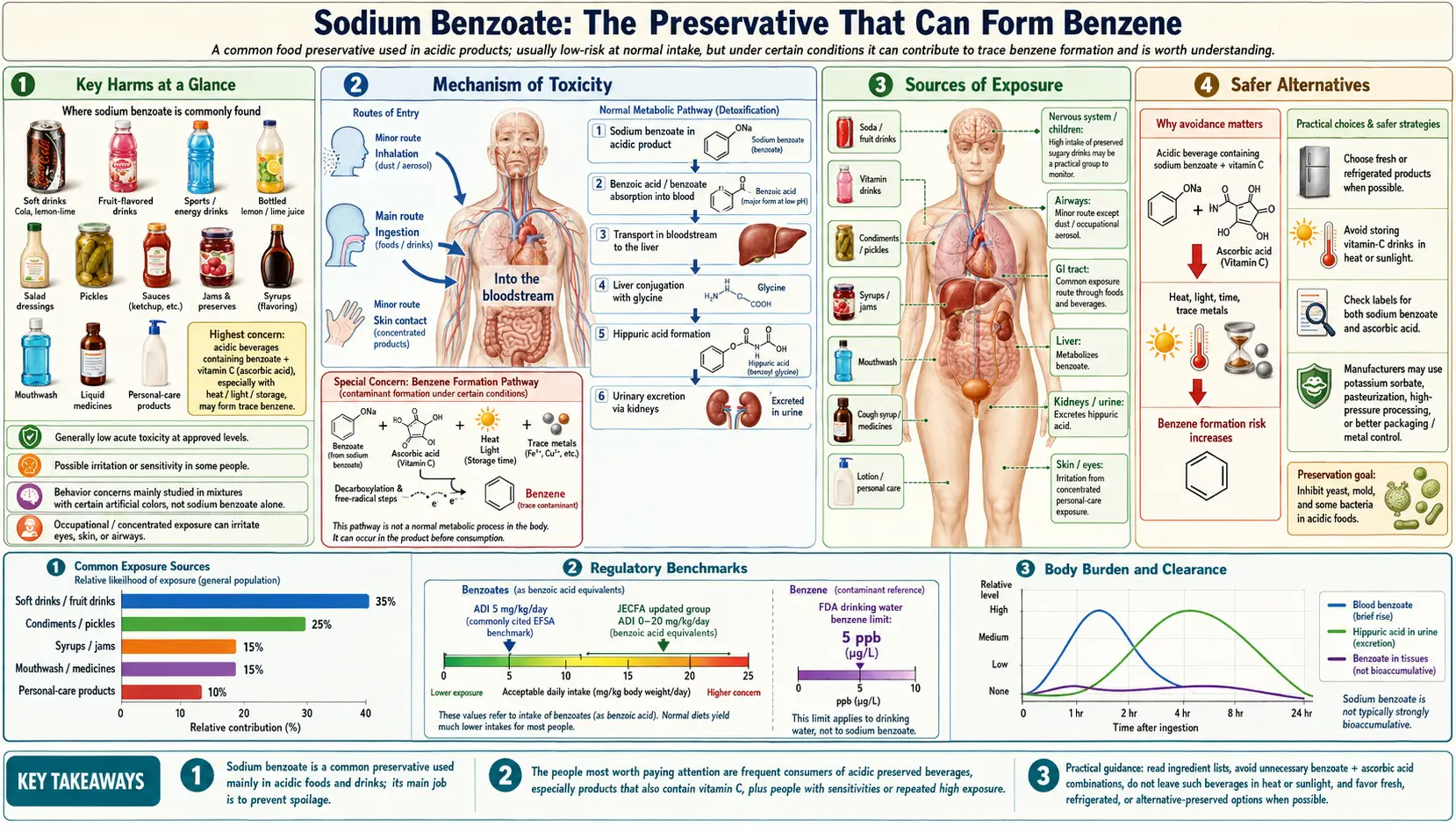
Sodium benzoate (C6H5COONa, E211) is the sodium salt of benzoic acid and the most widely used antimicrobial preservative in acidic food and beverage products worldwide. Found in soft drinks, fruit juices, salad dressings, pickles, condiments, and hundreds of other products, it has been regarded as safe by food regulators for decades. Yet sodium benzoate harbors a critical and underappreciated hazard: when it coexists in a product with vitamin C (ascorbic acid), a chemical reaction can occur that produces benzene — a compound classified by the International Agency for Research on Cancer (IARC) as a Group 1 carcinogen with no safe threshold of exposure. FDA testing in 2006 detected benzene at levels up to 87 parts per billion (ppb) in soft drinks, a concentration nearly 18 times the EPA's maximum contaminant level for benzene in drinking water (5 ppb). Reformulation efforts have reduced but not eliminated the problem, and sodium benzoate's other health concerns — hyperactivity in children, mitochondrial damage, and allergic reactions — add further weight to calls for its replacement.
Table of Contents
- Key Harms at a Glance
- Overview
- Benzene Formation
- Mechanism of Toxicity
- Health Effects
- Sources of Exposure
- Regulatory Status
- Interaction with Vitamin C
- Safer Alternatives
- Research Papers and References
- Connections
- Featured Videos
Key Harms at a Glance
- Benzene formation with vitamin C — generates a Group 1 IARC carcinogen with no safe threshold.
- 87 ppb benzene in soft drinks — FDA 2006 testing found levels 18x EPA drinking-water limit.
- Hyperactivity in children — McCann 2007 Lancet trial linked benzoate+dyes to ADHD-like symptoms.
- Mitochondrial DNA damage — Piper et al. showed benzoate inactivates an area of mitochondrial DNA in yeast.
- Allergic and pseudo-allergic reactions — urticaria, angioedema, asthma exacerbation in sensitized individuals.
- Ubiquitous in acidic beverages — sodas, fruit juices, salad dressings, pickles.
- Hippurate pathway stress — glycine-conjugation detoxification may deplete glycine in high-exposure consumers.
Overview
Benzoic acid (C6H5COOH) occurs naturally in trace amounts in many fruits, including cranberries, prunes, and cinnamon, where it contributes to the natural antimicrobial defense of the plant. The industrial sodium salt form — sodium benzoate — is synthesized by reacting benzoic acid with sodium hydroxide. It is a white granular or crystalline powder that is highly water-soluble and essentially odorless at room temperature.
As a preservative, sodium benzoate is effective specifically in acidic environments (pH below 4.5). In acidic conditions, sodium benzoate converts to its active, undissociated form, benzoic acid. Undissociated benzoic acid is lipophilic and can cross microbial cell membranes, where it interferes with membrane transport proteins and inhibits key enzymes involved in phosphorylation reactions, effectively acidifying the intracellular environment of susceptible microorganisms. This mechanism makes it particularly effective against yeasts, molds, and acid-tolerant bacteria in soft drinks, fruit juices, and condiments — environments where these spoilage organisms would otherwise proliferate.
Sodium benzoate is one of the oldest synthetic food preservatives, having been in use since the late nineteenth century. Its long history of use, combined with its low cost and effectiveness at the concentrations required (typically 0.05–0.1% by weight), made it a default choice for beverage and condiment manufacturers. However, its ability to react with co-occurring vitamin C to form the human carcinogen benzene was not recognized as a food safety problem until the 1990s, and significant consumer exposure continued for another decade before industry-wide reformulation efforts began.
Benzene Formation
The reaction between sodium benzoate and ascorbic acid (vitamin C) to produce benzene is well-established organic chemistry. It proceeds via a free-radical decarboxylation mechanism:
- Ascorbic acid donates an electron to a transition metal ion (most commonly ferrous iron, Fe2+, or cuprous copper, Cu+) present as a trace contaminant in water, ingredients, or processing equipment.
- The transition metal is oxidized; the ascorbate radical reacts with dissolved oxygen to produce hydrogen peroxide (H2O2).
- In the Fenton reaction, H2O2 reacts with Fe2+ to generate the hydroxyl radical (•OH), a highly reactive oxygen species.
- The hydroxyl radical attacks the benzoate ion, abstracting a hydrogen from the carboxyl group and initiating decarboxylation. Carbon dioxide is released and the phenyl radical (C6H5•) is formed.
- The phenyl radical abstracts a hydrogen atom from ascorbic acid or the solvent, yielding benzene (C6H6).
This sequence of reactions is accelerated by heat, ultraviolet light, and the presence of catalytic metal ions. All three conditions are commonly encountered by packaged soft drinks during storage, transportation, and retail display.
FDA Testing and Industry Response
The FDA became aware of the benzene formation potential in the early 1990s following concerns raised by European regulators, but did not conduct comprehensive market testing until 2005–2006. The results were alarming: of 200 beverages tested, a subset contained benzene at levels exceeding the 5 ppb EPA drinking water limit, with one product measuring as high as 87.9 ppb. The FDA publicly disclosed the results in 2006 and entered into voluntary agreements with four major soft drink manufacturers to reformulate products that tested positive, primarily by replacing sodium benzoate with potassium sorbate or by eliminating ascorbic acid as a co-ingredient.
However, the FDA's response stopped well short of a ban. The agency concluded that the benzene levels found did not represent an immediate safety concern based on the low volumes of beverages people consume daily. Critics pointed out that this assessment did not account for cumulative benzene exposure from all sources, including ambient air, tobacco smoke, automobile exhaust, and other foods, to which the contribution from beverages adds meaningfully.
Mechanism of Toxicity
Benzene Metabolism and Bone Marrow Toxicity
Benzene itself is chemically relatively inert; its toxicity arises from its metabolic activation by hepatic cytochrome P450 enzymes (primarily CYP2E1):
- Benzene → benzene oxide — the first and most critical metabolic step. Benzene oxide is a highly reactive arene epoxide capable of forming covalent adducts with DNA, RNA, and proteins.
- Benzene oxide → phenol — the dominant pathway, accounting for approximately 70% of benzene metabolism. Phenol is further hydroxylated to catechol and hydroquinone, which are oxidized in bone marrow to the highly reactive benzoquinones.
- Benzoquinones → muconaldehyde and ring-opened products — trans,trans-muconaldehyde is a bifunctional electrophile formed by ring-opening of benzene oxide. It crosslinks DNA and is considered a major contributor to benzene genotoxicity.
The ultimate target of benzene toxicity is the bone marrow, where the combination of DNA adducts, reactive quinone metabolites, and oxidative stress destroys hematopoietic stem cells and progenitor cells. Chronic benzene exposure leads to aplastic anemia, a condition in which the bone marrow fails to produce sufficient blood cells, and is the established cause of benzene-associated leukemia.
Mitochondrial Damage
Independent of the carcinogenicity pathway, research by Peter Piper at the University of Sheffield, published in 2007, demonstrated that sodium benzoate itself (not benzene derived from it) can damage mitochondrial DNA in yeast cells. Piper showed that sodium benzoate deactivates key mitochondrial membrane proteins, causing the organelles to dysfunction and eventually fail. If replicated in human cells, this finding would suggest that sodium benzoate causes mitochondrial damage at concentrations routinely ingested from preserved foods and beverages, independent of its benzene-forming potential. Mitochondrial dysfunction has been implicated in aging, neurodegenerative diseases, metabolic syndrome, and cancer progression.
Oxidative Stress
Both sodium benzoate and its metabolic products can induce oxidative stress by depleting cellular glutathione — the primary intracellular antioxidant — and by stimulating the production of reactive oxygen species. Animal studies have found elevated markers of oxidative stress in the liver, brain, and blood of rodents administered sodium benzoate at doses extrapolating to ranges achievable through heavy soft drink consumption.
Health Effects
Hyperactivity in Children
The most publicly prominent health concern associated with sodium benzoate is its apparent contribution to hyperactivity and attention-deficit behaviors in children. The critical study was the McCann et al. investigation published in The Lancet in 2007, funded by the UK Food Standards Agency. The double-blind, placebo-controlled trial enrolled 153 three-year-old children and 144 eight-to-nine-year-old children from the general population (not a clinical ADHD population). Children were randomized to receive one of two artificial food color mixtures (Mix A or Mix B) combined with sodium benzoate (45 mg/day for the younger group, 77 mg/day for the older group), or placebo, across three one-week periods.
Both mixes significantly increased hyperactivity scores compared to placebo in both age groups, as rated by blinded classroom teachers and independent observers. Mix A contained sunset yellow, carmoisine, tartrazine, and ponceau 4R; Mix B contained sunset yellow, carmoisine, quinoline yellow, and allura red — all in combination with sodium benzoate. The effect size was clinically meaningful, equivalent in magnitude to roughly one-third of the effect observed with methylphenidate (Ritalin) in ADHD treatment trials.
Because the study used combinations of dyes plus benzoate rather than sodium benzoate alone, it is not possible to isolate sodium benzoate's independent contribution from the published data. Animal studies, however, have found hyperactivity-related behavior changes from sodium benzoate administered without dyes. The European Food Safety Authority (EFSA) concluded that the Southampton study provided sufficient evidence to require warning labels on products containing the six dyes used in the trials.
Allergic Reactions
Sodium benzoate is a recognized cause of non-IgE-mediated allergic and pseudoallergic reactions in sensitive individuals:
- Urticaria (hives) — sodium benzoate is one of the most commonly identified dietary triggers of chronic urticaria. Challenge studies with oral sodium benzoate have provoked urticarial reactions in a significant proportion of patients with idiopathic chronic urticaria who are positive on elimination diet trials.
- Angioedema — swelling of deeper skin layers, lips, and throat that can be life-threatening when severe. Sodium benzoate-induced angioedema has been documented in case reports and small challenge studies.
- Asthma exacerbation — sodium benzoate has been found to provoke asthmatic reactions in a subset of asthmatic patients, particularly those who are also sensitive to aspirin (salicylate-sensitive asthmatics). The mechanism may involve inhibition of cyclooxygenase-1, altering prostaglandin and leukotriene balance in favor of bronchoconstriction.
- Rhinitis and other symptoms — runny nose, eye irritation, and general malaise have been reported in benzoate-sensitive individuals following oral challenge.
Genotoxicity
Multiple in vitro and animal studies have detected genotoxic effects from sodium benzoate at concentrations within the range of estimated human dietary exposure. These include DNA strand breaks, micronucleus formation (a marker of chromosomal damage), and increased sister chromatid exchange frequency. While the relevance of in vitro genotoxicity data to human cancer risk at real-world exposure levels is debated, the consistency of findings across multiple experimental systems is a signal that warrants concern.
Benzene-Related Leukemia Risk
Benzene is an established cause of acute myeloid leukemia (AML) and has been associated with other hematologic malignancies including non-Hodgkin lymphoma and myelodysplastic syndrome. The risk from benzene exposure via contaminated beverages is difficult to quantify precisely because: (1) benzene levels in products vary widely and have changed over time with reformulation; (2) individual susceptibility varies based on CYP2E1 genotype and bone marrow sensitivity; and (3) benzene exposure from beverages is a small fraction of total benzene exposure for most people. Nonetheless, because benzene is a human carcinogen with no established safe dose, any avoidable source of exposure represents a preventable risk.
Sources of Exposure
- Soft drinks — carbonated beverages are the primary dietary source. Products from major brands including formulations of Diet Coke, Sprite, Fanta, Mountain Dew, and many store-brand sodas have historically contained sodium benzoate. Many have been reformulated since 2006, but not all.
- Fruit juices and juice drinks — particularly non-refrigerated and shelf-stable varieties; acidic pH makes them ideal candidates for benzoate preservation.
- Salad dressings — especially commercial bottled dressings with vinegar or citrus bases where pH is low enough to activate benzoic acid.
- Pickles and pickled vegetables — high-acid pickling brines support benzoate use; sodium benzoate appears on the ingredient lists of many commercial pickle brands.
- Condiments and sauces — ketchup, hot sauce, soy sauce, oyster sauce, and many other table condiments contain sodium benzoate.
- Jams and jellies — acidic fruit preserves are commonly preserved with sodium benzoate.
- Cosmetics and personal care products — sodium benzoate is widely used as a preservative in lotions, shampoos, conditioners, and other personal care items. Dermal absorption provides an additional exposure route beyond dietary intake.
- Pharmaceuticals — sodium benzoate is used as a preservative in many liquid oral medications including cough syrups and antacid suspensions, and also as an active ingredient in some treatments for urea cycle disorders.
- Margarine and some dairy products — sodium benzoate is permitted in some countries for use in certain dairy-based products and spreads.
Regulatory Status
United States
The FDA classifies sodium benzoate as Generally Recognized As Safe (GRAS) as a food preservative at concentrations up to 0.1% by weight (1,000 mg/kg or 1,000 ppm) in finished food products. This GRAS determination has not been formally revisited in light of benzene formation data or the Southampton hyperactivity study. The FDA requires sodium benzoate to be declared on food ingredient labels and, after the 2006 benzene testing revealed problematic levels in some products, worked with manufacturers on voluntary reformulation rather than imposing regulatory action.
European Union
The EU permits sodium benzoate (E211) in specified food categories at defined maximum levels. Following the McCann 2007 Lancet study, the European Food Safety Authority reviewed the Southampton findings and the EU adopted a regulation requiring that foods containing any of the six dyes used in the Southampton study (sunset yellow, tartrazine, quinoline yellow, allura red, carmoisine, ponceau 4R) bear a warning label stating: "may have an adverse effect on activity and attention in children." This requirement, which applies to products also containing sodium benzoate when used in combination with these dyes, effectively caused many EU manufacturers to remove the implicated additives rather than carry the warning label. Some EU member states have moved toward stricter limits on benzoate independently.
Other Jurisdictions
Sodium benzoate is permitted with labeling requirements in most countries that have comprehensive food additive frameworks. No major food regulatory authority has banned it outright, though Japan limits its use to fewer food categories than the US or EU, and some countries prohibit it in specific products such as baby food.
Interaction with Vitamin C
The benzene-forming interaction between sodium benzoate and ascorbic acid deserves detailed examination because both ingredients are widespread and their co-occurrence is common, sometimes in the same product and sometimes through food combining during a meal or snack.
Factors That Accelerate Benzene Formation
- Heat — higher storage and transportation temperatures increase the rate of the Fenton reaction and free-radical decarboxylation. Products stored in hot warehouses, delivery trucks, or left in direct sunlight in vehicles or on shelves can accumulate benzene substantially faster than refrigerated products. A beverage that tests below 5 ppb benzene when freshly produced can exceed that threshold after weeks of warm storage.
- Ultraviolet light — UV radiation generates free radicals that initiate the reaction chain. Clear plastic and glass bottles that allow UV light penetration accelerate benzene formation compared to opaque or dark-colored containers.
- Ferrous iron (Fe2+) — trace iron contamination from water, ingredient impurities, or processing equipment is the primary metal catalyst. Even microgram-per-liter (ppb) levels of iron are sufficient to catalyze the reaction at a rate that produces measurable benzene over days to weeks.
- Cuprous copper (Cu+) — copper is a less efficient catalyst than iron for this reaction but contributes in beverages where iron content is controlled but copper is present.
- Lower pH — more acidic conditions favor the protonation of ascorbate to ascorbic acid, which is more rapidly oxidized and generates higher hydrogen peroxide yields, accelerating the Fenton cascade.
Factors That Inhibit Benzene Formation
- EDTA (ethylenediaminetetraacetic acid) — a chelating agent that sequesters transition metal ions and prevents their participation in the Fenton reaction. Adding EDTA to beverages containing both benzoate and ascorbate significantly reduces benzene formation. EDTA is already used in many beverages as a stabilizer.
- Sugar and high-viscosity matrices — sucrose and high-fructose corn syrup can partially inhibit benzene formation, possibly by competing as radical scavengers. This may explain why diet drinks (without sugar) have historically shown higher benzene levels than their full-sugar equivalents.
- Darkness and opaque packaging — UV-blocking containers substantially reduce the photochemical initiation pathway.
- Refrigeration — lower temperatures slow all the reaction steps. Refrigerated products generate benzene more slowly than ambient-temperature products.
- Removal of one co-ingredient — the simplest and most reliable mitigation is reformulation to eliminate either sodium benzoate or ascorbic acid from products that contain both. This was the primary approach taken by manufacturers following the 2006 FDA findings.
The interaction is not limited to packaged beverages. A consumer who drinks a sodium benzoate-preserved soft drink alongside a vitamin C supplement or a glass of orange juice — or who takes vitamin C-containing cold medicine preserved with sodium benzoate — may be creating benzene-generating conditions inside their body. The acidic gastric environment and the presence of trace metal ions in gastric fluid provide conditions similar to those in a beverage, albeit with faster kinetics and higher temperatures (37°C versus room temperature).
Safer Alternatives
The food and beverage industry does not lack for effective, safer alternatives to sodium benzoate. The argument that benzoate is irreplaceable is not supported by the evidence:
- Potassium sorbate (E202) — the most widely used alternative to sodium benzoate. It is effective against yeasts, molds, and some bacteria in acidic to moderately acidic foods, has a broader pH range of effectiveness than benzoate, and does not form benzene when combined with vitamin C. Potassium sorbate is the primary reformulation replacement used by manufacturers who eliminated sodium benzoate after 2006. Its safety profile is substantially better than benzoate.
- Citric acid — creates an acidic environment unfavorable to microbial growth and synergizes with other preservation methods. Widely used as a standalone preservative in many acidic beverages and foods.
- Nisin — a natural antimicrobial peptide produced by Lactococcus lactis bacteria during fermentation. Effective against a wide range of gram-positive bacteria and approved for food use in many countries. Used in dairy products, beverages, and sauces.
- Natamycin (E235) — a natural antifungal agent produced by Streptomyces natalensis bacteria, particularly effective against yeasts and molds. Used in dairy products, meat products, and some beverages where fungal contamination is the primary concern.
- Rosemary extract and other plant-derived antioxidants — natural phenolic antioxidants can extend shelf life in some food matrices by preventing oxidative spoilage, reducing the need for synthetic preservatives.
- High-pressure processing (HPP) — a non-thermal preservation technology that uses extremely high pressure to inactivate pathogens and spoilage organisms without chemical additives. HPP products typically require refrigeration but are free of synthetic preservatives.
- Modified atmosphere packaging — displacing oxygen with nitrogen or carbon dioxide in packaging inhibits aerobic spoilage organisms and extends shelf life without chemical preservatives.
The consistent availability and commercial viability of these alternatives underscores that continued widespread use of sodium benzoate is a choice driven by cost, inertia, and regulatory permissiveness rather than technical necessity.
Research Papers and References
Key research papers and authoritative sources. Links resolve to DOI, PubMed, or the issuing agency.
- McCann D, Barrett A, Cooper A, et al. Food additives and hyperactive behaviour in 3-year-old and 8/9-year-old children in the community: a randomised, double-blinded, placebo-controlled trial. Lancet. 2007;370(9598):1560-1567.
- Nair B. Final report on the safety assessment of benzyl alcohol, benzoic acid, and sodium benzoate. International Journal of Toxicology. 2001;20 Suppl 3:23-50.
- Piper PW. Yeast superoxide dismutase mutants reveal a pro-oxidant action of weak organic acid food preservatives. Free Radical Biology and Medicine. 1999;27(11-12):1219-1227.
- Badawi AF, Stern SJ, Lang NP, Kadlubar FF. Cytochrome P-450 and acetyltransferase expression as biomarkers of carcinogen-DNA adduct levels and human cancer susceptibility. Progress in Clinical and Biological Research. 1996;395:109-140. PMID 8895990.
- McNeal TP, Nyman PJ, Diachenko GW, Hollifield HC. Survey of benzene in foods by using headspace concentration techniques and capillary gas chromatography. Journal of AOAC International. 1993;76(6):1213-1219.
- Nishino SF, Spain JC. Oxidative pathway for the biodegradation of nitrobenzene by Comamonas sp. strain JS765. Applied and Environmental Microbiology. 1995;61(6):2308-2313.
- International Agency for Research on Cancer. IARC Monographs on the Evaluation of Carcinogenic Risks to Humans, Volume 29: Some Industrial Chemicals and Dyestuffs: Benzene. Lyon: IARC; 1982. IARC Monographs Vol. 29
- Monks TJ, Lau SS. Toxicology of quinol-thioethers. Sub-Cellular Biochemistry. 1994;22:83-133.
- Beezhold BL, Johnston CS, Nochta KA. Sodium benzoate-rich beverage consumption is associated with increased reporting of ADHD symptoms in college students: a pilot investigation. Journal of Attention Disorders. 2014;18(3):236-241.
- Pongsavee M. Effect of sodium benzoate preservative on micronucleus induction, chromosome break, and Ala40Thr superoxide dismutase gene mutation in lymphocytes. BioMed Research International. 2015;2015:103512.
- Warshaw EM, Nelsen DD, Maibach HI, et al. Positive patch test reactions to sodium benzoate: retrospective analysis of the North American Contact Dermatitis Group data, 1992-2004. Dermatitis. 2009;20(1):33-40.
- Doyle E. Sodium Benzoate/Benzoic Acid. Food Research Institute, University of Wisconsin- Madison. 2006. FRI Briefings: Sodium Benzoate
- European Food Safety Authority. Opinion of the Scientific Panel on food additives, flavourings, processing aids and materials in contact with food (AFC) on a request from the Commission related to benzoic acid and its salts. EFSA Journal. 2005;3(1):80.
- US Food and Drug Administration. Data on Benzene in Soft Drinks and Other Beverages. 2007. Updated 2014. FDA Benzene Data
- Burdock GA, Carabin IG, Griffiths JC. Toxicology and pharmacology of sodium benzoate. Food and Chemical Toxicology. 2006;44(5):599-616.
- Rowe KS, Rowe KJ. Synthetic food coloring and behavior: a dose response effect in a double-blind, placebo-controlled, repeated-measures study. Journal of Pediatrics. 1994;125(5 Pt 1):691-698.
- PubMed — sodium benzoate benzene formation search
Connections
- All Toxins
- Preservatives
- Food Additives
- Vitamin C
- Potassium Sorbate
- ADHD
- Leukemia
- Cancer
- Sodium Nitrite
- Sulfites
- Artificial Sweeteners
- Iron
- Oxidative Stress
- Asthma
- BHA
- TBHQ
- Elimination Diet
- BHT
- Red 40 Allura Red
- Benzene — the Group 1 carcinogen this preservative forms when it reacts with vitamin C in soft drinks.