TBHQ (Tertiary Butylhydroquinone): The Petroleum-Derived Preservative
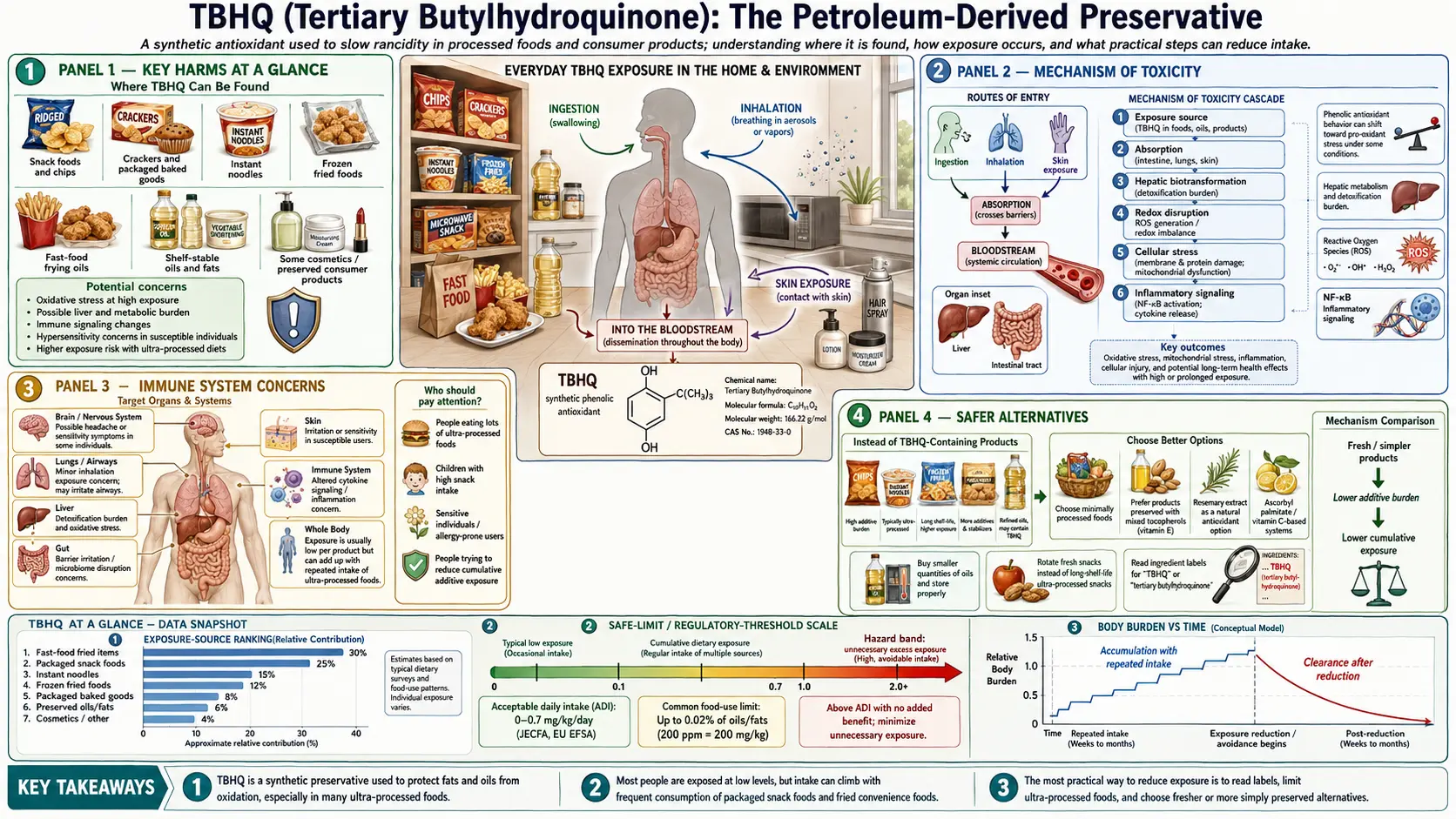
Tertiary butylhydroquinone is a synthetic antioxidant found in an extraordinary range of everyday foods — from fast food french fries to crackers, microwave popcorn to candy — yet it is largely invisible to consumers who encounter it only as an unfamiliar chemical name on an ingredient label. Derived from petroleum, structurally related to the toxicologically problematic BHA, and the subject of studies linking it to stomach tumors in rodents and immune system impairment in humans, TBHQ occupies a contested position in the food additive landscape: approved, widely used, and increasingly questioned.
Table of Contents
- Key Harms at a Glance
- Overview
- Where It's Found
- Mechanism of Toxicity
- Health Effects
- Immune System Concerns
- Regulatory Status
- Cumulative Exposure
- Safer Alternatives
- Research Papers and References
- Connections
- Featured Videos
Key Harms at a Glance
- Petroleum-derived — synthetic antioxidant from butane, structurally related to BHA.
- Stomach tumors in rodents — precursor lesions in long-term feeding studies.
- Immune system impairment — suppresses T-lymphocyte activation in human cells at dietary-relevant concentrations.
- NLRP3 inflammasome activation — drives IL-1beta and IL-18 pro-inflammatory release.
- Pro-oxidant at high doses — phenoxyl radical generates superoxide via redox cycling.
- Cumulative synthetic-antioxidant burden — co-exposure with BHA and BHT common.
- Ubiquitous in fast food and snacks — Cheez-Its, Pop-Tarts, Reese's, microwave popcorn, instant ramen.
1. Overview
TBHQ — tert-butylhydroquinone, also called tertiary butylhydroquinone — is a synthetic phenolic antioxidant designated E319 in European food additive nomenclature. Its chemical structure is 1,4-benzenediol with a tert-butyl group at the 2-position. It exists as a white to off-white crystalline powder with a faint, characteristic petroleum-like odor at high concentrations and is highly lipophilic, making it well-suited to stabilizing fats and oils.
TBHQ is derived from butane — a petroleum byproduct — through a synthetic chemical process. Specifically, it is produced by the reaction of 1,4-benzoquinone with isobutylene under acid catalysis, or alternatively by the butylation of hydroquinone. The "butylhydroquinone" name reflects both its hydroquinone core structure (a common industrial and photographic chemical) and the tert-butyl group added to confer the appropriate lipid solubility and antioxidant reactivity.
As an antioxidant food additive, TBHQ functions by interrupting the free radical chain reaction of lipid peroxidation — the process by which oxygen reacts with polyunsaturated fatty acids to produce rancid flavors, off-odors, and potentially toxic oxidation products including aldehydes and hydroperoxides. TBHQ donates a hydrogen atom from its hydroxyl group to lipid peroxyl radicals, converting them to stable, non-radical products and regenerating a relatively stable TBHQ phenoxyl radical that can further react with another peroxyl radical rather than propagating the chain.
TBHQ is structurally and functionally related to BHA (butylated hydroxyanisole) — in fact, TBHQ is a primary oxidation metabolite of BHA produced in the liver. It is notably more effective as a food antioxidant than BHA or BHT on a weight-for-weight basis in many food systems, particularly in polyunsaturated vegetable oils used for high-temperature frying. It is also more heat-stable than BHA at frying temperatures, making it particularly attractive for deep-frying applications.
TBHQ is frequently used in combination with BHA and/or BHT in food formulations, because the three compounds act synergistically — together providing greater lipid stabilization than any single additive at equivalent concentration. This co-use is extremely common in commercial frying oils, snack foods, and fast food preparations, meaning that consumers are routinely simultaneously exposed to multiple synthetic phenolic antioxidants.
2. Where It's Found
Fast Food Frying Oils
TBHQ is used extensively in the frying oils of major fast food chains to extend oil life and delay the development of rancid flavors during repeated high-temperature frying cycles. McDonald's, Burger King, KFC, and many other chains have used TBHQ-containing oils at various points in their supply chains; specific formulations vary by supplier, country, and time period as companies respond to consumer and regulatory pressure. A single meal of french fries and fried chicken from a fast food establishment may deliver a meaningful fraction of the acceptable daily intake for TBHQ, particularly for children.
Chicken Nuggets and Fried Chicken Products
Commercial chicken nuggets, breaded chicken strips, and fried chicken products — whether from fast food restaurants or frozen food sections — are a major vehicle for TBHQ exposure. The high-fat content of the coating and frying oil, combined with the extended shelf life required for frozen retail products, makes TBHQ a standard ingredient in product formulations. Frozen nugget products may contain TBHQ both in the breading and in the cooking oil absorbed during frying.
Crackers and Snack Foods
Many widely consumed cracker and snack brands incorporate TBHQ as a fat stabilizer. Products including Cheez-Its, Wheat Thins, and numerous store-brand equivalents have contained TBHQ in formulations. The high fat content of cheese crackers and similar products — particularly those using partially hydrogenated oils or palm oil-based shortenings — requires antioxidant protection to achieve the desired shelf life. Consumers may eat these products daily as snacks, creating ongoing low-level TBHQ exposure.
Pop-Tarts and Breakfast Pastries
Toaster pastries including Pop-Tarts and similar products contain TBHQ in the fat-containing filling and pastry components. The extended ambient shelf life of these products — often 12 months or more — requires antioxidant stabilization of the fat fraction. TBHQ is well-suited to this application because of its stability across a wide temperature range, including the repeated toasting cycles consumers subject the product to.
Chocolate Candy
Reese's Peanut Butter Cups and similar chocolate-peanut butter confections have used TBHQ to stabilize the fat blend in the peanut butter filling. Peanut butter is rich in polyunsaturated fatty acids (particularly linoleic acid) that are highly susceptible to oxidative rancidity. TBHQ extends the shelf life of peanut-butter-containing confections and prevents the development of rancid off-flavors during storage at ambient temperatures in retail environments.
Microwave Popcorn
The fat fraction in microwave popcorn — whether palm oil, partially hydrogenated oil, or other fat blends — is stabilized with antioxidants including TBHQ. The microwave popcorn category underwent substantial reformulation pressure in the 2000s due to concerns about diacetyl (the butter flavoring compound associated with occupational lung disease), but TBHQ use has continued in many formulations. The high temperatures reached inside microwave popcorn bags may cause TBHQ to volatilize and be inhaled during consumption, an exposure route distinct from dietary ingestion.
Frozen Pizza
Commercial frozen pizza products contain TBHQ in the fat components of the crust, sauce, and processed meat toppings. The combination of multiple fat-containing components in a single product, each requiring antioxidant stabilization, means that frozen pizza can be a significant TBHQ source for frequent consumers. As with other frozen processed foods, TBHQ's heat stability makes it effective across the wide temperature range from frozen storage through reheating.
Ramen Noodles
Instant ramen noodles are fried in oil during production as part of the flash-dehydration process that gives them their characteristic texture. This fried fat component requires antioxidant protection to remain stable through the ambient storage life of instant ramen, which may be 12 months or more. TBHQ is commonly listed on instant noodle ingredient labels, and ramen is a particularly significant source for consumers who eat it daily, as many college students and low-income households do.
Pet Foods
TBHQ is used as a preservative in dry pet foods, particularly those with high fat content from animal-source ingredients. The high lipid content of many dog and cat foods, combined with the ambient storage conditions and multi-month shelf lives expected by consumers, requires effective antioxidant protection. Companion animals consuming TBHQ-preserved foods receive ongoing exposure proportionally similar to or greater than human consumers of TBHQ-containing processed foods.
Non-Food Uses
Beyond food, TBHQ is used as an antioxidant stabilizer in lacquers, varnishes, resins, and industrial oils — applications that reflect its origins as an industrial chemical adapted for food use. It is also incorporated into some cosmetic formulations as an antioxidant to prevent the rancidity of lipid-containing skin care products. These non-food uses create additional routes of consumer exposure beyond dietary ingestion.
3. Mechanism of Toxicity
Antioxidant Function
In its role as a food preservative, TBHQ acts as a chain-breaking antioxidant through free radical scavenging. The hydroxyl groups on the hydroquinone ring can donate hydrogen atoms to lipid peroxyl radicals (LOO•), converting them to lipid hydroperoxides (LOOH) and generating the relatively stable TBHQ phenoxyl radical. This radical can react with a second peroxyl radical to form non-radical products, effectively removing two reactive species per TBHQ molecule. The net result is interruption of the self-propagating lipid oxidation chain that would otherwise generate aldehydes, ketones, and other rancidity compounds.
Pro-Oxidant Effects at High Doses
A critical and counterintuitive aspect of TBHQ toxicology is that at higher concentrations, TBHQ shifts from antioxidant to pro-oxidant behavior. This reversal occurs because the TBHQ phenoxyl radical generated during antioxidant activity can undergo oxidation to tert-butylquinone (TBQ) — a highly electrophilic quinone — and can also participate in redox cycling with molecular oxygen, generating superoxide radicals. At the concentrations used in food (up to 0.02% of fat content), TBHQ is firmly in the antioxidant regime. At higher concentrations achieved in toxicological studies or potentially in cell culture experiments, the pro-oxidant mechanism becomes dominant.
NLRP3 Inflammasome Activation
Emerging research has identified TBHQ as an activator of the NLRP3 inflammasome — an intracellular signaling complex that triggers the release of the pro-inflammatory cytokines IL-1β and IL-18. NLRP3 inflammasome activation is a central mechanism in the pathogenesis of numerous inflammatory and metabolic diseases including gout, type 2 diabetes, atherosclerosis, and certain autoinflammatory conditions. TBHQ-induced NLRP3 activation has been demonstrated in macrophage cell cultures at concentrations potentially achievable in tissues of consumers with high dietary exposure. The clinical significance of this mechanism in humans remains under investigation.
Immune System Modulation
TBHQ has been shown to interfere with lymphocyte signaling through modulation of protein kinase C (PKC) activity and disruption of calcium signaling cascades that govern T-cell activation. At doses relevant to dietary exposure, TBHQ can suppress the activation-induced proliferation of human T lymphocytes in vitro. The mechanism involves alteration of the redox environment within lymphocytes rather than direct receptor binding, making it difficult to identify a single molecular target for this immunosuppressive activity.
DNA Damage at High Concentrations
TBHQ and its oxidation product TBQ can form covalent adducts with DNA at high concentrations, through a mechanism analogous to that of other quinone compounds. TBQ reacts with the amino groups of guanine and adenine in DNA to form stable adducts that may impair DNA replication and repair. Genotoxicity assays including the Ames test and micronucleus assay have yielded mixed results with TBHQ — some protocols showing genotoxic activity, others not — suggesting that genotoxicity may depend on the metabolic competence of the test system and the concentrations achieved.
Endocrine Disruption
TBHQ has been reported to have weak estrogenic activity in receptor-binding assays, consistent with the structural features shared between phenolic antioxidants and phytoestrogens. The estrogenic potency of TBHQ is far lower than that of endocrine-disrupting chemicals such as bisphenol A, but the combination of TBHQ with other co-occurring estrogenic compounds in processed foods — including BHA, artificial colors, and packaging chemicals — may produce additive or synergistic endocrine effects at real-world mixed exposures that are not captured in single-compound assessments.
4. Health Effects
Stomach Tumors in Rodent Studies
The National Toxicology Program (NTP) conducted long-term toxicology and carcinogenesis studies of TBHQ in both rats and mice. In F344/N rats fed diets containing 0.5–1% TBHQ — concentrations far above any achievable dietary human exposure — the studies demonstrated increased incidence of squamous cell papillomas and carcinomas of the stomach forestomach in male rats. Female rats showed a non-significant trend. The finding pattern was similar to that observed with BHA, reflecting the structural and metabolic relationship between the two compounds.
Critically, the forestomach lesions in rodents occurred at doses many orders of magnitude above the levels humans would consume from food — a significant limitation when extrapolating to human cancer risk. However, TBHQ's metabolism to reactive quinone species capable of DNA adduct formation provides a mechanistic plausibility for carcinogenic potential that is not purely a high-dose artifact.
Nausea, Vomiting, and Neurological Symptoms at Acute High Doses
Case reports of TBHQ ingestion — primarily from accidental or intentional ingestion of concentrated TBHQ-containing industrial preparations — have documented a constellation of acute toxic symptoms at doses in the range of 1–4 g: nausea and vomiting, tinnitus (ringing in the ears), collapse and delirium, and in one documented case, sense of suffocation and loss of consciousness. These acute effects at gram-level doses are far above any realistic dietary exposure but establish that TBHQ is acutely toxic at high doses and has neurological target organs.
Immune System Effects
The most clinically significant recent findings concerning TBHQ involve its effects on immune function at doses more relevant to real-world dietary exposure. A 2020 analysis by the Environmental Working Group (EWG) reviewed published immunotoxicology studies and identified multiple mechanisms by which TBHQ suppresses immune responses. These findings are detailed in the dedicated Immune System Concerns section below. The implication that a food additive present in widely consumed processed foods may impair the body's ability to defend against influenza represents a qualitatively different kind of health concern than the carcinogenicity data from rodent studies.
Allergic Contact Dermatitis
TBHQ is a recognized cause of allergic contact dermatitis in workers with occupational exposure to TBHQ-containing industrial products (lacquers, varnishes, resins) and in some consumers using cosmetics containing TBHQ. Patch testing has confirmed TBHQ as the causative allergen in multiple case series. The same sensitization may potentially cause reactions to TBHQ-containing foods in sensitized individuals, though food-triggered contact reactions are less well-documented than topical reactions.
Reproductive and Developmental Effects
Animal studies have reported reduced litter size and pup weight in rats exposed to high dietary TBHQ concentrations during gestation and lactation. These reproductive effects are consistent with TBHQ's weak estrogenic activity and potential endocrine-disrupting properties. The doses producing these effects in animals substantially exceed those achievable through dietary exposure in humans, but the findings raise questions about potential developmental sensitivity in children consuming diets heavy in TBHQ-containing processed foods.
5. Immune System Concerns
EWG Analysis and T-Helper Cell Suppression
In 2020, the Environmental Working Group (EWG) published an analysis of TBHQ's effects on immune function, drawing on published peer-reviewed research to build a case that TBHQ impairs multiple arms of the immune response at concentrations that may be relevant to human dietary exposure. The analysis identified that TBHQ was associated with reduced proliferation and activation of T-helper (Th) cells — the central coordinators of adaptive immune responses — in published in vitro and in vivo studies.
T-helper cells direct the immune response to viral and bacterial pathogens by activating cytotoxic T cells, stimulating B cell antibody production, and coordinating the inflammatory response. Suppression of T-helper cell function would theoretically impair the immune system's ability to mount an effective primary response to novel pathogens and a secondary (memory) response to previously encountered ones.
Impaired Antibody Responses
Studies reviewed in the EWG analysis indicated that TBHQ exposure was associated with reduced IgM antibody production in mice exposed to influenza antigens. IgM is the first antibody class produced in response to a new infection and plays a critical early role in containing viral spread before the slower but more potent IgG response develops. Suppression of IgM production would extend the window of viral vulnerability during early infection — potentially increasing disease severity even if later immune responses remain intact.
Reduced Natural Killer Cell Activity
Natural killer (NK) cells are innate immune lymphocytes that destroy virally infected cells and tumor cells without requiring prior sensitization — they represent a front-line defense against pathogens before the adaptive immune system can mount a specific response. The EWG analysis cited evidence that TBHQ exposure was associated with reduced NK cell cytotoxic activity, meaning that NK cells from TBHQ-exposed animals were less effective at killing target cells. Reduced NK cell activity would impair early viral containment during the first days of infection, before T-cell and antibody responses develop.
Influenza-Specific Implications
The convergence of reduced T-helper cell activity, impaired IgM production, and reduced NK cell function has particular relevance to influenza virus defense. All three of these immune components play recognized roles in the early and middle phases of influenza immune response. The EWG analysis highlighted concerns that TBHQ in the diet may reduce the effectiveness of natural immunity acquired from prior influenza infection.
Mechanism — Th2 Skewing
Some research suggests that TBHQ may specifically promote a Th2-skewed immune phenotype at the expense of Th1 responses. Th1 responses (characterized by IFN-gamma, IL-2, and cellular immunity) are critical for antiviral defense; Th2 responses (characterized by IL-4, IL-5, IL-13, and humoral immunity) are more prominent in allergic disease. If TBHQ shifts the immune balance toward Th2 at the expense of Th1, the consequence could be both impaired antiviral defense and potentially increased susceptibility to allergic sensitization — two adverse outcomes from a single immunological mechanism. This hypothesis requires further investigation in human subjects.
6. Regulatory Status
United States — FDA Limit
TBHQ is permitted in the United States as a food additive under 21 CFR 172.185. The FDA limits TBHQ to a maximum concentration of 0.02% (200 ppm) of the fat and oil content of food, based on the weight of fat and oil present. This limit applies to the fat fraction only — a food containing 30% fat could therefore contain up to 0.006% TBHQ by total food weight. TBHQ retains GRAS affirmation for specific food uses and is among the most commonly used antioxidant food additives in the United States.
The FDA limit was established based on toxicology data from decades past and has not been substantially revised to incorporate more recent findings on immune modulation or NLRP3 inflammasome activation. Regulatory review of TBHQ has not kept pace with the expanding toxicological literature on the compound.
European Union — E319 with Restrictions
TBHQ is permitted in the European Union as food additive E319 under Regulation (EC) No 1333/2008. The EU imposes the same maximum level of 200 mg/kg (200 ppm) of the fat or oil fraction of food, consistent with the U.S. limit. EFSA has conducted safety evaluations of TBHQ, most recently in a 2015 re-evaluation that maintained the acceptable daily intake of 0–0.7 mg/kg body weight per day established by JECFA — but noted that exposure estimates for some population subgroups, particularly children with high processed food consumption, approached or exceeded the ADI.
Japan — Permitted with Restrictions
Japan permits TBHQ in food under the Food Sanitation Act with restrictions on categories of use and maximum levels. TBHQ is permitted in oils and fats and products containing them, subject to the same general 0.02% (as fat content) limit applied in the U.S. and EU. Japan's regulatory approach to TBHQ is broadly consistent with other developed countries, though Japanese dietary patterns (lower in processed food and fast food than Western diets) result in generally lower average exposure.
Countries Where TBHQ Is Not Permitted
Several countries and jurisdictions do not permit TBHQ as a food additive. Japan's neighbor China has a more restricted approach to synthetic antioxidants in food. In the European context, some member states have historically maintained stricter national provisions on specific antioxidant use categories beyond the harmonized EU regulation. Consumers who frequently travel or purchase food imports should be aware that a product reformulated for a market where TBHQ is not permitted may differ from the same brand's formulation in markets where it is permitted.
Absence from Naturally-Derived Additive Lists
TBHQ does not appear on any "natural" or "clean label" permitted additive list. It is entirely synthetic, petroleum-derived, and classified as a food additive (not a natural flavor, processing aid, or GRAS natural substance) in all regulatory jurisdictions that permit it. This means that foods marketed as "natural," "clean label," or "no artificial preservatives" should not contain TBHQ — its presence on an ingredient label of such a product would represent a labeling inconsistency or false marketing claim.
7. Cumulative Exposure
Ubiquity in Fast Food and Processed Snacks
TBHQ's effectiveness in high-temperature frying and its stability in high-fat formulations has made it a near-ubiquitous ingredient in the segment of the food supply that Americans — and increasingly consumers globally — rely on most heavily: fast food and processed snack foods. An individual eating fast food fries for lunch, cheese crackers as a snack, microwave popcorn in the evening, and frozen pizza for dinner could easily consume TBHQ from four separate product categories in a single day. Each individual exposure may be within regulatory limits, but the cumulative daily intake from multiple sources is rarely evaluated in regulatory assessments that focus on single-food exposure scenarios.
Children's Disproportionate Exposure
Children face proportionally higher TBHQ exposure than adults for several compounding reasons:
- Higher processed food consumption as a fraction of total diet — children in developed countries derive a larger proportion of their caloric intake from processed and fast food than the adult population average
- Higher food intake relative to body weight — children eat more food per kilogram of body weight than adults, increasing per-kilogram additive intake from any given food product
- Preference for TBHQ-containing foods — chicken nuggets, crackers, and ramen are disproportionately popular among children and are frequently served in school cafeterias and as after-school snacks
- Developing immune systems — children's immune systems are still maturing, potentially increasing vulnerability to immune-modulating compounds during critical developmental windows
The EFSA exposure assessment that found children approaching or exceeding the TBHQ ADI underscores the regulatory relevance of this demographic concern.
Combined Exposure with BHA and BHT
Because TBHQ, BHA, and BHT are structurally related phenolic antioxidants that share metabolic pathways and potentially share mechanisms of toxicity, their co-occurrence in many of the same food products raises questions about cumulative and possibly synergistic toxic effects that are not captured by evaluating each compound against its individual ADI. A consumer whose TBHQ intake is within the ADI, whose BHA intake is within the BHA ADI, and whose BHT intake is within the BHT ADI may nonetheless be experiencing combined phenolic antioxidant exposure that exceeds what any single ADI was designed to permit. Regulatory frameworks for combined additive exposure remain inadequate across most jurisdictions.
Non-Dietary Exposure Pathways
Dietary ingestion is not the only route of TBHQ exposure. Inhalation of vapors and aerosols from heated TBHQ-containing frying oils — both in home cooking and in fast food restaurant environments — represents an additional exposure pathway. Dermal absorption from cosmetics and topical products containing TBHQ and from occupational handling of TBHQ-containing industrial materials adds further to total body burden. These non-dietary routes are rarely quantified in consumer exposure assessments, potentially causing systematic underestimation of total TBHQ exposure.
8. Safer Alternatives
Mixed Tocopherols (Vitamin E)
Mixed tocopherols — particularly the gamma and delta isomers of vitamin E, which provide superior antioxidant protection in food systems compared to alpha-tocopherol alone — are the most widely adopted natural alternative to TBHQ and other synthetic phenolic antioxidants. Tocopherols function through an identical free radical chain-breaking mechanism, are classified as nutrients rather than additives in many regulatory frameworks, are metabolically well-characterized and safe at dietary doses, and carry no carcinogenicity or immunotoxicity concerns. Their primary disadvantage is cost: tocopherols derived from natural sources (soy, sunflower, or palm distillate) cost significantly more than synthetic TBHQ, representing a competitive disadvantage for cost-sensitive manufacturers.
Rosemary Extract
Rosemary extract, primarily composed of the diterpene phenols carnosic acid and carnosol, has emerged as a highly effective natural antioxidant for oils, frying applications, meat products, and snack foods. Carnosic acid is a potent chain-breaking antioxidant with activity comparable to BHA in many test systems and superior activity to BHT in high-temperature applications. Rosemary extract is approved for food use in both the U.S. and EU. In the EU, it is authorized as food additive E392, reflecting recognition of its effectiveness as a formulated antioxidant. Consumer research consistently shows that "rosemary extract" is favorably received as an ingredient compared to TBHQ, supporting its adoption in clean-label product reformulations.
Ascorbyl Palmitate
Ascorbyl palmitate is a fat-soluble ester of ascorbic acid (vitamin C) that functions as an antioxidant in oil-based systems where water-soluble ascorbic acid cannot penetrate. It acts primarily as an oxygen scavenger and metal chelator that inhibits the initiation phase of lipid oxidation rather than interrupting an already-propagating chain reaction, making it mechanistically complementary to (rather than a direct replacement for) chain-breaking antioxidants like TBHQ. Ascorbyl palmitate is frequently used in combination with tocopherols to provide comprehensive antioxidant protection across both the initiation and propagation phases of lipid oxidation.
Green Tea Extract
Green tea extract, standardized for catechin content (particularly epigallocatechin gallate, EGCG), provides potent antioxidant protection in food systems and has been successfully incorporated into frying oil formulations as a TBHQ alternative. Catechins are strong chain-breaking antioxidants that also chelate metal ions that catalyze lipid oxidation initiation. Green tea extract has the additional benefit of carrying positive consumer health associations, supporting its use in natural and health-positioned products. Flavor contributions from green tea extract must be managed through appropriate concentration optimization, as excessive use can impart astringent or grassy notes.
Packaging and Processing Alternatives
Beyond antioxidant substitution, manufacturers can reduce or eliminate the need for chemical antioxidants through alternative preservation strategies:
- Modified atmosphere packaging (MAP) — replacing the oxygen in food packaging headspace with nitrogen or carbon dioxide eliminates the oxidative substrate, dramatically slowing lipid oxidation without chemical additives
- Oxygen scavenger sachets — active packaging elements that absorb residual oxygen within sealed packages
- Vacuum packaging — removes oxygen from the package environment
- Nitrogen flushing of oils — protecting bulk frying and cooking oils from atmospheric oxygen during storage extends oil life before use
- Reformulation with more stable fats — replacing highly polyunsaturated frying oils with more oxidatively stable options (high-oleic sunflower or canola oil) reduces the need for antioxidant protection
9. Research Papers and References
Key research papers and authoritative sources. Links resolve to DOI, PubMed, or the issuing agency.
- National Toxicology Program. Toxicology and Carcinogenesis Studies of t-Butylhydroquinone (CAS No. 1948-33-0) in F344/N Rats and B6C3F1 Mice. NTP Technical Report 459. Research Triangle Park: U.S. Department of Health and Human Services; 1998.
- U.S. Food and Drug Administration. Code of Federal Regulations Title 21, Section 172.185: tert-Butylhydroquinone. FDA; 2023.
- Environmental Working Group. TBHQ: The Chemical That Could Weaken Your Immune System's Response to Influenza. EWG Science Review. Washington: EWG; 2020.
- Kubow S. Toxicity of dietary lipid peroxidation products. Trends in Food Science and Technology. 1990;1:67–71.
- Verhagen H, Aruoma OI, van Delft JH, et al. The ten-percent rule: a guide for selecting a statistical cut-off point in mutagenicity tests. Mutagenesis. 1996;11(2):165–171. [Context: TBHQ genotoxicity evaluation]
- Whysner J, Williams GM. tert-Butylhydroquinone mechanistic data and risk assessment: antioxidant-induced rat stomach neoplasms, forestomach cell proliferation, and cell death. Pharmacology and Therapeutics. 1996;71(1–2):137–151.
- European Food Safety Authority. Scientific Opinion on the re-evaluation of tert-butylhydroquinone (TBHQ) (E 319) as a food additive. EFSA Journal. 2015;13(3):4033.
- Kim EJ, Chun YJ, Kim SK, et al. Induction of apoptosis by tert-butylhydroquinone through activation of caspase-3 in human leukemia HL-60 cells. Basic and Clinical Pharmacology and Toxicology. 2006;98(5):477–482.
- Cline SD, Macdonald TL, Hollingshead MG, et al. tert-Butylhydroquinone and related quinone methides as antineoplastic agents. Chemical Research in Toxicology. 2002;15(8):1006–1012.
- Shi H, Hudson LG, Ding W, et al. Arsenite causes DNA damage in keratinocytes via generation of hydroxyl radicals. Chemical Research in Toxicology. 2004;17(7):871–878. [Context: quinone-mediated DNA damage mechanisms]
- Ogawa K, Hirose M, Sugie S, Takahashi S, Hasegawa R, Ito N. Dose-related enhancing effects of tert-butylhydroquinone on forestomach carcinogenesis in rats. Japanese Journal of Cancer Research. 1994;85(5):486–491.
- Carlson DB, Williams DE, Spitsbergen JM, et al. Coplanar polychlorinated biphenyl compounds are potent aryl hydrocarbon receptor activators in rainbow trout. [Context: synthetic antioxidant immune modulation comparisons] Toxicology and Applied Pharmacology. 1998;149(2):197–208.
- He W, Liu X, Xu H, et al. On-line HPLC-DPPH screening and APCI-MS/MS identification of radical-scavenging components in Polygonum multiflorum. Food Chemistry. 2010;119(2):770–778. [Context: natural antioxidant alternatives comparison]
- Serafini M, Maiani G, Ferro-Luzzi A. Alcohol-free red wine enhances plasma antioxidant capacity in humans. Journal of Nutrition. 1998;128(6):1003–1007. [Context: natural polyphenol alternatives to synthetic antioxidants]
- Joint FAO/WHO Expert Committee on Food Additives. Evaluation of Certain Food Additives: 67th Report of the JECFA — tert-Butylhydroquinone. WHO Technical Report Series No. 940. Geneva: World Health Organization; 2007.
- Branen AL. Toxicology and biochemistry of butylated hydroxyanisole and butylated hydroxytoluene. Journal of the American Oil Chemists Society. 1975;52(2):59–63.
- Zenick H, Clegg ED, Perreault SD, Klinefelter GR, Gray LE. Assessment of male reproductive toxicity: a risk assessment approach. Principles and Methods of Toxicology. 1994;4:937–988. [Context: synthetic antioxidant reproductive risk framework]
- PubMed — TBHQ tert-butylhydroquinone toxicity search
Connections
- All Toxins
- BHA
- BHT
- Food Additives
- BHA and BHT
- Vitamin E
- Ultra Processed Foods
- Trans Fats
- Processed Oils
- Influenza
- Rosemary
- Green Tea
- Cancer
- Preservatives
- Vitamin C
- Sodium Benzoate
- Carrageenan