Symptoms
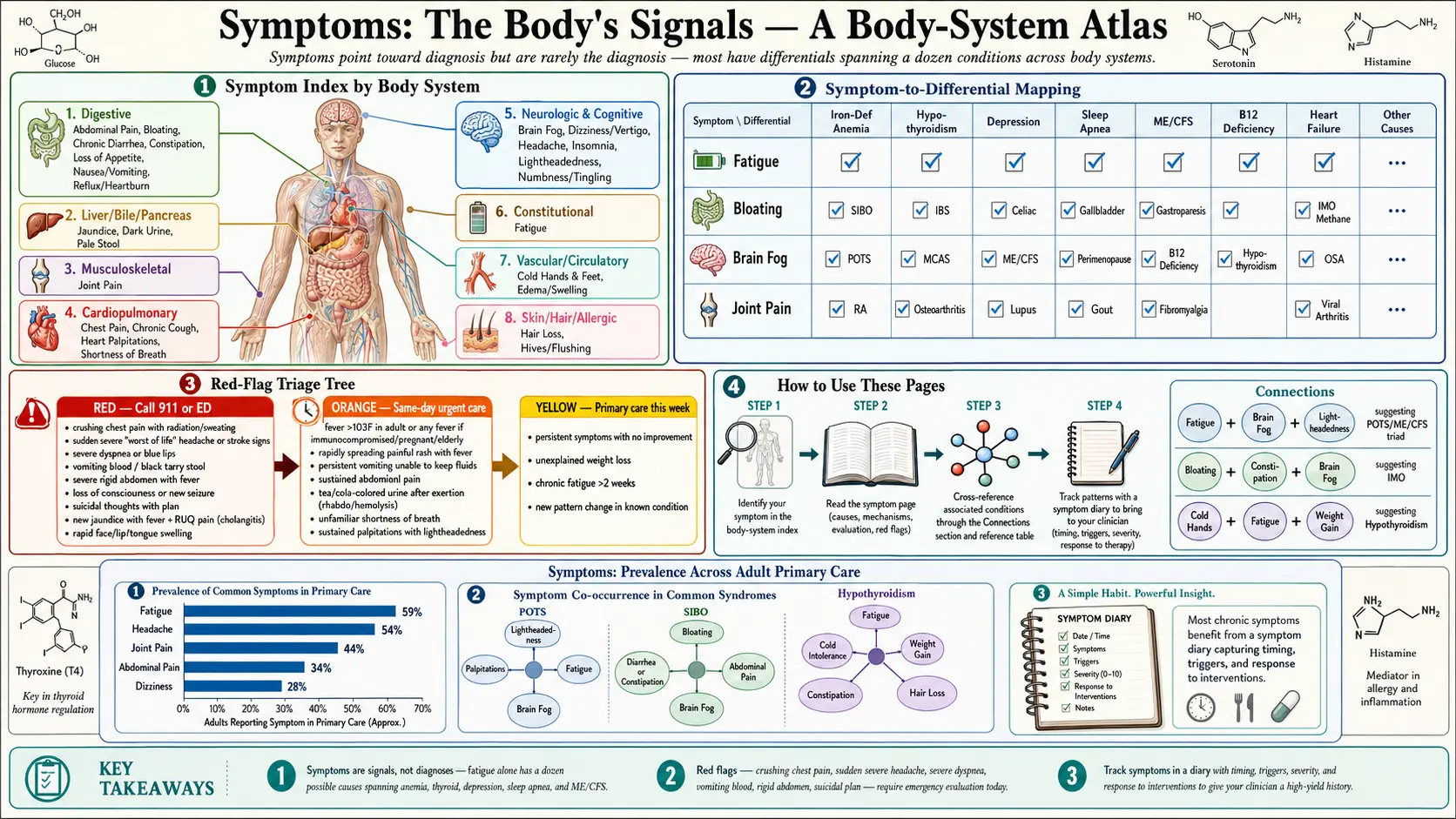

Symptoms are the body's signals that something has changed. They point clinicians toward an underlying diagnosis but are rarely a diagnosis on their own — fatigue can mean iron-deficiency anemia, hypothyroidism, depression, sleep apnea, or any of a dozen other conditions, and the same is true of headache, bloating, joint pain, and most of the symptoms below. Each page describes a symptom, its common causes, when it warrants medical evaluation, and links to the conditions where it most often appears. Use the Symptom-to-Condition Reference Table to jump directly from a symptom you are experiencing to the conditions that produce it.
On This Page
- Symptom Index by Body System
- Red Flags — When to Seek Care
- Symptom-to-Condition Reference Table
- How to Use These Pages
- Connections
- Featured Videos
Symptom Index by Body System
Detailed pages exist for the symptoms below. The reference table further down covers a wider range, including symptoms without their own dedicated page yet.
Digestive
- Abdominal Pain or Discomfort — visceral, parietal, or referred pain from the GI tract, liver, pancreas, or pelvic organs.
- Bloating — abdominal distension, gas, and pressure; common in SIBO, IBS, celiac disease, and gallbladder disorders.
- Chronic Diarrhea — loose stools more than four weeks; common in IBS-D, celiac, IBD, microscopic colitis, bile-acid diarrhea.
- Constipation — fewer than three bowel movements per week, hard stools, straining; common in IBS-C, methane SIBO (IMO), and hypothyroidism.
- Loss of Appetite — anorexia driven by inflammation, infection, medication, or psychological factors.
- Nausea and Vomiting — protective reflexes triggered by GI, central, vestibular, or metabolic stimuli.
- Reflux & Heartburn — GERD and laryngopharyngeal reflux; burning chest pain, regurgitation, throat irritation.
Liver, Bile & Pancreas
- Jaundice — yellowing of the skin and eyes from elevated bilirubin; signals liver, biliary, or hemolytic disease.
- Dark Urine — tea- or cola-colored urine from conjugated bilirubin, blood, or myoglobin.
- Pale Stool — clay-colored or acholic stool indicating absent bile flow into the intestine.
Musculoskeletal
- Joint Pain — arthralgia from mechanical, inflammatory, infectious, or metabolic causes.
- Shoulder Pain
- Neck Pain
- Muscle Cramps
- Back Pain
Cardiopulmonary
- Chest Pain — from cardiac ischemia, GERD, costochondritis, pulmonary embolism, anxiety, or aortic disease.
- Chronic Cough — cough lasting more than eight weeks; usually upper-airway cough syndrome, asthma, GERD, or ACE-inhibitor cough.
- Heart Palpitations — conscious awareness of heartbeat; from ectopic beats, atrial fibrillation, anxiety, hyperthyroidism, or POTS.
- Shortness of Breath — from heart failure, asthma, COPD, pulmonary embolism, anemia, or anxiety.
- Syncope (Fainting)
Neurologic & Cognitive
- Brain Fog — subjective cognitive slowing without dementia; common in POTS, MCAS, ME/CFS, perimenopause, B12 deficiency.
- Dizziness and Vertigo — true vertigo (BPPV, Meniere's, vestibular migraine), presyncope, disequilibrium, or non-specific lightheadedness.
- Headache — primary (migraine, tension, cluster) vs secondary; the SNNOOP10 red-flag screen guides imaging.
- Insomnia — difficulty initiating or maintaining sleep; common with anxiety, depression, sleep apnea, perimenopause, RLS.
- Lightheadedness on Standing — orthostatic intolerance from POTS, orthostatic hypotension, anemia, or autonomic neuropathy.
- Numbness and Tingling — paresthesias from peripheral neuropathy, MS, diabetes, B12 deficiency, or radiculopathy.
- Tremor — rhythmic involuntary shaking; essential tremor, Parkinson's disease, physiologic, cerebellar, or drug-induced.
Constitutional (Whole-Body)
- Fatigue — persistent tiredness not relieved by rest; common in anemia, infection, thyroid disease, and chronic illness.
- Fever (Pyrexia) — elevated core temperature from infection, inflammation, malignancy, or drug reaction; the pattern and duration guide the workup.
- Unexplained Weight Loss — loss of more than 5% of body weight without trying; a red flag for malignancy, hyperthyroidism, diabetes, malabsorption, or depression.
- Night Sweats
- Swollen Lymph Nodes
Skin, Hair & Allergic
Urinary
Ear, Nose & Throat
Neurologic & Cognitive
Vascular & Circulatory
- Cold Hands & Feet — Raynaud's phenomenon, peripheral artery disease, hypothyroidism, anemia.
- Edema & Swelling — from heart failure, liver or kidney disease, lymphedema, venous insufficiency, or DVT.
Skin, Hair & Allergic
- Hair Loss — androgenetic alopecia, telogen effluvium, alopecia areata, scarring alopecia.
- Hives and Flushing — mast-cell-mediated wheals and vasodilation; from urticaria, MCAS, alpha-gal syndrome, histamine intolerance.
Red Flags — When to Seek Care
Most symptoms can be evaluated by a primary-care physician within a few days. A handful warrant urgent care or emergency care today. The lists below are general guidance — when in doubt, call.
Call 911 or Go to the Emergency Department
- Crushing, squeezing, or pressure-like chest pain — especially with shortness of breath, sweating, nausea, or pain radiating to the jaw, neck, or left arm.
- Sudden severe headache (the worst of your life), or sudden weakness or numbness on one side of the body, slurred speech, vision loss, or facial droop.
- Severe difficulty breathing, blue lips or fingertips, or inability to speak in full sentences.
- Vomiting blood, or stool that is black and tarry, maroon, or bright red.
- Severe abdominal pain that is constant and worsening, especially with a rigid abdomen, fever, or vomiting blood.
- Loss of consciousness, a new seizure, or confusion that comes on suddenly.
- Suicidal thoughts with a plan or means.
- New-onset jaundice in someone who looks unwell, or jaundice with fever and right-upper-quadrant pain (suggests cholangitis).
- Rapid swelling of the face, lips, or tongue, or difficulty swallowing or breathing after a food, drug, or insect-sting exposure.
Same-Day Urgent Care
- Fever above 103°F (39.4°C) in an adult, or any fever in someone who is immunocompromised, pregnant, or very elderly.
- New rash that is rapidly spreading, painful, or accompanied by fever.
- Persistent vomiting that prevents keeping any fluids down for more than several hours.
- Moderate, sustained abdominal pain that does not resolve over a few hours.
- Tea- or cola-colored urine in a person who is dehydrated, has just exercised heavily, or has new back pain (rule out rhabdomyolysis or hemolysis).
- New shortness of breath that is not severe but is unfamiliar, particularly in someone with heart or lung disease.
- Heart palpitations that are sustained, accompanied by chest discomfort, lightheadedness, or near-fainting.
Schedule with Primary Care This Week
- Fatigue that has lasted more than two weeks despite adequate sleep.
- Unintentional weight loss of more than 5 percent of body weight over six months.
- A chronic headache pattern that is changing in frequency or character.
- Persistent joint pain that is interfering with daily activities or work.
- Bloating, reflux, or bowel-habit changes that have lasted more than a few weeks.
- Mild persistent yellowing of the skin or eyes.
- Brain fog, memory complaints, or word-finding difficulty interfering with function.
Symptom-to-Condition Reference Table
A quick map from symptom to the conditions on this site that most often produce it. Where a symptom has its own page, the symptom name is linked. Otherwise, follow the links in the right-hand column to the relevant condition pages.
How to Use These Pages
Each symptom page is meant for two readers:
- Someone trying to make sense of a new or persistent symptom. The Overview, Common Causes, and When to Seek Medical Care sections are the starting point — they describe what the symptom usually means, what tests a clinician might order, and when to escalate care.
- Someone trying to understand a symptom that comes with an existing diagnosis. The Mechanisms, Evaluation, and Connections sections explain how the symptom fits the broader condition and what overlapping diagnoses to consider.
None of this content replaces medical care. Every page links to peer-reviewed research with DOIs and to PubMed topic searches so you can read further or bring evidence to your appointments.
Connections
- All Conditions
- By specialty: Cardiology · Dermatology · Endocrinology · ENT · Gastroenterology · Hematology · Infectious Disease · Nephrology & Hepatology · Neurology · Oncology · Ophthalmology · Orthopedics · Pain & Allergy · Psychiatry · Pulmonology · Reproductive Medicine · Rheumatology · Urology
- Lab Tests — the panels most commonly ordered for the symptoms above.
- Bacteria — pathogens behind infectious causes of fever, fatigue, and GI symptoms.
- Toxins — environmental and chemical exposures that present as fatigue, neuropathy, or organ-specific symptoms.
- Vitamins and Minerals — nutrient deficiencies that mimic chronic disease.